Home / Blog / MicroBT Whatsminer M50S
Field report · Sep 19, 2026 · 7 min read
We bought the Whatsminer M50S the week it was replaced
Six months before the halving, at a settled price, in the same week MicroBT unveiled its successor. The months before April 2024 did the heavy lifting; one crossing to Nigeria did the rest.
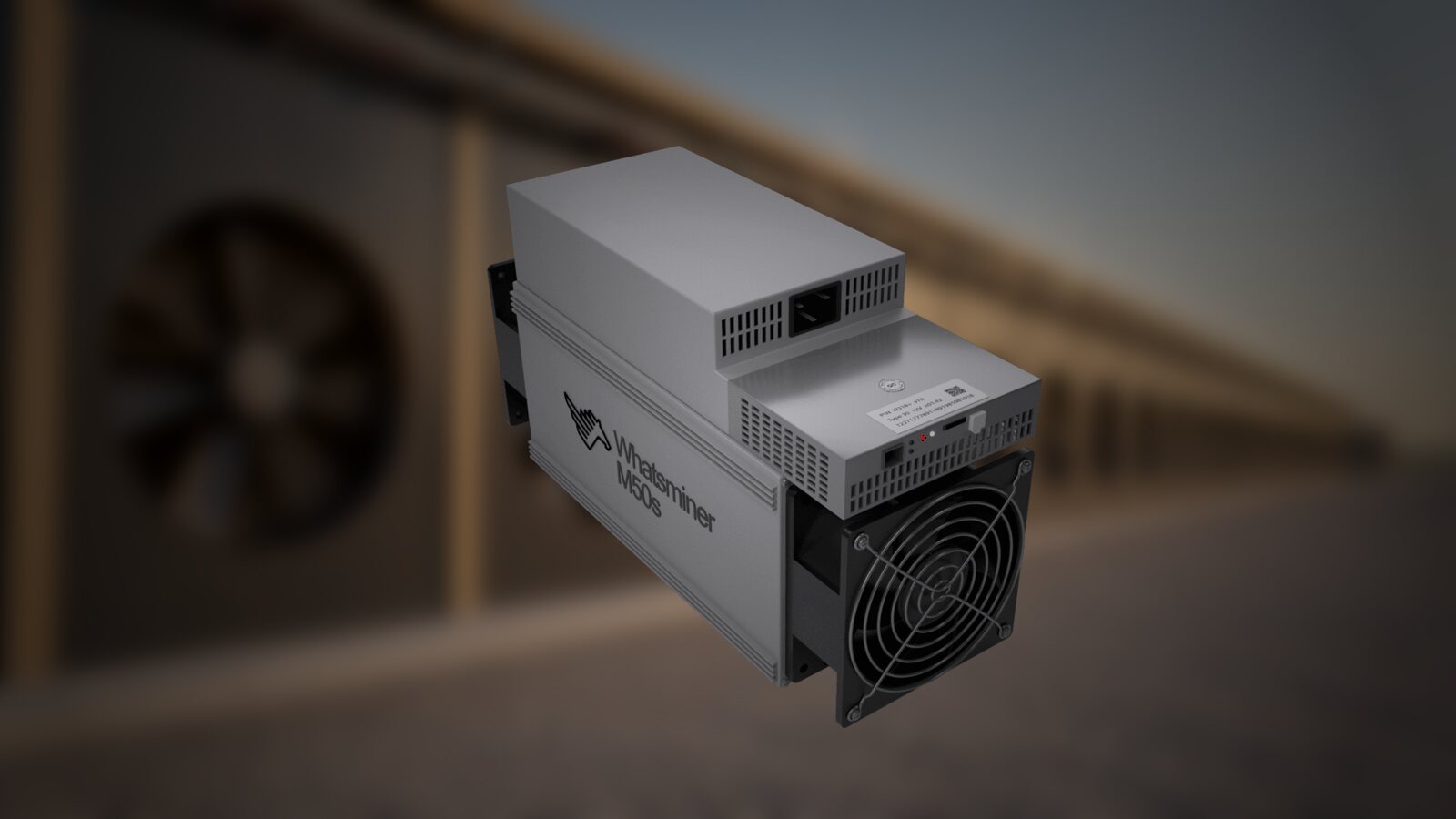
MicroBT Whatsminer M50s (128 TH/s)
The outgoing model
MicroBT unveiled the M50 series at the Bitcoin 2022 conference in Miami in April 2022. The M50S sat in the middle of the range: 126 TH/s at 26 J/TH from a Samsung 5-nanometre chip, air-cooled, shipping from the third quarter of that year with a one-year warranty. Ours is the 128 TH/s bin, drawing 3,328 W.
By the time we bought one, in October 2023, it was no longer the newest thing MicroBT made. The M50S++ had been unveiled in May 2023 at 22 J/TH, and in the very week our order went in, MicroBT took the wraps off an entire new generation — the M60 series, launched in Dubai. By any launch-day measure, we bought an old machine.
That was the point. A generation eighteen months into its life has a settled price, and the hashrate it produces does not care what came out after it. Bought at $2,051 and landed in Argentina at $3,366, it was a proven 26 J/TH machine at a price that left very little to prove.
Nobody writes a launch announcement for the machine being replaced. That is exactly what makes it worth buying.
Six months before the halving
The calendar mattered more than the spec sheet. The machine started hashing 179 days before the April 2024 halving, while every block still paid 6.25 bitcoin. In those 179 days it mined 0.0436 BTC — 44% of everything it has mined to date, from 17% of its working life so far.
The halving arrived with block 840,000 in the first minutes of 20 April 2024 and cut the subsidy to 3.125 bitcoin. At the prices of the day, the machine had been clearing about $6.68 a day over its electricity before it. Afterwards it cleared about $1.59.
Nothing about the machine changed that night. What changed was the line it had to clear, and a 26 J/TH machine went from comfortably above it to working for a living — which is exactly what efficiency decides. It is also why the pre-halving coins are the last coins anyone should sell: they were cheap to make, and a miner who keeps them values them at today’s price rather than the price of the week they were mined.
Its first 179 days mined 44% of every coin it has ever mined.
What it was like to own
Whatsminers are built differently from most machines of their era. The case is designed to work as one large heatsink, which is why, as one veteran operator on Bitcointalk points out, they run hot to the touch and want space between them rather than being packed shoulder to shoulder. MicroBT rates the M50 family for intake air up to 35 °C and asks for clean, dry air, with the dust blown out every few months (operation guide).
The owner record is the ordinary one for a mature machine: a few early warranty returns, then long, uneventful running. One owner of a 48-unit batch sent three back under warranty and reported the rest still hashing; another found one dead board among eight. MicroBT has not walked away from it either — its September 2026 firmware still covers the M50 series alongside the M60 and M70 generations, for units on the current control board.
Hosted with us, the practical consequence of a fault on a machine like this is a parts bill: repairs at our Argentina site are billed at the cost of the parts and nothing else.
Moved to Nigeria, March 2025
It stayed in Argentina for 517 days — through the halving, through the thin months that followed it, and through the rally into the end of 2024. That was the right home for it all along: while a terahash still earned well, near-continuous uptime at 6¢ was worth more to it than cheaper power with more downtime.
On 24 March 2025 it crossed to Nigeria, once a full year of its own figures said 3.9¢ had become decisively the better home for a 26 J/TH machine. It is the one crossing it will make, and it has been there for the 549 days since.
The difference the site makes is plain in today’s numbers. At 3.9¢ the M50S makes a bitcoin for about $53,600 of electricity, and at today’s price a unit racked there would return roughly 28% in its first year. At 6¢ the same box would spend about $82,500 on every coin — which is why it is not at 6¢.
The tally
Over 1,066 days it has mined and kept 0.0983 BTC for $3,889 of electricity — $39,559 a coin, averaged over its life so far. That lifetime figure is flattered by the pre-halving months; the number to plan on is today’s.
Valued at today’s price, those coins less every dollar of power come to $4,626 of cashflow against a $3,366 landed cost: 1.4× its box, from the coins alone. Between now and the April 2028 halving it has about 0.026 BTC still in it at today’s difficulty, worth roughly $3,216 with bitcoin back at its previous high — about 2.3× its hardware by the halving, still running at the end of it.
What we would tell ourselves
Its successor had the opposite experience. The Whatsminer M60 is the better machine on paper — 19.9 J/TH against 26 — and it reached our floor six weeks after the halving, with no pre-halving months to bank. It is on track to cover its box too; it simply needs the full four years to do it.
So the lesson is not that old machines beat new ones. It is that the entry price and the calendar can matter as much as the spec sheet. A proven machine at a settled price, bought ahead of a halving, kept through it, and sent to cheap power once when the numbers said so, is about as dependable an outcome as mining offers.
If you are buying now, buy for the halving in front of you rather than the one behind. Every machine below makes a bitcoin for far less electricity than a 26 J/TH box can.
- MicroBT Whatsminer M74S+ (332 TH/s) — 12 J/TH, In stock, $38,083 of electricity per bitcoin, 38% year one
- MicroBT Whatsminer M73S (560 TH/s) — 13 J/TH, In stock, $41,256 of electricity per bitcoin, 44% year one
- MicroBT Whatsminer M7DS (672 TH/s) — 13.5 J/TH, In stock, $42,843 of electricity per bitcoin, 47% year one
What people are saying online
I think they are great overall and the ones that worked are still hashing.
An owner of a 48-unit M50-series batch: a few early warranty returns, then steady running.
Sources and further reading
- MicroBT Released WhatsMiner M50 Series to Step Into 2XJ/T Era of Bitcoin Mining — GlobeNewswire, April 2022
- MicroBT debuts WhatsMiner M60 series in Dubai — GlobeNewswire, October 2023
- Bitcoin blockchain has fourth halving in 15-year history — CoinDesk, April 2024
- Re: M30 vs M50 a short review — Bitcointalk, May 2023
Which machines this covers
Disclosure
Firsthand Bitcoin sells and hosts mining hardware, including this machine. No manufacturer, distributor or affiliate programme paid for or reviewed this page and we take no commission on the links above. Historical figures are computed from daily bitcoin price and network hashprice, each day valued at its own prices. Nothing here is investment advice.