News · Oct 12, 2026 · 5 min read
CleanSpark, Riot and MARA now report production quarterly. Hashprice still updates daily.
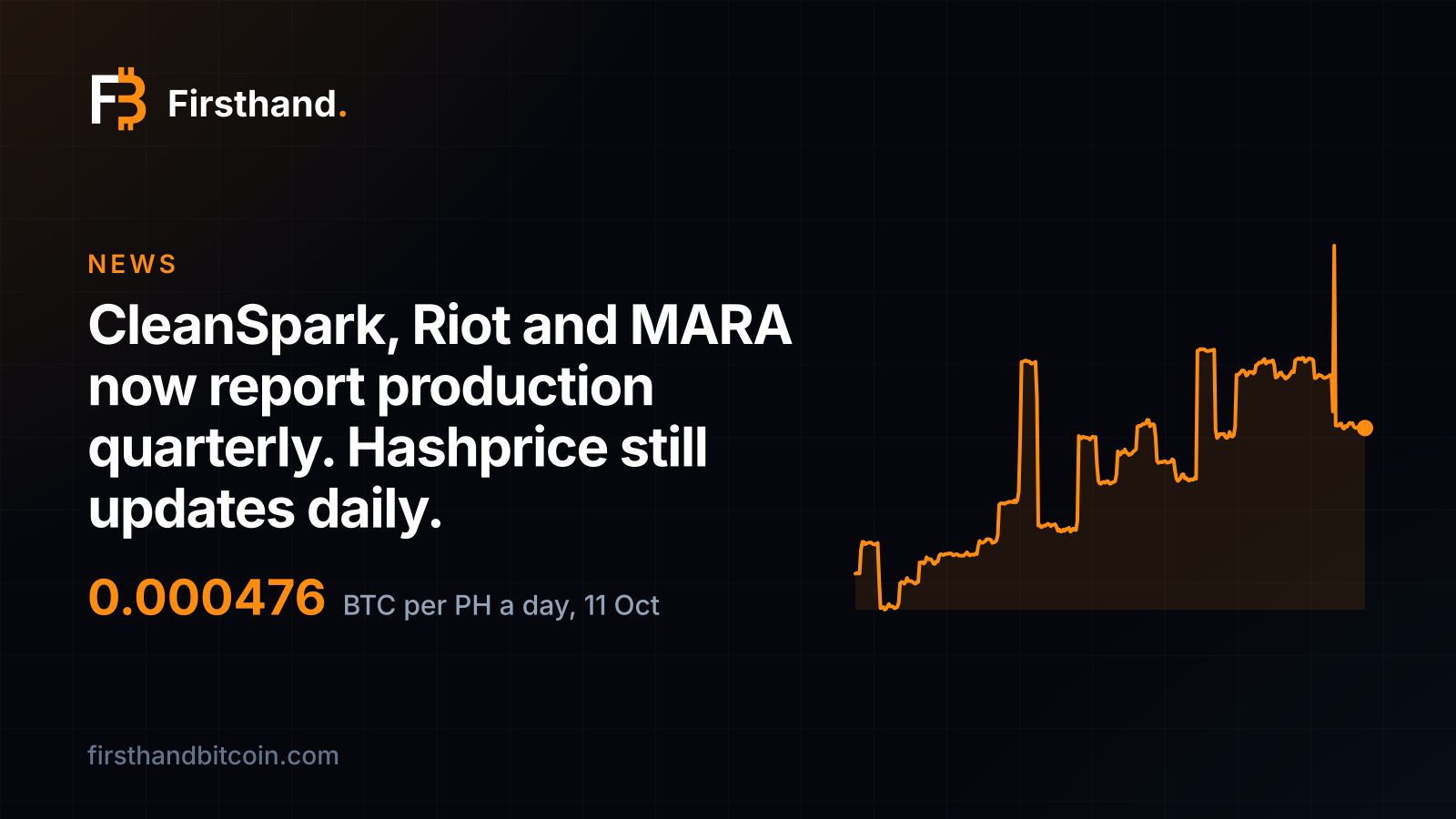
CleanSpark’s 9 October update was its last monthly one, after Riot and MARA had gone quarterly. Twelve listed miners mined about a third of the second quarter’s bitcoin, so the gap matters. What replaces their calendar is hashprice in bitcoin, which matched CleanSpark’s September to within half a percent.
CleanSpark’s last monthly update: 529 bitcoin mined, 702 sold
On Friday 9 October CleanSpark published its September operating update and said it would not publish another monthly one. It mined 529 bitcoin, 17.64 a day, and sold 702: 2 at spot and 700 through call-option exercises, at an average of $72,928. It ended the month holding 13,530, down from 13,703, of which 3,475 are posted as collateral or receivable in derivative transactions. Its average operating hashrate was 36.0 EH/s, with a peak of 50 (release).
The same release says CleanSpark “will transition to standard quarterly reporting consistent with peers in the energy and data center sectors”. It also reports that $2.276 billion of senior secured notes have closed and that its Sandersville data-centre project is fully funded, against a lease it puts at about $6.6 billion of contracted revenue. We covered the day’s other news in Sunday’s recap. This piece asks what the change does to the public record.
Riot and MARA had already gone first
Of the twelve listed miners in CoinShares’ second-quarter table, the four that mined the most coins were Bitdeer (2,694), MARA (2,422), CleanSpark (1,925) and Riot (1,587), in its Q2 mining report. Three of those four now report quarterly.
Riot went first. Its December 2025 update, published on 6 January, said “this will be the final monthly production and operations update”, with quarterly updates to follow. The first-quarter update on 2 April gave 1,473 bitcoin produced and 42.5 EH/s deployed; its second-quarter presentation gave 1,587 bitcoin and 44.4 EH/s of capacity at quarter-end.
MARA made no announcement we could find. Its press-release archive shows the last monthly production update, for September 2025, on 3 October 2025, and its output since appears in quarterly results. The second-quarter shareholder letter reports 2,422 bitcoin, 26.6 a day, and an energized hashrate of 70.3 EH/s.
Bitdeer still publishes monthly: its update for May, on 18 June, gave 921 bitcoin and a self-mining hashrate of 70.2 EH/s. So does Canaan, whose August update, on 14 September, counted 44 bitcoin.
Of the four biggest miners in CoinShares’ second-quarter table, only Bitdeer still reports every month.
Others now lead with data-centre revenue
TeraWulf’s second-quarter results release splits revenue into $31.9 million of high-performance-computing lease income, 71% of the $44.8 million total, and $12.8 million from mining, against $47.6 million a year earlier. It gives no coin count and no hashrate. CoinShares puts its second-quarter output at 179 bitcoin.
Core Scientific’s 10-Q shows self-mining revenue of $21.5 million for the quarter, against $62.4 million a year earlier, and 848 bitcoin held on 30 June, down from 2,537 at the end of 2025. Keel, formerly Bitfarms, has stopped mining altogether, with its last sites switched off on 29 June, according to CoinShares.
They made about a third of the quarter’s bitcoin
The twelve miners in CoinShares’ second-quarter table mined 13,607 bitcoin between them. On our blocks series, 13,011 blocks were found from 1 April to 30 June; at 3.125 bitcoin of subsidy each, plus 262 bitcoin of fees, that is about 40,900 bitcoin issued. The listed twelve took about a third.
MARA, CleanSpark and Riot alone mined 5,934, about one coin in seven. Monthly reports were how outsiders saw what that share was doing: how many coins were held, how many sold. CleanSpark’s September is a month where it sold 702 bitcoin and mined 529. A quarterly line folds a month like that into a total.
The hashrate that is leaving is still counted
Hashrate is leaving listed miners faster than the network. Miner Weekly, a BlocksBridge newsletter, estimated on 3 September that public miners “shed an estimated 56 EH/s of realized hashrate over the first half of 2026”, a 15% fall against 10% for the network (TheEnergyMag). In the same cohort, Cointelegraph reported, realised hashrate went from 368.3 EH/s in the fourth quarter of 2025 to 319 EH/s in the second quarter of 2026, down 13.4%; without Bitdeer, which rose 44% to 63 EH/s, it fell 21.2%.
None of that stops the network counting. On our hashrate series, the network averaged 1,073 EH/s in the fourth quarter of 2025, 956 EH/s in the second quarter of 2026 and 944 EH/s in September. A machine switched off leaves that average; a machine that carries on mining, whoever owns it, stays in it. The same blocks are shared among them whether or not anyone files a report.
The network figure matched CleanSpark’s September
CleanSpark’s 17.64 bitcoin a day on an average operating hashrate of 36.0 EH/s works out at 0.000490 bitcoin per petahash per day. Our hashprice in bitcoin averaged 0.000492 across September. A large miner’s reported coins per unit of hashrate came within half a percent of a figure anyone can compute from the chain. CleanSpark’s 36.0 EH/s was 3.8% of the network’s September average, and its 529 bitcoin were 3.8% of the roughly 13,900 issued.
The same sum on MARA’s second quarter gives 0.000379: 26.6 bitcoin a day on 70.3 EH/s, against a network figure of 0.000470, about 81%. Its letter says hashrate figures are estimates based on manufacturer specifications. That is the case for reading the coins, and for checking them against the network, rather than the hashrate a company states.
Coins are the number that can be checked. Hashrate is each company’s own estimate.
What it means for a miner
What goes quiet is the monthly view of what listed companies hold and sell. What does not is the arithmetic of mining: the network publishes its hashrate, difficulty and blocks every day, and hashprice in bitcoin is derived from them. It stood at 0.000476 bitcoin per petahash per day on 11 October, 13% above its fourth-quarter 2025 average of 0.000421, a rise we covered in A petahash earns 13% more bitcoin than it did at the 2025 record. What hashprice is explains how to read it.
For anyone mining to keep the coins, that daily figure is the one that matters, and it does not wait for a filing. On it, the most efficient machine in stock on our cheapest power, the Bitmain Antminer S23 XP Hyd at 8.9 J/TH in Nigeria at 3.9¢ a kilowatt-hour, makes a coin for about $17,900 of electricity, against a market price of about $83,700 on 12 October. Output is never guaranteed.
Sources and further reading
- CleanSpark Releases September 2026 Operational Update — PR Newswire (CleanSpark), 9 Oct 2026
- Riot Announces December 2025 Production and Operations Updates — Riot Platforms, 6 Jan 2026
- Riot Announces First Quarter 2026 Production and Operations Updates — Riot Platforms, 2 Apr 2026
- Riot Platforms Q2 2026 earnings presentation (Exhibit 99.2) — SEC, 10 Aug 2026
- MARA press releases — MARA Holdings, Oct 2025 to Feb 2026
- MARA Q2 2026 shareholder letter — SEC (MARA), 6 Aug 2026
- Bitdeer Announces May 2026 Production and Operations Update — SEC (Bitdeer), 18 Jun 2026
- Canaan Inc. Provides August 2026 Bitcoin Production and Mining Operation Updates — PR Newswire (Canaan), 14 Sep 2026
- TeraWulf Reports Second Quarter 2026 Results — SEC (TeraWulf), 5 Aug 2026
- Core Scientific Form 10-Q, quarter ended 30 June 2026 — SEC (Core Scientific), 28 Jul 2026
- Bitcoin mining report, Q2 2026 — CoinShares, 15 Sep 2026
- Miner Weekly: Bitcoin Miners Unplug 23% as AI Revenue Surges 52% — TheEnergyMag, 3 Sep 2026
- Public Bitcoin miners cut hashrate 13.4% as AI infrastructure revenue grows — Cointelegraph, 13 Aug 2026
Disclosure
Firsthand Bitcoin sells and hosts mining hardware, including this machine. No manufacturer, distributor or affiliate programme paid for or reviewed this page and we take no commission on the links above. Historical figures are computed from daily bitcoin price and network hashprice, each day valued at its own prices. Nothing here is investment advice.