Home / Blog / How to think about mining
Guide · Sep 30, 2026 · 7 min read
What is hashprice, and what does it mean for my miner?
Hashprice is what one unit of mining power earns in a day, and it is the same for every machine on the network. A few steps of arithmetic turn it into what your own miner earns and costs, and show how far apart the two are.
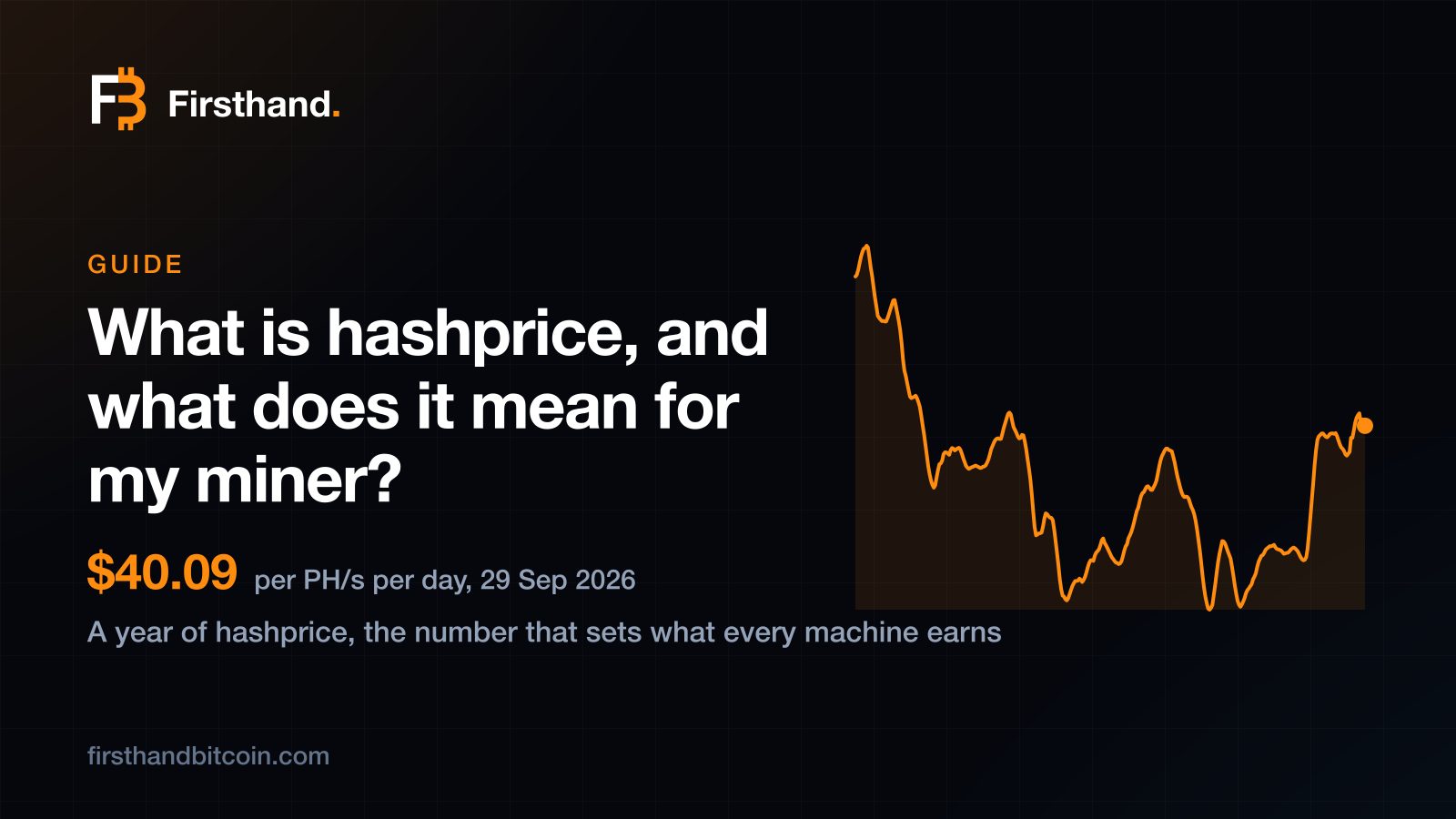
Hashprice is what one unit of hashing earns in a day
A bitcoin miner sells one thing: hashes, guesses at the puzzle that decides who writes the next block. The network pays for them in bitcoin, and hashprice is the price of that work. It is what one unit of hashing power earned in one day.
The unit is usually a petahash per second, a thousand terahashes, for one day. On 29 September 2026 that came to $39.77 per petahash per day on our hashprice chart, or 0.00047647 bitcoin. Scaled down to the terahash, the unit machines are sold in, it is 47.6 satoshis per terahash per day.
Nobody sets it for your machine. The network pays out about 450 new bitcoin a day in block rewards, plus the fees in each block, and that pot is shared out across all the hashing power competing for it. Divide the pot by the hashing power and you have hashprice. A newer, faster machine gets more of the pot because it brings more terahashes, not because each one is worth more.
Every terahash on earth earns the same amount on the same day. Only the electricity bill differs.
What your own machine earns is a multiplication
Once you know hashprice, your machine's daily income is one step away. Multiply the machine's hashrate by hashprice, remembering that a petahash is a thousand terahashes.
Take an Antminer S21 XP rated at 270 terahashes per second. That is 0.27 petahash. At $39.77 per petahash per day it earns about $10.74 a day, paid in bitcoin, or roughly 12,865 satoshis. A 600-terahash machine earns 2.2 times as much, because it brings 2.2 times the hashing power.
If you mine through a pool, which almost every machine does, the pool pays each miner in proportion to the work they contributed, so luck does not come into the daily figure. What a mining pool is explains how the payments arrive.
Four things move it
The price of bitcoin. This is the biggest lever, because hashprice is measured in dollars but paid in bitcoin. Between 6 June and 22 September 2026 bitcoin rose 42%, from $60,771 to $86,608. Hashprice rose 49%, from $27.74 to $41.31. The number of coins one petahash earned hardly changed: 0.00045647 on 6 June and 0.00047694 on 22 September, up 4.5%. Almost all of that rise came through the coin's price, not through miners earning more coins.
Difficulty. The network adjusts how hard the puzzle is every 2,016 blocks, about every two weeks, so that blocks keep arriving roughly every ten minutes. When more machines switch on, difficulty rises and each petahash earns a smaller slice of the same pot. Over the past year it went the other way: difficulty fell 6.7%, from 142.3 trillion on 29 September 2025 to 132.8 trillion, and a petahash earned 7.3% more bitcoin, 0.00047647 against 0.0004441. Hashprice in dollars still fell 21% over the year, from $50.13 to $39.77, because bitcoin fell 26%, from $112,880 to $83,471. You can follow difficulty on the difficulty chart.
Fees. People pay a fee to have their transactions included, and miners keep it on top of the block reward. In 2026 fees are a small part of the pot: on 28 September they came to 3.4 bitcoin against about 450 in block rewards, under 1%. Why they are so low this year is in Bitcoin's busiest year is paying its miners the least in a decade.
The halving. Every 210,000 blocks, about four years, the block reward halves. Our data shows it going from 6.25 to 3.125 bitcoin on 20 April 2024, and the next halving, expected around April 2028, halves it again. On the day it happens, every petahash earns about half the bitcoin it did the day before, fees aside. Efficiency decides how many halvings a machine survives covers what that means for choosing a machine.
The one-line check: does it cover the power?
Earnings are half the picture. The other half is what it costs to run the machine, and that comes from two numbers on its spec sheet: joules per terahash, written J/TH, and the price of electricity where it runs.
First take the machine's J/TH. The S21 XP is rated at 13.5. Second, multiply it by 0.024, which turns joules per second into kilowatt-hours per day, to get the electricity one terahash burns in a day: 13.5 × 0.024 is 0.324 kilowatt-hours. Third, multiply by the price of a kilowatt-hour. At our Argentina site that is 6¢, which makes 1.94¢ per terahash per day. Fourth, multiply by 1,000 to get the cost of a petahash-day, the same unit as hashprice: $19.44.
Now compare the two. At $39.77 hashprice earns about twice what the electricity costs in Argentina. On our Nigeria site, where power is 3.9¢, the same machine's line is $12.64. Whichever site you pick, the gap between the two numbers is what the machine has left over each day for the owner. Current rates for every site are on the sites page, and uptime, the share of the time a machine is switched on and mining, trims the earnings a little.
For the S21 XP the day works out like this: it earns 0.27 petahash times $39.77, about $10.74, and burns 87.5 kilowatt-hours, which at 6¢ is $5.25.
The line does not move when hashprice does
The useful habit is to keep the two numbers apart. Hashprice moves every day with the bitcoin price and the network. A machine's cost per petahash does not move at all, because efficiency and the power rate are fixed. The machine's line is a single number you can write down before you buy.
This year shows how wide hashprice swings. Across the 271 days of 2026 for which we hold complete data, it has ranged from $27.74 on 6 June to $41.64 on 15 January. A 13.5 J/TH machine at 6¢ has a line of $19.44, and hashprice stayed above it on every one of those days.
An old machine at 30 J/TH on the same power has a line of $43.20. Hashprice was below that on every one of those days, so that machine could not have covered its power at 6¢ at any point this year. On 3.9¢ power its line is $28.08, which is where cheaper electricity changes the answer for an older machine.
Hashprice is the weather. J/TH and the power rate are the building.
What it means for a miner
For a first-time buyer, hashprice is the number to check against a machine's line, and it should be checked before the machine is bought, not after. Find the J/TH, find the power rate, work out the line, and set it beside today's hashprice on the hashprice chart. If the gap is wide, the machine has room to absorb a lower hashprice. If it is narrow, a small fall in the bitcoin price or a difficulty rise can push it below.
Efficiency and the power price are the two things you choose. Hashprice is the one you do not, which is why a machine that works comfortably at today's hashprice is a better buy than one that only works at yesterday's. And because the coins you mine are yours to keep, a machine that clears its line adds to a stack you still hold whatever hashprice does next month. Nobody sells the coins to pay the power bill explains how that works in practice.
Disclosure
Firsthand Bitcoin sells and hosts mining hardware, including this machine. No manufacturer, distributor or affiliate programme paid for or reviewed this page and we take no commission on the links above. Historical figures are computed from daily bitcoin price and network hashprice, each day valued at its own prices. Nothing here is investment advice.