Data insight · Oct 11, 2026 · 5 min read
A petahash earns 13% more bitcoin than it did at the record high a year ago
Bitcoin closed at a record $124,493 on 6 October 2025 and was $82,562 on 10 October 2026. Over the same year mining difficulty fell 12%, so each petahash of hashrate now earns more coins a day than it did at the top. Here is how far that has gone and why it has slipped since August.
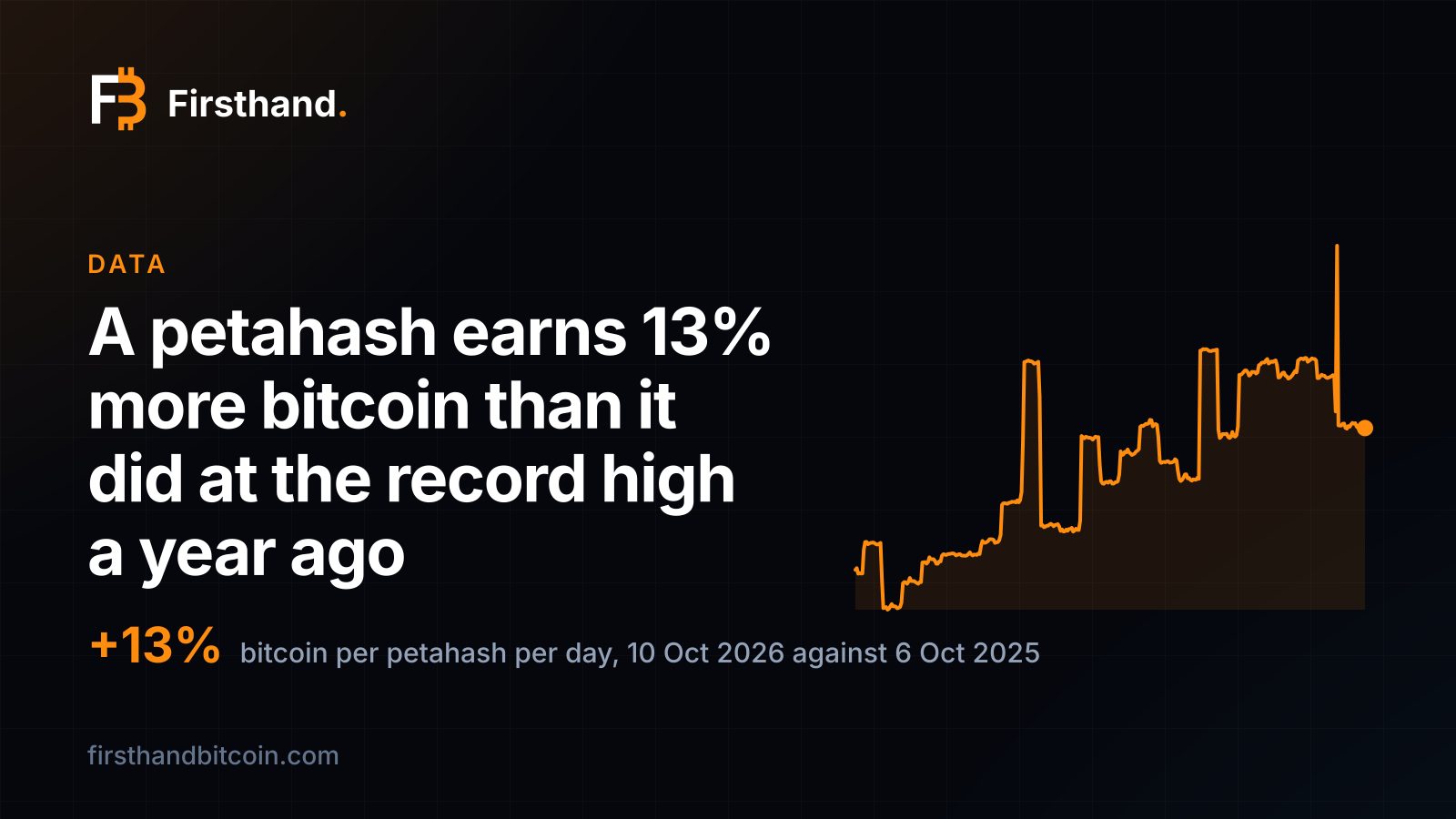
The coins per petahash are 13% higher than at the top
Bitcoin's record close in our series is $124,493, on 6 October 2025. On 10 October 2026, the last complete day, it closed at $82,562, a fall of 34%. A year of holding bitcoin would have been a year of watching the price shrink.
A year of running machines looks different. On 6 October 2025 one petahash per second of hashrate earned 0.000419 bitcoin a day. On 10 October 2026 it earned 0.000476, an increase of 13%. That is the hashprice in bitcoin, and it is the number that decides how many coins a machine adds to the stack whatever the dollar price does.
The two moves are linked by difficulty. The network reset to 150.84 trillion on 1 October 2025 and stands at 132.72 trillion now, 12% lower. Fewer machines are competing for the same 450 new bitcoin a day, so each one gets a bigger share. We covered the gap to the all-time difficulty high in September; this piece follows what that gap has done to the coins.
The dollar hashprice fell by a quarter, not a third
Priced in dollars, a petahash earned $52.22 a day at the record and $39.30 on 10 October 2026, a fall of 25%. That is smaller than the 34% fall in the price because the other half of the sum moved the miner's way: the same hashrate was dividing a smaller pool of competitors' work.
The low point shows the same thing in the extreme. The dollar hashprice bottomed at $27.74 on 6 June 2026, when bitcoin closed at $60,771. Even there, the hashprice in bitcoin was 0.000456, above its level on the record day. CoinShares put the monthly average for June at an all-time low of $27.7 per petahash per day, and noted that hashprice had since recovered to around $38. Our daily reading was $39.30 on 10 October.
A falling price is when efficient machines on cheap power stack the most coins for the dollars spent, because the power bill is paid in dollars and the reward arrives in bitcoin. A coin that costs less to make against a market that pays less for it is the position a holder of machines wants to be in.
Price fell 34%. Difficulty fell 12%. A petahash gave up a quarter of its dollars and gained a seventh in coins.
Why the coins rose: machines left
Difficulty only falls when hashrate does. Between the October 2025 record and June 2026 the network lost a large share of its machines, and the difficulty chart records each step: the all-time high of 155.97 trillion on 29 October 2025, a low of 124.93 trillion on 14 June 2026.
Our daily hashrate reading is noisy, so compare averages. The 30-day average was 1,036 exahashes a second to 10 October 2025 and 958 exahashes to 10 October 2026, 7% lower. Part of the departure is temporary, machines parked while the dollar hashprice sat at its lows. Part is structural. CoinShares counted "at least 35 EH/s" scheduled to leave the publicly listed miners as IREN and Cipher complete their exits, and estimated annualised profit of about $1.5 million per megawatt for AI hosting against $0.5 million for mining.
Those machines are not coming back to bitcoin, which is the part that makes the gain last. It does not depend on the price. It depends on how much hashrate chooses to compete, and a share of that has chosen something else.
A year of rising coins, then a pause
The direction was not always up. In the first full month after the April 2024 halving, May 2024, a petahash earned 0.000795 bitcoin a day on average. The monthly average then fell in 14 of the next 18 months, to 0.000413 in November 2025, as the network added machines faster than the price could carry them.
Since then it has turned. The monthly average rose in 8 of the 10 months from December 2025 to September 2026, reaching 0.000500 in August 2026, the highest since July 2025.
It has slipped since. September averaged 0.000492 and the first ten days of October 0.000477. Difficulty rose 5.5% from 125.81 trillion on 23 August to 132.76 trillion on 19 September, and the estimate on our difficulty adjustments chart points to a further rise of about 3% at the next retarget. Fees do not offset it: they averaged 2.9 bitcoin a day over the 30 days to 10 October, against 3.7 a year earlier.
What it means for a miner
Count in bitcoin and the year looks like this. A machine of the same efficiency, on the same power bill, makes about 12% more coins than it did at the record, so each coin costs about 12% less in electricity to make. That is arithmetic on the 13% rise, not a forecast.
The cost of a coin is the figure to hold against the market. Today the most efficient machine we stock, the Bitmain Antminer S23 XP Hyd at 8.9 J/TH, running at the cheapest site that can host it, makes a coin for about $18,000 in electricity against a market price of $82,917 on 11 October. That counts electricity only, at today's hashprice, and leaves out the machine and the pool fee.
The yield will move with every retarget, and the dollar price is not ours to call. The structural point holds on both: fewer competitors, more coins per petahash, and the miner who keeps the coins holds more of them for the same power.
Bitcoin per petahash is the number that does not care what the price did.
Sources and further reading
- Bitcoin Mining Report Q2 2026 — CoinShares, 15 Sep 2026
Disclosure
Firsthand Bitcoin sells and hosts mining hardware, including this machine. No manufacturer, distributor or affiliate programme paid for or reviewed this page and we take no commission on the links above. Historical figures are computed from daily bitcoin price and network hashprice, each day valued at its own prices. Nothing here is investment advice.