Home / Blog / Bitmain Antminer T17
Lifespan report · Oct 11, 2026 · 3 min read
Antminer T17 lifespan report: the cheap machine that beat buying bitcoin by half
Bought at launch in May 2019 for $1,270 and run on 3.9¢ power until it stopped paying in September 2025. It paid for itself in under six months, earned 5.6 times its price after power, and mined 52% more bitcoin than the same dollars would have bought.
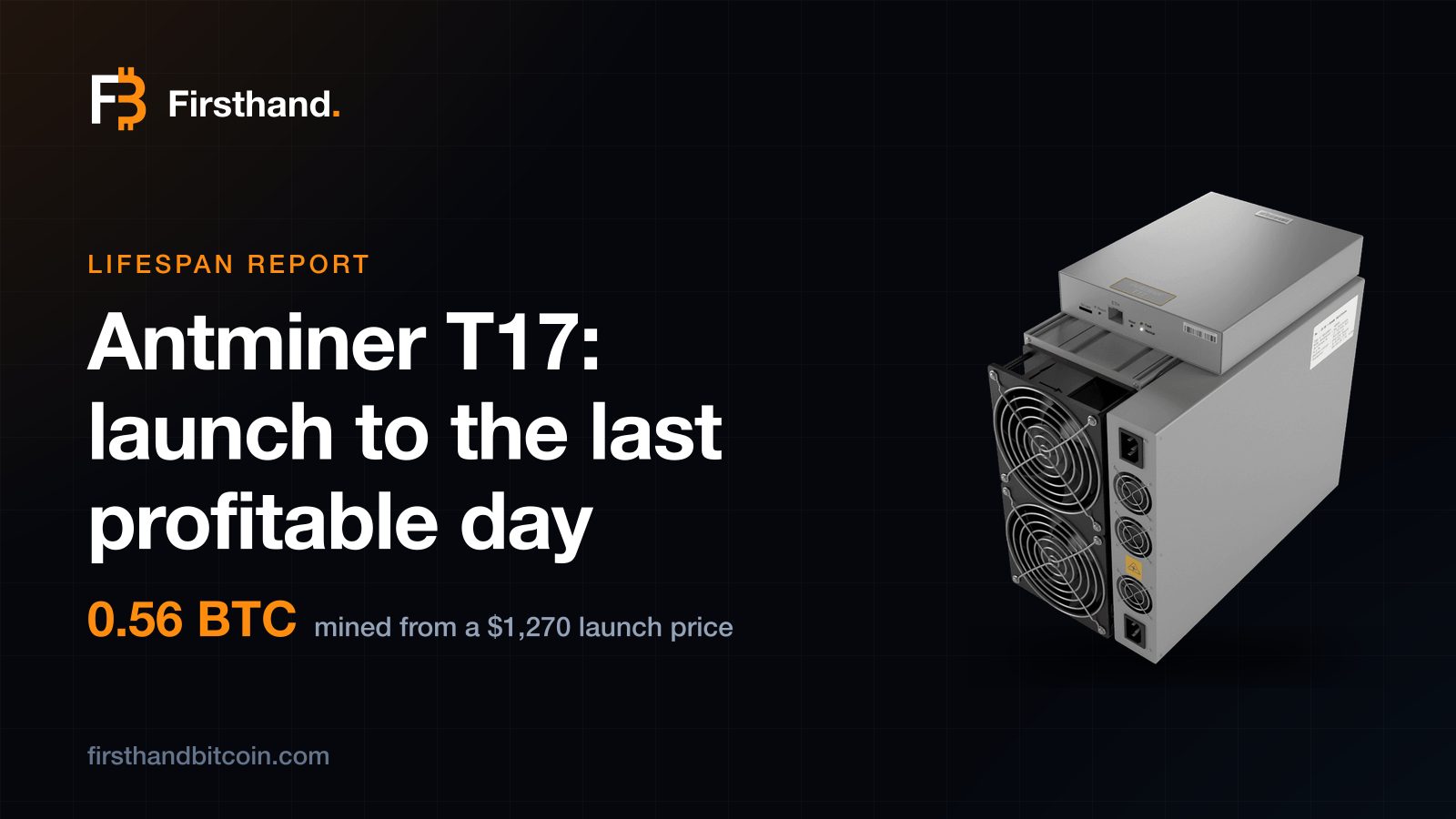
Bitmain Antminer T17 (40 TH/s)
TL;DR
- It paid for itself in under six months, by 3 November 2019.
- It returned 5.6 times its price in cash after power, the best multiple of the 2019 machines.
- It beat buying by 52%. 0.562 BTC mined against 0.370 BTC for the same dollars on the same days.
- The lesson: the price of a terahash matters as much as its efficiency. At $32 per terahash it was the cheapest way into its generation.
- Its life ended on 8 September 2025, a year and a half after the 2024 halving.
The budget machine of the 17 series
Bitmain announced the Antminer T17 at the end of April 2019, at $1,270 a unit, shipping in May: 40 TH/s at 55 joules per terahash. Less efficient than the S17, but at about $32 per terahash it was the cheapest way into the new generation. Bitcoin was $7,993 when it shipped.
This report follows one T17 bought at that price, from its first day to its last, on 3.9¢ power (our cheapest site's rate today), 95% uptime and a 2% pool fee, switched off on any day it would lose money. Its life ends on the last day its trailing month still paid for its power. It is the method behind our study of mining against buying, and the charts compute it live.
70% of its bitcoin in two years
In the rest of 2019 the T17 mined 0.214 BTC, and in 2020 another 0.151 BTC. By May 2021 it had 70% of its lifetime output. After that the bitcoin came slowly: 0.091 BTC in 2021, 0.058 in 2022, 0.036 in 2023.
Its most valuable year was 2021, when that 0.091 BTC sold for $4,221 and left $3,469 after power. Its best month, August 2021, made $367.
Paid for in under six months
Sold as mined, its bitcoin covered the $1,270 price by 3 November 2019, five and a half months after it shipped. At 3.9¢ it cost $2.06 a day to run, against about $8.50 a day of bitcoin in its first months.
A $1,270 machine that made its price back before the end of its first year, and five times over by the end of its life.
Worth three times its price in 2021
In March 2021 a used T17 sold for about $3,780, three times what it cost new: its class traded at about $95 per terahash. The hardware had become the best-performing part of the investment.
From there it fell to about $136 by December 2023, and then to scrap. Over its life it lost its whole $1,270, about $200 a year, a small cost against $7,095 of cash after power.
Two halvings, and a slow switch-off
At 55 J/TH the T17 had less room than the S17, but 3.9¢ was enough for it to run every day from launch to the end of 2023. The April 2024 halving changed that: it ran 183 days in 2024 and 107 in 2025, only when fees or price made it worth switching on. It stopped for good on 8 September 2025, when hashprice, about $52 per petahash a day, sat below the $55 it needed.
The full accounts
Over 6.3 years of life the T17 ran on 1,982 days and mined 0.562 BTC. Sold as mined, that brought in $11,176. Power took $4,081, 37% of it. Take away the $1,270 price, with nothing back at the end, and it left $5,825 in profit: 5.6 times its price in cash from mining. Each bitcoin cost $9,530.
Kept instead, its 0.562 BTC were worth $46,561 at bitcoin's price on 11 October 2026.
Was it worth buying?
Against buying bitcoin with the same dollars on the same days, $1,270 in May 2019 and every power bill after, the T17 wins by the widest margin of the four machines we have followed to the end: 0.562 BTC mined against 0.370 BTC bought, 52% more.
It is the clearest case that a machine's price per terahash matters as much as its efficiency. The Antminer S17 was more efficient and lived two months longer, but the T17 cost 41% less, and on 3.9¢ power the extra watts were cheap. What a machine costs to buy, and what its power costs to run, decide it together.
Mining output depends on bitcoin's price, difficulty and uptime, and isn't guaranteed. These are past results, not a forecast.
0.562 BTC mined, against 0.370 BTC for the same dollars. The cheapest machine of 2019 beat buying by half.
Which machines this covers
Disclosure
Firsthand Bitcoin sells and hosts mining hardware, including this machine. No manufacturer, distributor or affiliate programme paid for or reviewed this page and we take no commission on the links above. Historical figures are computed from daily bitcoin price and network hashprice, each day valued at its own prices. Nothing here is investment advice.