Data insight · Oct 19, 2026 · 4 min read
Bitcoin moves half as much on weekends. Miners are paid the same.
Since 2021 the typical Saturday or Sunday has moved bitcoin's price only 52% as far as a weekday, and fees have run about a quarter lower. The blocks, and the day's pay to miners, have not noticed the calendar at all.
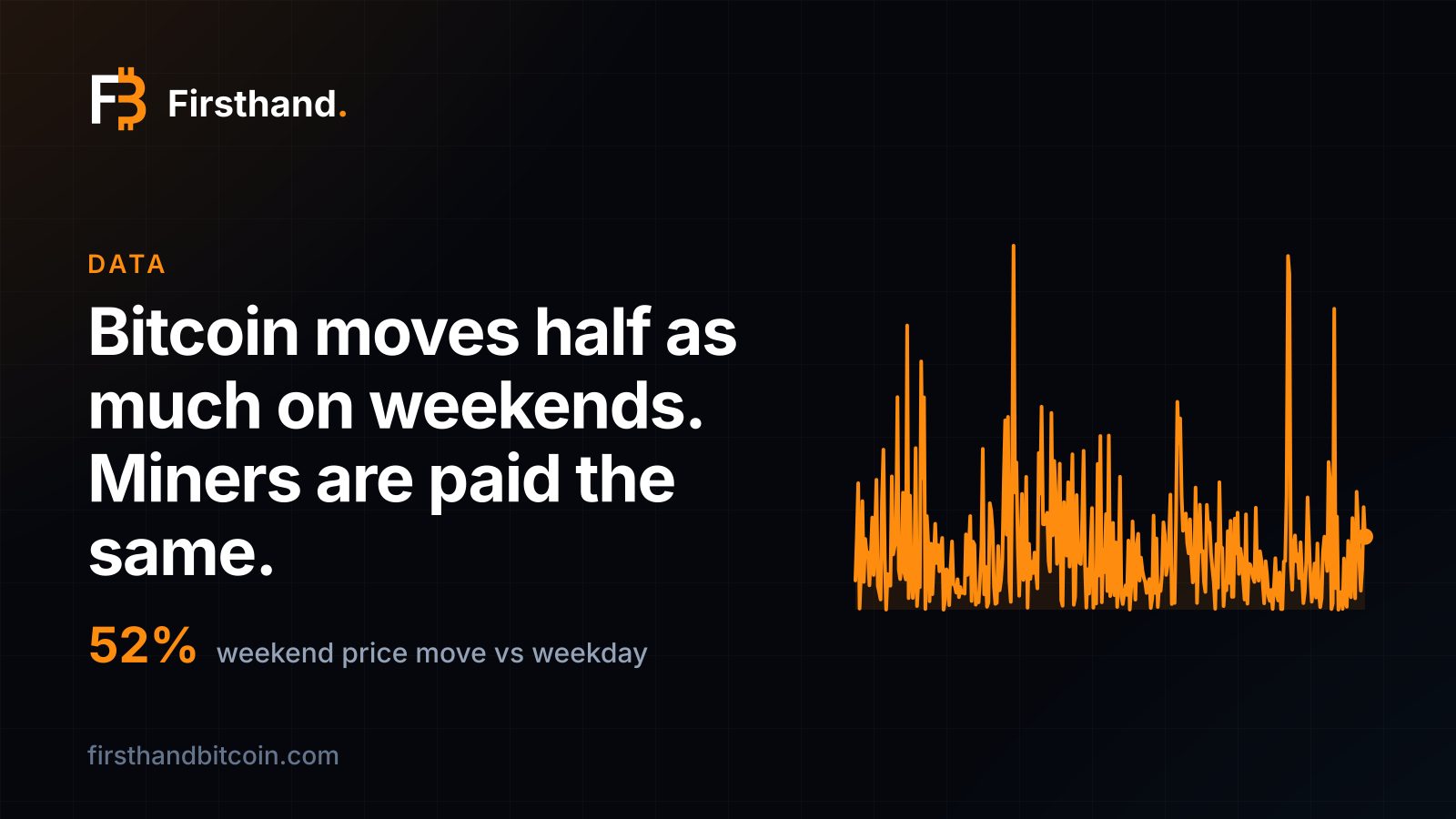
On a weekend, bitcoin moves about half as far
Bitcoin trades every hour of every day, but the people who move the price do not. Banks, funds and the exchange-traded products that hold bitcoin for them work Monday to Friday. From 1 January 2021 to 14 October 2026 we have 2,113 days with a fresh daily price in our record, 1,509 of them weekdays and 604 of them Saturdays and Sundays.
On a typical weekday the price closed 1.24% away from the day before. On a typical weekend day it was 0.65%. That is 52% of the weekday move. Sunday is the quietest of all, at 0.51%, and Saturday sits between at 0.86%.
It is not a one-year accident. In every year from 2022 to 2026 the weekend move was between 40% and 59% of the weekday one. Only 2021, when weekends ran at 91% of weekdays, looks different.
The biggest days almost never fall on one
If weekends were like weekdays, two days in seven would carry two sevenths of the biggest moves. They do not. Of the 100 largest one-day moves since 1 January 2021, 14 fell on a Saturday or Sunday. A random spread would put about 29 there.
The pattern holds at 5%. There have been 73 days since 2021 when the price moved 5% or more in a day, and only 10 of them were weekend days. The largest, 12.3% on Monday 13 June 2022, arrived on a weekday.
CryptoTicker found the same shape in exchange data this week. Across 84 daily candles on Kraken from 28 July to 19 October, weekend turnover was 912 bitcoin a day at the median against 2,559 on weekdays, and the weekend's daily range was 1.24% against 2.61%. Saturday 17 October was the thinnest day of the week, at under a third of Friday's turnover.
Of the 100 largest daily moves since 2021, 14 landed on a weekend. A random spread would give 29.
Monday does not make it up
A quiet weekend could mean the market is storing movement for Monday. The record says it is not. Monday's median move, 1.27%, matches Tuesday's 1.27%, Thursday's 1.27% and Friday's 1.30%, and Wednesday's is lower at 1.09%.
The better test takes three days either side. From Friday's close to Monday's close, a span that holds a whole weekend, the price moved 2.17% at the median over 302 weeks. From Monday's close to Thursday's, three weekdays, it moved 2.28% over 301. The weekend leaves a little less distance travelled, and nothing that has to be repaid on Monday morning.
Fees fall by about a quarter
Fees are the other part of the week that looks like a market. People moving money, paying for exchanges and settling trades make fewer transactions on a Saturday, and the fees they pay fall faster than the count. The median weekday paid miners 14.7 bitcoin in fees, and the median weekend day 10.7, 27% less.
That has been true every year we hold. The weekend figure ran between 66% and 84% of the weekday one in each of the six years from 2021.
It matters less than it sounds. Fees are a few percent of what a miner is paid on any day, so a quarter off a few percent is a rounding error in the day's total.
Blocks, and the day's pay, do not move
The network has no idea what day it is. Machines keep solving, and a block is found whenever one of them gets lucky. The median weekday since 2021 saw 145 blocks and the median weekend day 148. If anything, weekends ran a shade fast, and the blocks per day chart shows no calendar at all.
The dollar value of everything paid to miners tells the same story. At the median, the network paid about $36.5 million on a weekday and $37.1 million on a weekend day, 1.8% more. In each of the six years the weekend figure was within 3% of the weekday one. Lower fees and a quieter price are both in that number, and it still did not drop.
The reason is arithmetic. The block subsidy is a fixed number of bitcoin per block, difficulty is set by counting blocks rather than days, and nothing in the rules pays more or less on a Tuesday.
What it means for a miner
A machine earns in bitcoin by the hash, and a hash is worth the same on Sunday as on Wednesday. The week does not hand a miner a good day and a bad day. What it gives is a price that is quieter on Saturday and Sunday, and a Monday that is free to move it again.
For anyone who keeps the coins mined, the weekend is a lower-volatility window, not a pause. Coins arrive at the same rate throughout, the machine's electricity cost is the same, and the dollar value of the stack is set by whichever market is open when you look. Looking on a Saturday tells you less than looking on a Tuesday.
It also says something about how to read the Data section. A figure that changes on Monday morning usually reflects the traders' return to their desks. Hashrate, difficulty and the coins per day a machine mines run to a different clock, and they are the numbers a miner is paid on.
A machine does not know it is Sunday. The coins it earns are the same on every day of the week.
Sources and further reading
- Bitcoin price $82,769: the level that decides — CryptoTicker, 19 Oct 2026
Disclosure
Firsthand Bitcoin sells and hosts mining hardware, including this machine. No manufacturer, distributor or affiliate programme paid for or reviewed this page and we take no commission on the links above. Historical figures are computed from daily bitcoin price and network hashprice, each day valued at its own prices. Nothing here is investment advice.