Guide · Oct 4, 2026 · 5 min read
What mining difficulty is, and why your machine's earnings change when it does
Difficulty is how hard each of a miner's guesses is to win, and the network resets it every two weeks. When it rises 10%, the same machine earns about 9% fewer coins. Here is the arithmetic, worked through for one machine.
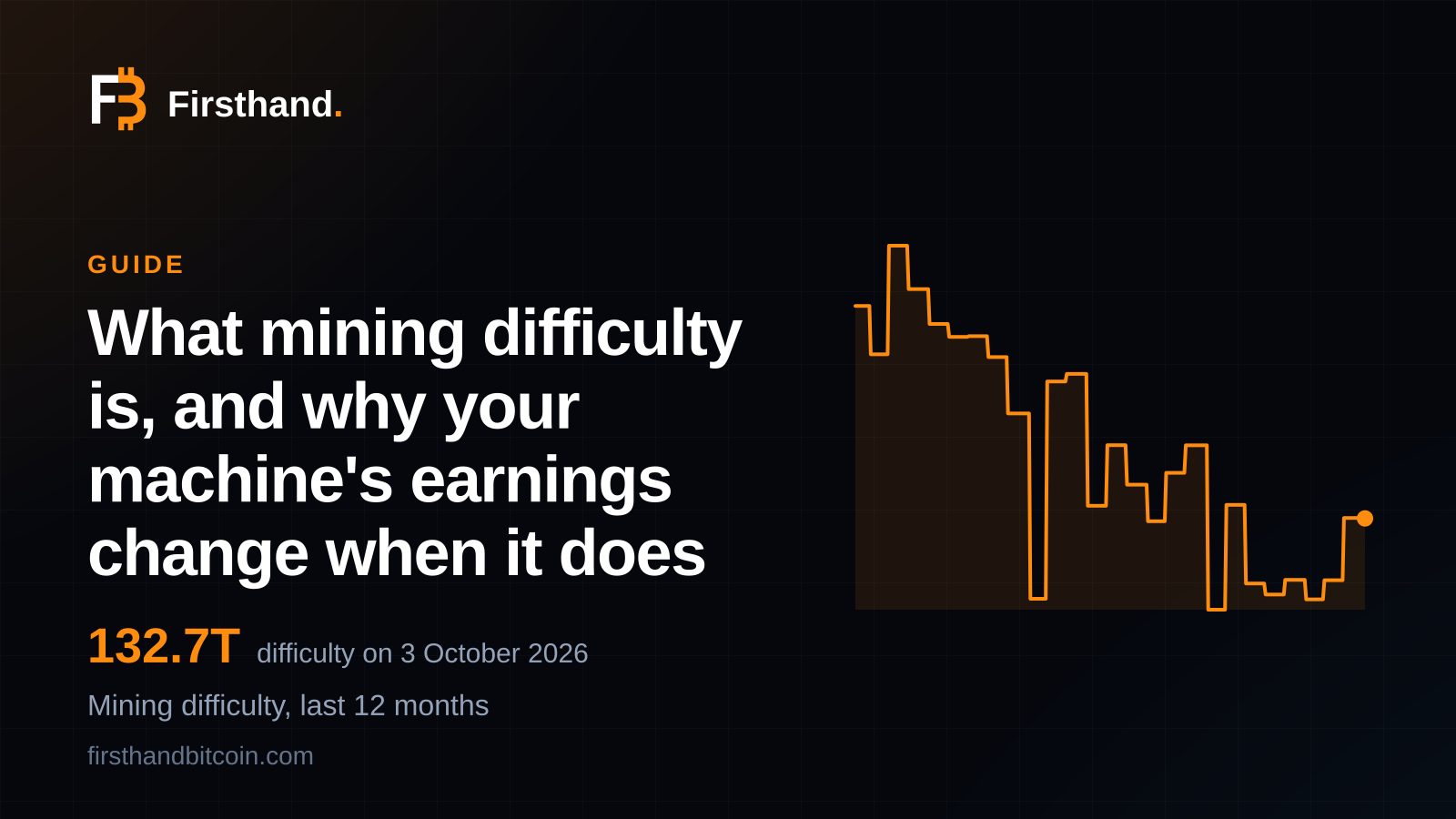
Difficulty is how hard each guess is to win
A bitcoin miner is a box that makes guesses. Each guess is a number, and the machine checks whether that number produces a result below a target. A result below the target wins a block. Almost every guess loses, so the machine makes trillions of them a second.
Difficulty is the name for how small that target is. The Bitcoin wiki puts it in one line: “Difficulty is a measure of how difficult it is to find a hash below a given target.” A higher difficulty means a smaller target, so each guess is less likely to win.
Think of rolling a die and needing to beat a number. If you need to roll under 6, you win most throws. If you need to roll under 2, you win rarely. The die and your hand are the same either way. Only the target moved.
The network resets it every two weeks to keep blocks ten minutes apart
Bitcoin is built to produce one block about every ten minutes, whatever the world's machines are doing. Nobody sets that pace by hand. The network adjusts the difficulty itself, and it does it on a fixed schedule: the wiki says the adjustment comes “every 2016 blocks”, and that “at the desired rate of one block each 10 minutes, 2016 blocks would take exactly two weeks to find.”
The rule is simple. If the last 2016 blocks arrived faster than ten minutes apiece, more machines must have joined, so difficulty goes up. If they arrived slower, machines must have left, so difficulty goes down. Each change is called a retarget.
On 4 October 2026 the next retarget was 1,904 blocks away on our difficulty chart, which is about thirteen days at ten minutes a block. Our retarget chart lists every one of them back to 2009.
What one guess is worth, worked through for one machine
Take the Antminer S21, which the store lists at 200 terahashes a second. On 3 October 2026 the difficulty was 132.7 trillion. Here is what that means for it, in four steps.
Step one: guesses per block. Difficulty is a count of guesses, scaled. Multiply it by 4.29 billion and you get the average number of guesses the whole network needs to find one block: about 570 sextillion, or 5.7 followed by 23 zeros.
Step two: guesses per day. A 200 TH/s machine makes 200 trillion guesses a second, which is 17.3 quintillion a day.
Step three: its share of a block. Divide the second number by the first and the S21 does about 0.00003 of a block's worth of guessing a day. On its own that is a block every 90 years, which is why machines work through a pool.
Step four: the coins. Multiply 0.00003 of a block by the 3.125 bitcoin each block pays in new coins and you get about 0.0000947 bitcoin a day, before fees on the transactions inside the blocks and before the pool's cut. Our hashprice guide gives the same answer in a form that is easier to track every day.
A higher difficulty does not slow your machine down. It makes each of its guesses worth less.
When difficulty rises, the same machine earns fewer coins
Every coin a machine earns is its guesses divided by the guesses a block needs. The machine's guesses do not change. If the number of guesses a block needs goes up 10%, the machine earns about 9% fewer coins. A rise of 14.73% cuts them by 12.8%.
That is not a hypothetical. On 19 February 2026 difficulty rose 14.73%, the largest rise in a single retarget since May 2021. For the S21 above, the 0.0000947 bitcoin a day becomes about 0.0000826. The machine, the power bill and the pool are all unchanged. Only the target moved.
It works the other way too. On 14 June 2026 difficulty fell 10.09%, and each guess became worth about 11% more. A machine does not earn more because it got better, and it does not earn less because it got worse. It earns what its share of the network's guessing is worth.
Most retargets are small, and you can ignore any single one
The 19 February rise was unusual. Across the 179 retargets since 2020, the typical move was 3.4% in either direction. In 2026, up to 3 October, there were 20 retargets: 9 raised difficulty and 11 lowered it. The latest, on 3 October, moved it by 0.03%, one of the smallest on record, which our data piece on it goes through.
Difficulty also tends to climb over years, because machines get more efficient and more of them are switched on. That rise is part of why a new machine earns less each year than the same machine did when it was new, and why efficiency decides how many halvings a machine survives.
There is no need to react to one retarget. What matters is the direction over months, and the best single number for that is hashprice, which already folds difficulty in.
What difficulty does not change
Difficulty has no effect on what a machine costs to run. A machine draws the same watts at a difficulty of 100 trillion or 150 trillion. Its power bill is the same, and so is its efficiency in joules per terahash.
It also does not decide the bitcoin price, or how many coins are created. The reward is set by the halving schedule, not by difficulty. What difficulty decides is how that reward is shared out: the more guessing power on the network, the thinner each machine's slice.
So the two things you control are the two that matter most. A more efficient machine keeps earning at a higher difficulty, because it needs less power for each guess. And cheaper power does the same job from the other side.
How to check it yourself in two minutes
Open the retarget chart and look at the last three bars. One tall bar up means the network added machines recently and each guess is worth less than it was. One tall bar down means machines left and each guess is worth more.
Then open the hashprice chart. It shows what one unit of hashing earns each day in bitcoin, so it already contains the effect of difficulty. If hashprice in bitcoin is falling while the price of bitcoin is steady, difficulty is usually the reason.
Last, compare the retarget date with your pool's daily earnings. You will see the step in the same fortnight. That is the whole mystery of earnings moving with nothing wrong on the machine.
What it means for a miner
Difficulty is the network's way of keeping the race fair, and it makes the race harder when more machines join. It is not a risk you can avoid. It is a running number you can read: look at the retarget chart every two weeks, and look at hashprice for what it did to earnings.
The numbers that decide whether a machine makes sense are the ones difficulty cannot touch. On 4 October the most efficient machine in stock, at the cheapest site that can run it, comes to about $18k to make a bitcoin in electricity, and about $85k to buy one. That is electricity only, at today's hashprice, before the machine and the pool's fee.
Mining output depends on bitcoin's price, network difficulty and uptime, and is not guaranteed. Nothing here is investment advice.
Sources and further reading
- Difficulty — Bitcoin Wiki, 22 Feb 2025
Disclosure
Firsthand Bitcoin sells and hosts mining hardware, including this machine. No manufacturer, distributor or affiliate programme paid for or reviewed this page and we take no commission on the links above. Historical figures are computed from daily bitcoin price and network hashprice, each day valued at its own prices. Nothing here is investment advice.