News · Nov 1, 2026 · 4 min read
Bitcoin today: FBI names North Korea for the Binance hack, Binance says 90% is replaced
The FBI, Secret Service and IRS have named North Korea's TraderTraitor group for the $6.3 billion Binance theft, and Binance says it has replaced 90% of what was taken. Bitcoin held near $77,800, and a coin still costs about a quarter of that to make.
The FBI says North Korea's TraderTraitor did it, and asks the industry to block the coins
The FBI, the US Secret Service and IRS Criminal Investigation said in a joint statement on Saturday that North Korea's TraderTraitor group, a subunit of the Lazarus Group, was behind Thursday's theft from Binance, according to CoinDesk. The agencies published more than 600 Ethereum addresses, just under 20 bitcoin addresses and one Solana address, and asked node operators, instant exchanges, DeFi services and analytics firms "to block transactions with or derived from addresses TraderTraitor actors are using to launder these stolen assets."
Stablecoin issuers have frozen more than $2.4 billion of the proceeds. Chainalysis chief executive Jonathan Levin said the attackers have already used "thousands of addresses" and expects that "will become tens of thousands over the coming weeks." How the theft happened is in our standalone piece on the hack.
The coins are named, and the industry has been asked to refuse them.
Binance says it has replaced 90% and expects to reopen withdrawals on Sunday
Binance said on Saturday that 90% of the roughly $6.3 billion taken has been replaced, up from about 80% a day earlier, per CoinDesk. The balances for bitcoin, ether, USDT, BNB, Solana, USDC, XRP, USD1, RLUSD and ZEC are now fully backed. The remaining 10% is in less liquid tokens that will take longer to buy.
The money comes from the corporate treasury, part of the futures insurance fund and a partial use of its SAFU fund, which Binance plans to restore to about $1 billion. "Binance will absorb the financial impact of these stolen funds, not our users," it said. Withdrawals were expected to reopen on Sunday 1 November, and the full proof of reserves is due by 3 November. We could not confirm from a primary source that withdrawals have reopened, so treat Sunday as the stated plan.
The stolen bitcoin is more than Tesla holds, and had not moved
The 18,270 bitcoin taken is worth about $1.4 billion at $78,500, more than the 11,509 Tesla holds and more than twice the roughly 7,820 in El Salvador's reserve wallets, CoinDesk reported. The hot wallet sent the coins to one new address in 11 transactions, and that address split them across 19: 17 holding exactly 1,000 bitcoin each. As of early Friday morning in New York none had been spent.
That is the number to watch against the FBI's request. A coin that every large service refuses is hard to turn into cash, and the 19 addresses are public.
A Nasdaq-listed company has authorised selling or borrowing against 5,833 bitcoin
Next Technology Holding (Nasdaq: NXTT), a Japan-based software company, said after the close on Friday that its board approved selling or borrowing against its bitcoin in one or more batches, citing the Binance hack, exchange security and the risk quantum computing poses to bitcoin's cryptography, according to CoinDesk. The coins are worth about $449 million. The company says none are held at Binance and gives no assurance that any sale will happen.
CoinDesk notes the filings include no wallet addresses or custodian attestations, so the holding cannot be checked independently, and that the bitcoin is more than 50 times the market value of the company's shares. Read it as an authorisation, not a sale.
Moscow Exchange is still on track to open crypto trading on 1 December
Boris Blokhin of the Moscow Exchange told Interfax on 8 October that the exchange plans to enable crypto trading from 1 December and has been testing with professional participants since the start of that month. Under Russia's digital currency law, which took effect on 1 September, ordinary investors may buy only bitcoin, ether and Tether, up to 300,000 rubles a year through one intermediary. Qualified investors face no limit.
What it means for miners
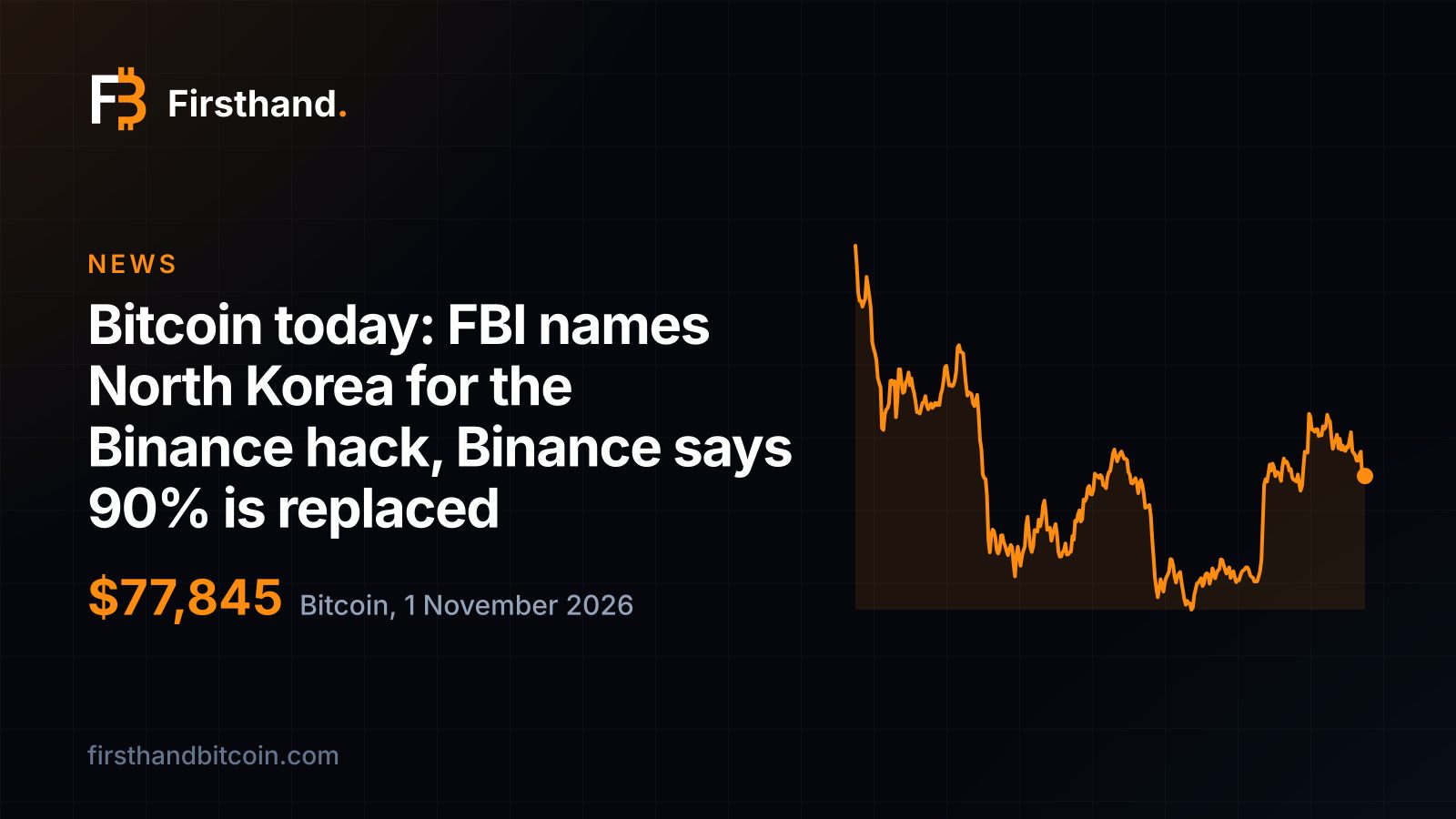
None of this changes how many coins a machine makes. Bitcoin closed at $77,209 on Saturday and $77,845 on Sunday in our series, against $81,275 on Thursday, and a petahash earned 0.000426 bitcoin a day on Saturday against 0.000445 on Thursday on our hashprice chart. Difficulty rose 5.54% on Thursday evening, and a petahash now earns about 4% fewer coins; the price fall took the dollar value down further.
On our best case, an Antminer S23 XP Hyd at 8.9 J/TH on Nigeria's 3.9¢ power, electricity makes a bitcoin for about $19,500 at today's hashprice, against $77,845 to buy one. That is a quarter of the price, electricity only, and output is not guaranteed. A lower market price is when an efficient machine on cheap power stacks the most coins per dollar spent, and the coins are the part a miner keeps.
About $19,500 to make a bitcoin, $77,845 to buy one.
Sources and further reading
- FBI confirms North Korea's role in $6 billion Binance hack, asks DeFi community to block BTC, ETH, SOL addresses — CoinDesk, 31 Oct 2026
- Binance says it has replaced 90% of stolen crypto after massive $6.3 billion breach — CoinDesk, 31 Oct 2026
- Bitcoin stolen from Binance tops Tesla's holdings and is over twice El Salvador's reserve — CoinDesk, 31 Oct 2026
- A Nasdaq-listed company may sell $450 million bitcoin, citing Binance hack and quantum fears — CoinDesk, 31 Oct 2026
- Moscow Exchange plans to enable cryptocurrency trading from 1 December — Interfax, 8 Oct 2026
Disclosure
Firsthand Bitcoin sells and hosts mining hardware, including this machine. No manufacturer, distributor or affiliate programme paid for or reviewed this page and we take no commission on the links above. Historical figures are computed from daily bitcoin price and network hashprice, each day valued at its own prices. Nothing here is investment advice.