Data insight · Oct 31, 2026 · 5 min read
$2.1 billion of longs were liquidated in October, and open interest in coins is 13% higher
Three days this month closed more than $250 million of bitcoin longs, where July, August and September had none. The data shows what that did to leverage: the positions that were cleared came back, and by 30 October there were more of them, counted in coins.
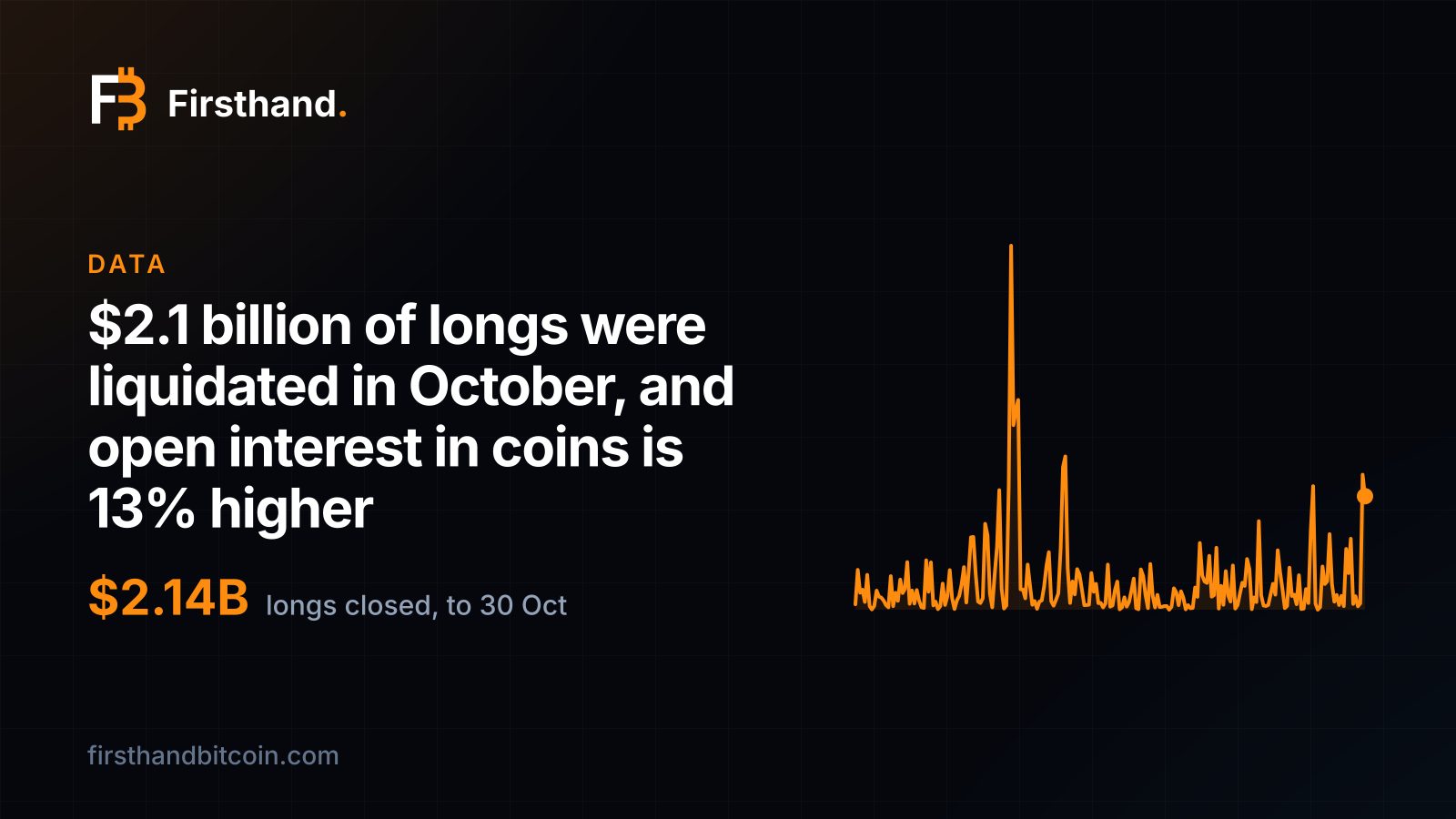
Three days in October closed more than $250 million of longs
Bitcoin longs force-closed on futures exchanges came to $272 million on 8 October, $298 million on 29 October and $250 million on 30 October on our liquidations chart. Of the 217 days in the record we hold, 11 reached $250 million. Three are in October, seven in June and one is 28 May.
Before 8 October the last day that large was 25 June, at $338 million. Nothing between 26 June and 7 October came close: the biggest was $195 million on 15 September. October's total to 30 October is $2.14 billion of longs and $0.96 billion of shorts, the second most of the seven full months we hold, behind June's $4.17 billion.
The price did far less. Bitcoin's daily closes in October ran from $86,488 on 5 October to $77,802 on 30 October, a spread of 11.2%. In June the spread was 22.5%, and the liquidations were twice the size.
The positions that were cleared came back
Open interest is the value of every open futures position. On 6 October it was $32.3 billion, which at that day's $85,771 is about 376,500 bitcoin, the lowest reading of the month. On 30 October it was $33.1 billion at $77,802, or about 425,700 bitcoin: 13% more coins in the market, with the price 9.3% lower.
Between those two dates longs were force-closed for $1.99 billion and shorts for $0.72 billion. The market was smaller on 8 October, when we wrote that leverage had already come down, and it did not stay small. Traders rebuilt the positions each time they were cleared. Open interest reached $35.2 billion on 22 October, the highest of the month, and the dollar figure then hid the rebuilding because the price fell underneath it.
Counting in coins is the fair comparison here. A falling price shrinks the dollar value of a position without anyone closing it, so the dollar line flattered the clear-out. The coin count says there are more bets resting on bitcoin than there were three weeks ago.
Since 6 October, $1.99 billion of longs were force-closed. The coins held in futures went up 13%.
The two largest days closed 1.6% of open interest
The 29 and 30 October liquidations, $298 million and $250 million of longs, add up to $548 million. Open interest on 28 October was $34.0 billion, so the two days cleared 1.6% of it. Open interest fell 2.5% in dollars between 28 and 30 October, while the price fell 4.3% from its 29 October close, so in coins it rose, from about 420,400 to 425,700.
The cause was outside the futures market. CoinDesk attributed the selloff to the breach at Binance, which the exchange estimates affected about $6.3 billion of assets, and counted $1.53 billion of liquidations across every coin in the 24 hours to Friday morning in Asia, 83.8% of them longs. We covered the theft in the Binance hack.
June is the comparison. From 1 to 6 June longs lost $2.43 billion and open interest fell 19%, from $30.4 billion to $24.6 billion, as the price dropped 16%. Leverage left the market then. It has not left it this week.
Funding is cheap, but fear arrived in a day
The funding rate on perpetual futures is what longs pay shorts to hold their positions. It averaged 4.9% a year across October on our funding chart and read 8.3% on 30 October. In the 30 days to 9 October 2025 it averaged 9.4%. Traders are not paying much to lean long, which is why a larger pile of positions has not shown up in the price of holding them.
Sentiment moved the other way. In the 13 days to 29 October the Fear & Greed Index stayed between 48 and 68. Then it fell from 51 on 29 October to 30 on 30 October, its lowest reading since 14 August. A market that is nervous and still carries more coins in futures than three weeks ago is one where a further shock clears positions again. The chart cannot say whether that shock comes, only that the fuel is there.
What it means for a miner
A miner who keeps the coins has no margin to be called. Nothing is borrowed against the price, so a long that is force-closed in a bad hour has no counterpart in a machine that keeps hashing. What a petahash earns is set by the network.
On 29 October difficulty rose 5.54% to 148.36 trillion, and the coins earned per petahash per day went from 0.000445 to 0.000427 on our hashprice chart, 4.1% fewer, the same size as the price move but for a different reason.
The cost of making a coin is electricity, and it did not move with the futures market. On our best case, an Antminer S23 XP Hyd at 8.9 J/TH on Nigeria's 3.9¢ power, a coin costs about $19,514 to make at 31 October's hashprice, against a market price of $77,313: a quarter of what it sells for. That figure leaves out the machine and the pool fee, and output is not guaranteed. The positions in futures can come and go. The coins a machine has mined stay in the wallet.
The liquidations moved the price. Difficulty moved the coins.
Sources and further reading
- Bitcoin, ether and XRP selloff wipes out $1.5 billion in leveraged crypto bets — CoinDesk, 30 Oct 2026
Disclosure
Firsthand Bitcoin sells and hosts mining hardware, including this machine. No manufacturer, distributor or affiliate programme paid for or reviewed this page and we take no commission on the links above. Historical figures are computed from daily bitcoin price and network hashprice, each day valued at its own prices. Nothing here is investment advice.