Guide · Oct 31, 2026 · 5 min read
Should your first bitcoin miner be new or used? The power bill decides
A used miner earns the same coins per terahash as a new one. What differs is the electricity it burns to earn them. That gap is a sum you can do before you pay, and it decides whether a low price is a bargain.
TL;DR
- A used miner earns the same coins per terahash as a new one. It simply burns more electricity to do it, and that is the whole difference.
- Do the line first. J/TH times 24 times your rate per kWh. If hashprice is above it, the machine covers its power.
- Price the extra power. A 30 J/TH machine pays $7.21 more per terahash each year than an 8.9 J/TH one at 3.9¢. The used price has to beat that.
- Ask what the listing hides: hours run, hashboards, firmware and who pays for a fault.
A used miner earns the same coins per terahash, and pays more to do it
The case for buying used is simple and sounds sensible: the same job for less money up front. Used machines are listed all over the internet, and their price per terahash is often well under a new one's.
Here is the part the listing does not show. Bitcoin pays by hashrate, not by age. A terahash from a machine built in 2021 earns exactly the same coins as a terahash from one built this year. What changes is how much electricity each terahash burns, which is the J/TH number on the spec sheet.
So the question is never whether a used machine works. It is whether the lower price pays for the extra power. Three checks answer it, in order.
First, the line: does the machine cover its own power?
Every machine has a line. Multiply its J/TH by 24 and by your rate per kilowatt-hour and you have what its electricity costs for each petahash it runs for a day. If what a petahash earns in a day, the hashprice, is above the line, the machine covers its power. If it is below, it does not. The guide to how much electricity a miner uses goes through the sum.
On 31 October 2026 a petahash earned $33.00 a day. The table gives the line for four efficiencies at our two main power prices, from the most efficient machine we stock down to an older one rated at 30 J/TH.
Same coins per terahash. The J/TH and the power price decide the rest.
| Efficiency | Line at 3.9¢ | Line at 6¢ |
|---|---|---|
| 8.9 J/TH | $8.33 | $12.82 |
| 12 J/TH | $11.23 | $17.28 |
| 20 J/TH | $18.72 | $28.80 |
| 30 J/TH | $28.08 | $43.20 |
The same older machine clears at one site and not at another
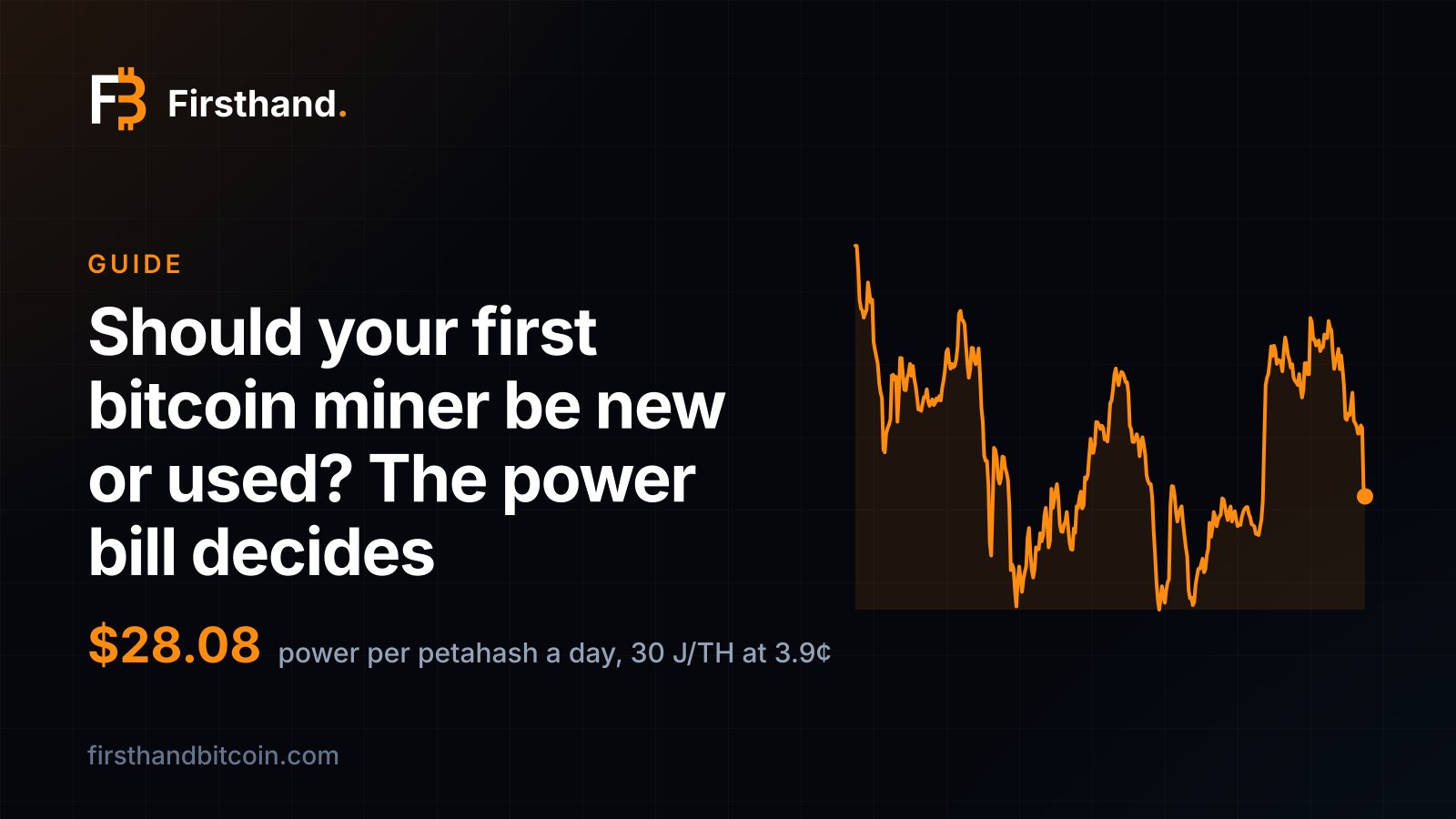
A used machine rated at 30 J/TH has a line of $28.08 at 3.9¢, our lowest power price, at the Nigeria site. It clears, with $4.92 to spare on 31 October. At 6¢ its line is $43.20, and in the last 365 days hashprice was below that line on 362 of them.
Same machine, same coins. Only the power price changed. At 6¢ it does not pay. At 3.9¢ it only just does, and the chart shows how close: hashprice dipped under $28.08 on four days, the lowest being $27.74 on 6 June 2026.
Second, price the extra power against the lower price
Compare the older machine with the most efficient one we stock, the Bitmain Antminer S23 XP Hyd, at 8.9 J/TH. Each terahash of a 30 J/TH machine draws 21.1 watts more. Over a year that is about 185 kWh, which costs $7.21 at 3.9¢ and $11.09 at 6¢.
That is the premium an older machine pays on every terahash, every year, to earn the same coins. Over two years in Nigeria it comes to $14.42 per terahash. A used machine is a bargain only if its price per terahash is below a new one's by more than that, over the years you will run it.
Compare like with like. A listing's price usually leaves out freight, duty and setup, which are paid per box whether it is new or used. Put them on both and compare the landed price per terahash, as the price of a miner is not the price of the box explains.
What the discount on a used machine is paying for
A used machine is cheaper for reasons you can name. Its efficiency is usually behind the current generation, so it burns more power per terahash. It has run for some years, so some of its working life is already spent. And it comes with less certainty: a maker will stand behind a new box in ways a stranger will not.
None of that makes it a bad buy. It makes the discount a payment for specific things, and your job is to check that the discount is large enough to cover them. The guide to how long a miner lasts shows what ends a machine's working life, which is the number to hold against how many years you plan to run it.
A worked example, with a made-up price
Say a seller offers a 30 J/TH machine at a price per terahash that is $12 under a new machine's landed price. Hosted in Nigeria, the extra power costs $7.21 per terahash a year, so the saving is gone after about 20 months. Run it for three years and you have paid $9.62 more than the new machine would have cost, for the same coins.
At 6¢ the same saving lasts about 13 months. The number is invented, but the shape is not: a used machine’s discount is a loan against its electricity bill, and the longer you run it the more of the loan comes due. A used machine bought to be run for one year looks very different from one bought to be run for four.
Third, what a listing cannot show you
A new machine arrives with no history. A used one has a history the seller knows and you do not: how many hours it has run, how hot, whether hashboards have been replaced, and whether its firmware has been changed. None of that is on a spec sheet.
A maker's warranty is set by the maker, and the terms differ. Ask whether any cover is left and whether it passes to a new owner. If it does not, a fault is yours to repair. A failed hashboard is a line item, not a catastrophe, and what it costs depends on where the machine lives: parts only in Argentina, and in the UAE the manufacturer's warranty centre is close by, which helps while the machine is still covered.
Four things to ask the seller before any money moves
Ask for the exact model and hashrate variant, with the serial number. The same model comes in several ratings, and which one you are buying changes both the line and the price.
Ask for a screenshot of the machine's own page showing every hashboard present and its 24-hour average, and set it against the spec sheet. A healthy machine sits close to its rating, and why a reading differs is mostly counting, not faults.
Ask what power mode it has run in and what firmware it carries. A machine run hard for years has had more wear than its age suggests.
Ask, in writing, who pays if it arrives faulty. If the answer is vague, the price should be lower by the cost of a repair.
What it means for a miner
On 31 October 2026, electricity alone cost about $19,514 to make a bitcoin on the most efficient machine we stock at Nigeria's 3.9¢, against a market price of $77,313. On a 30 J/TH machine at the same site the same coin cost about $65,776 of electricity. Both figures leave out the machine and the pool fee, and output is not guaranteed.
That gap is the reason to pay for efficiency. A machine far under its line keeps making coins through the weeks when hashprice dips, and a machine sitting on its line does not. A used machine can still be right, but only when its price per terahash is low enough to pay for years of the extra power.
For a first machine, the safer start is one with room under the line. Run the sum on any machine in the shop at the site you would host it, and you will know before you pay.
A cheaper coin is a wider cushion. Do the sum before you pay.
Disclosure
Firsthand Bitcoin sells and hosts mining hardware, including this machine. No manufacturer, distributor or affiliate programme paid for or reviewed this page and we take no commission on the links above. Historical figures are computed from daily bitcoin price and network hashprice, each day valued at its own prices. Nothing here is investment advice.