Data insight · Nov 6, 2026 · 4 min read
CME bitcoin futures hold 90,000 coins, 59% under their peak, while ETFs hold 95% of theirs
The futures that US institutions trade on the CME now cover 89,928 bitcoin, the fewest since October 2023 and 59% under the December 2024 peak. The spot ETFs went the other way: they hold 13% more coins than they did at that peak, and a fund share is a coin that stays put.
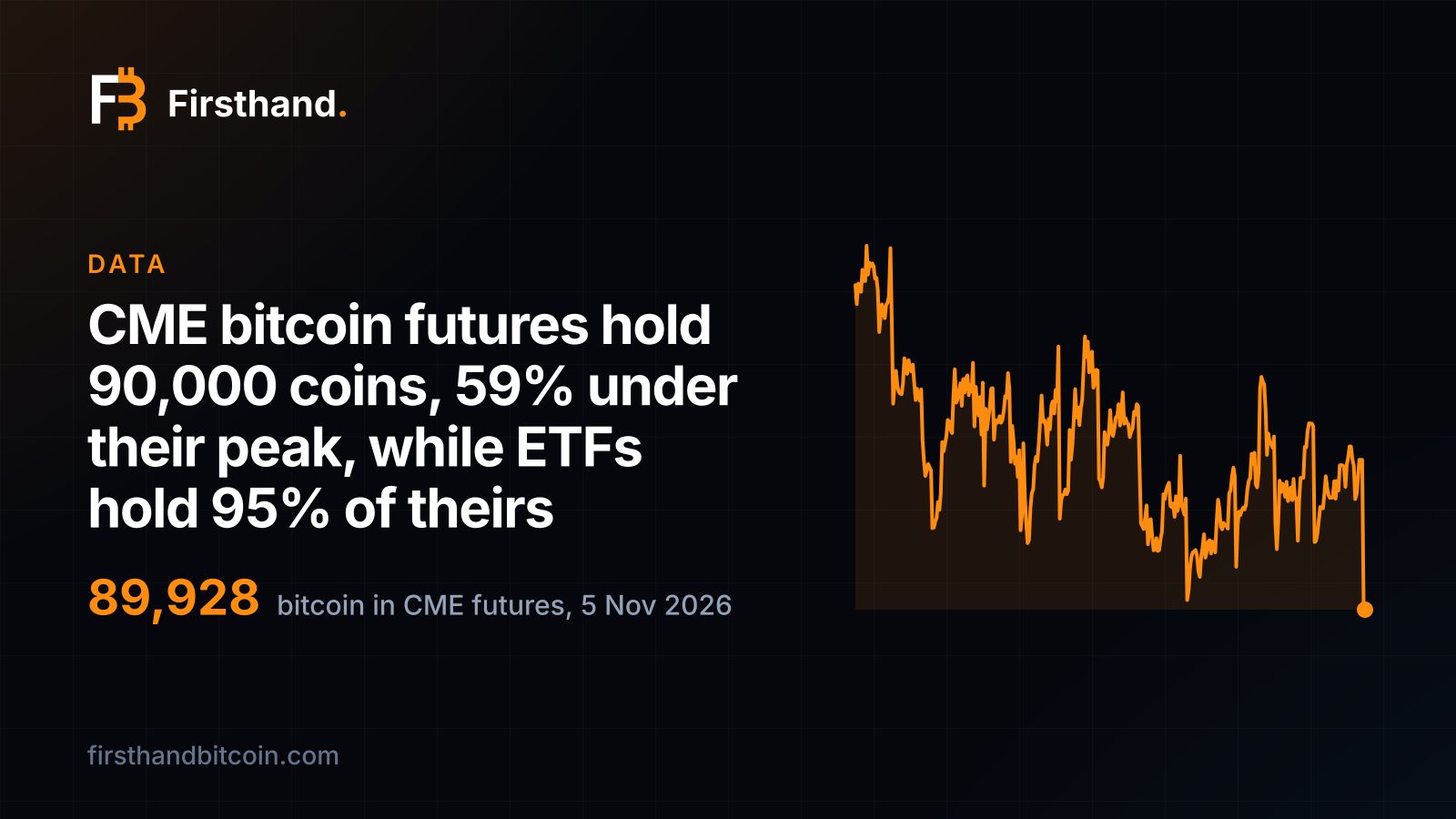
Wall Street's bitcoin futures book is the smallest in three years
The CME is where US institutions trade regulated bitcoin futures. On 5 November the open positions there were worth $7.23 billion, which at that day's price of $80,431 is 89,928 bitcoin. That is fewer coins than at any point since 21 October 2023, when the figure was 89,086, on the futures open interest chart.
The peak came on 20 December 2024, when the CME book held 220,879 bitcoin, worth $21.3 billion. Counted in coins, which is how a miner should count, it has shrunk by 59%. Counted in dollars it has shrunk by 66%, because the price is lower as well.
The two counts can disagree. The dollar value of the book is up 33% since 1 July, from $5.42 billion to $7.23 billion, which looks like recovery. But bitcoin was $59,308 on 1 July and $80,431 on 5 November, up 36%, so the same positions cover 1,491 fewer coins than they did on that day, 91,419 against 89,928. Most of the dollar rise is the price, not new positions.
Most of the latest shrinking came in six weeks
In September the book was rebuilding. On 25 September it held $9.92 billion, or 117,596 bitcoin, as the price climbed toward $84,000. By 3 November it was at 113,169 coins, and on 4 November our series drops to 90,140, a fall of 20% in one day while the price rose 0.9%. A drop that size has appeared in the series a few times, and several fall on the first day of a quarter, when contracts roll. 4 November is not one of those days, and we do not have a reason for it.
The spot funds moved with it, more gently. They held 1,297,627 bitcoin on 29 October and 1,286,177 on 5 November, 11,450 fewer. Our ETF flows series has $643.2 million leaving on 30 October, $398.6 million on 2 November and $115.6 million on 3 November, before $74.6 million came back on 4 November.
The CME's share of all futures positions has halved
The CME is not the only place to hold a bitcoin future. Across the major venues, open interest on 5 November stood at 412,733 bitcoin, 20% under the peak of 514,333 on 20 December 2024. The CME's slice of that total has fallen from 45.9% on 31 December 2024 to 21.8%.
So the CME has lost ground to the other venues, and the coins held in funds have grown while its book shrank.
In coins, the CME book is down 59%. The ETFs are up 13% on the same dates.
The ETFs went the other way
Over the same stretch the US spot ETFs added coins. They held 1,134,449 bitcoin on 20 December 2024 and 1,286,177 on 5 November, 13% more. Their peak was 1,348,977 on 13 October 2025, and today's holdings are 95% of that. The spot ETFs began trading on 11 January 2024 with 595,870 coins in our series, and the CME book held 115,289 bitcoin on 29 December 2023, just before. It now holds fewer coins than it did before the funds existed, and the funds hold more than double what they started with.
Part of the link is a trade. Funds that buy a spot ETF, sell a CME future against it and collect the gap between the two prices are running what is called the basis trade. The Block reported in April that CME open interest had fallen for five months and that the unwinding of that trade was part of the reason: with bitcoin down from above $120,000 to under $70,000, the gap had compressed to about 5% a year against a risk-free rate of about 4.5%, which leaves little reason to run it.
| Date | CME futures, bitcoin | CME futures, $ billion | US spot ETFs, bitcoin |
|---|---|---|---|
| 20 Dec 2024 | 220,879 | 21.28 | 1,134,449 |
| 30 Jun 2025 | 160,877 | 17.34 | 1,242,795 |
| 13 Oct 2025 | 147,917 | 17.02 | 1,348,977 |
| 31 Dec 2025 | 102,568 | 9.04 | 1,288,193 |
| 30 Jun 2026 | 107,155 | 6.32 | 1,249,299 |
| 5 Nov 2026 | 89,928 | 7.23 | 1,286,177 |
Coins in a fund stay put
A futures position is a bet that settles in cash and expires. A fund share is backed by bitcoin the issuer holds, and it stays held until shareholders redeem. When institutional demand moves from the first to the second, it moves from something that rolls off to something that sits.
The ETFs' 1,286,177 coins are the equivalent of about 2,860 days of block rewards at roughly 450 new coins a day, or close to eight years of everything miners produce. The holdings are on the ETF holdings chart and move with every day's flows.
What it means for a miner
A smaller futures book changes little for the machines. What matters is where the coins the market wants end up. Funds that hold the coin outright hold a supply that miners produced and that does not come back to market on a contract's expiry.
For anyone making coins, none of this touches the cost side. On the most efficient machine in stock at the cheapest site that can run it, the electricity for one bitcoin costs about $19,500, against a market price of $75,506 today. A petahash earned $32.22 a day at today's price on the hashprice chart. Output is never guaranteed, and nothing here is a price call.
The next thing to watch is whether the funds keep their coins. The count has held between 1,214,457 and 1,348,977 since October 2025, through a price that ranged from $59,014 to $115,115. If it holds through the next move as well, the coins institutions want are being kept off the market.
The coins institutions hold move out of a futures book and into funds that sit on them.
Sources and further reading
- CME Bitcoin futures activity slumps to 14-month low as basis trade unwind drains institutional demand — The Block, 9 Apr 2026
Disclosure
Firsthand Bitcoin sells and hosts mining hardware, including this machine. No manufacturer, distributor or affiliate programme paid for or reviewed this page and we take no commission on the links above. Historical figures are computed from daily bitcoin price and network hashprice, each day valued at its own prices. Nothing here is investment advice.