Data insight · Nov 4, 2026 · 4 min read
Two 5% difficulty rises in 13 days, a first since 2024, cut a petahash’s coins by 11%
Mining difficulty rose 5.9% on 16 October and another 5.5% on 29 October. It is the first time since February 2024 that two adjustments in a row each added more than 5%, and it means every petahash now wins about 11% fewer bitcoin a day than it did on 3 October.
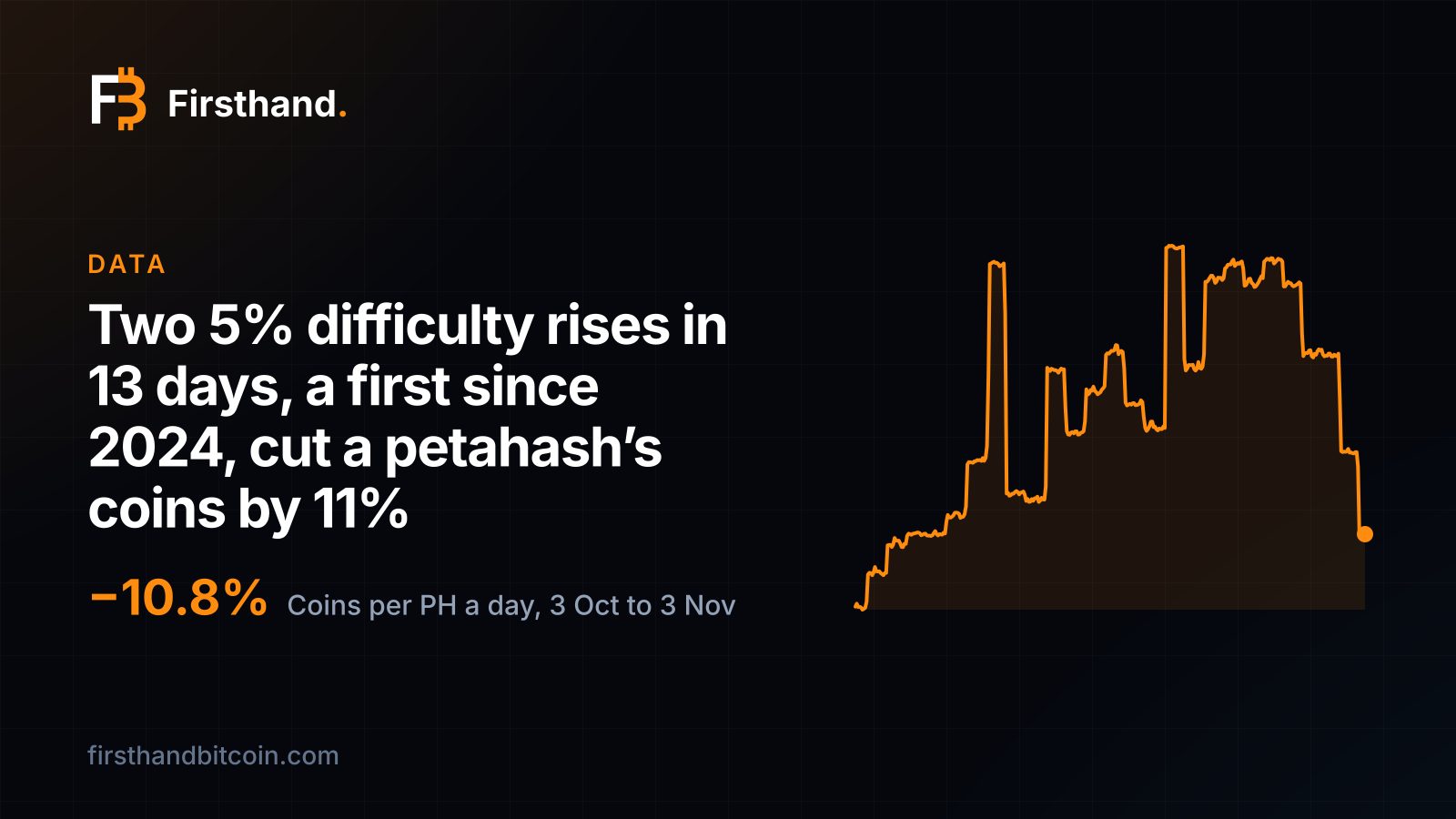
Difficulty rose 5.9%, then 5.5%, in 13 days
Bitcoin retunes its mining difficulty once every 2,016 blocks. The Bitcoin developer guide says the network looks at how many seconds those blocks took and aims for “1,209,600 seconds (two weeks)”. When machines have been finding blocks faster than ten minutes apiece, the next adjustment makes the puzzle harder.
That is what happened twice in a row. On 16 October difficulty went from 132.7 trillion to 140.6 trillion, up 5.9%. On 29 October it went to 148.4 trillion, up another 5.5%. Together that is 11.8% in 13 days.
The clock shows why. The 2,016 blocks before the 16 October adjustment took 13 days and 5 hours, and the 2,016 before 29 October took 13 days and 7 hours, each against a target of 14 days. Blocks were arriving about 5% too fast both times, so both times the rules made the puzzle harder.
It is not routine. Of the 154 adjustments since January 2021, only three earlier pairs had both rises above 5%: two overlapping pairs in August 2021 (31 July, 13 August and 25 August) and the most recent, 2 and 15 February 2024, at 7.3% and 8.2%. The other big move this year, 14.7% on 19 February, was followed by 0.4%, not by a second large rise.
A petahash now wins 10.8% fewer coins a day
A miner’s share of each day’s new bitcoin shrinks when difficulty rises, because more total guessing power is chasing the same prize. On 3 October a petahash of hashrate earned 0.000478 bitcoin a day on our hashprice in bitcoin chart. On 3 November it earned 0.000426. That is 10.8% fewer coins.
Almost all of it came in two steps. From 15 to 17 October the figure fell 5.7%, from 0.000477 to 0.000450. From 29 to 30 October it fell another 4.1%, to 0.000427. In between it hardly moved, which is how the figure behaves between adjustments.
The two numbers will not match the difficulty rise exactly, because the transaction fees miners collect on top of new coins also change from day to day. They were small: about 2 bitcoin a day in late October, against 450 new coins issued.
The coins did not fade gradually. They dropped in two steps, one after each adjustment.
The price took the same two weeks off the dollar figure
Coins are only half of what a miner’s day is worth. Bitcoin itself closed at $84,503 on 3 October and $76,683 on 3 November, 9.3% lower. Stack that on top of the 10.8% fall in coins and the dollars one petahash earns in a day, hashprice, fell 19%, from $40.38 to $32.70.
That is the part a dashboard shows. It is also the part that says least about the machine. The coin count fell because the network grew, and the dollar value fell because the market did. Neither is a fault in any machine, and neither changes how many coins a given machine adds a day relative to its neighbours on the network.
The guide to why daily earnings move shows how to tell the two apart on a dashboard.
Difficulty is still 5% below its record
The rises have taken difficulty back toward its highs, not past them. At 148.4 trillion it stands at 95.1% of the record of 156.0 trillion set on 29 October 2025, exactly a year before the latest adjustment. Our piece on how difficulty won back half of its fall from the record covers the climb up to the middle of October.
Difficulty rises when blocks have been coming faster than ten minutes apiece, which means more hashing power has come online. These two adjustments say the network added machines through October even as the price slid, and that is what shrank each petahash’s share.
The coin count agrees. On 30 October 2025, the day after the record, a petahash earned 0.000406 bitcoin a day. On 3 November 2026 it earned 0.000426, 5% more, with difficulty 5% lower. A petahash still wins more coins than it did at the peak of difficulty, even after losing 11% in a month.
What it means for a miner
When each petahash wins 10.8% fewer coins, the electricity needed to make one coin rises by about 12%, on every machine, in every country. Our piece on what a coin costs to make tracked that rise in the cost of a coin.
What differs between machines is the size of the starting point. On 4 November the most efficient machine we sell, the Antminer S23 XP Hyd at 8.9 J/TH on Nigeria’s 3.9¢ power, makes a bitcoin for about $19,533 in electricity, a quarter of the $78,019 market price. A machine that uses twice the power per terahash starts from a cost twice as high, and gets the same 12% added on top.
For a miner who keeps the coins, difficulty is a steady tax that everyone pays together, and the efficient machine on cheap power is the one that pays it out of the widest margin. Mining output is never guaranteed, but the steps are visible in advance, and they are on the Data section every two weeks.
Difficulty raises the electricity cost of every coin by the same 12%. Efficiency decides what that 12% is worth.
Sources and further reading
- Block Chain, Bitcoin developer guide — Bitcoin.org, 2026
Disclosure
Firsthand Bitcoin sells and hosts mining hardware, including this machine. No manufacturer, distributor or affiliate programme paid for or reviewed this page and we take no commission on the links above. Historical figures are computed from daily bitcoin price and network hashprice, each day valued at its own prices. Nothing here is investment advice.