Data insight · Oct 13, 2026 · 4 min read
A year on from their record, the bitcoin ETFs hold 60,000 fewer coins. Miners made 163,000.
On 13 October 2025 the US spot bitcoin ETFs held 1,348,977 bitcoin, the most in their history. A year later they hold about 4.5% fewer, while miners created 163,191 new coins. The funds gave back as many coins as miners made until July, then bought twice what miners made.
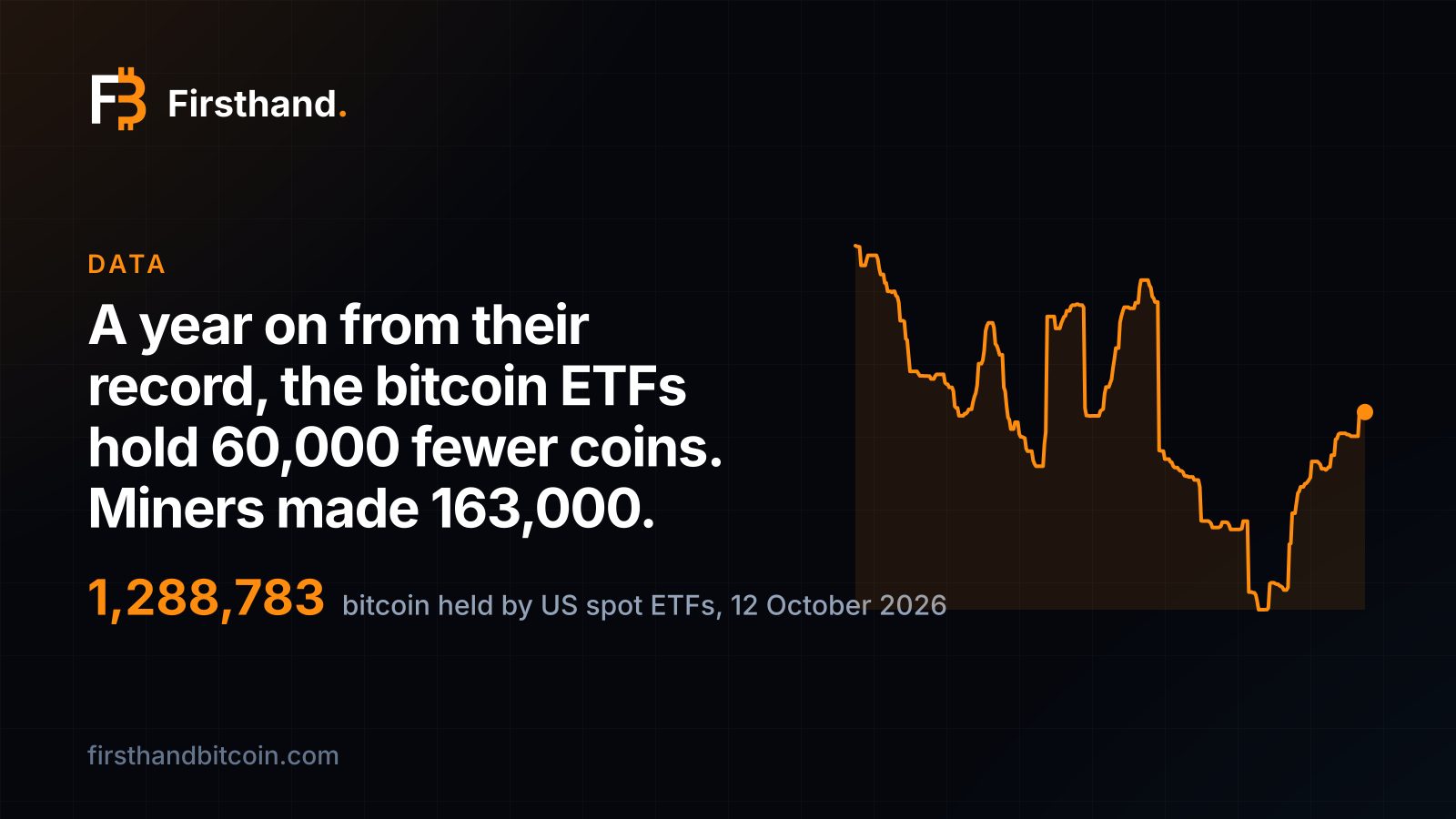
The price is 27% lower, the coins only 4.5%
On 13 October 2025 the US spot bitcoin ETFs held 1,348,977 bitcoin between them, the most on any day since they launched in January 2024. Bitcoin closed that day at $115,092, so the funds held about $155 billion.
On 12 October 2026 they held 1,288,783 bitcoin, which is 60,194 fewer, a fall of 4.5%. Bitcoin closed at $83,677, 27% below where it stood a year earlier, so the same funds are worth about $108 billion. Most of what the funds lost in dollars is price. In coins, the difference is a small slice of the stack.
Over their whole life the funds remain large net buyers: TFTC's tracker puts cumulative net inflows since launch at $57.1 billion as of 9 October. What they gave back this year is a small part of what they took in.
The coin count comes from our ETF holdings chart. The path between those two days was not smooth, and that is where the story is.
Until July the funds gave back as many coins as miners made
From 13 October 2025 to 31 July 2026 the funds' holdings fell by 127,946 bitcoin, to 1,221,031, a drop of 9.5% from the peak. Over the same stretch the network issued 129,819 new coins. The funds handed back almost exactly what miners produced.
The monthly flows from TFTC's tracker show where it happened: $3.5 billion out in November, $1.1 billion in December, $1.6 billion in January, then $2.4 billion in May and $4.5 billion in June, the worst of the thirteen months in that table. Bitcoin went from $115,092 to $63,586 over those months, a fall of 45%.
A fall that size is easy to read as bad news for miners. In dollars it was: hashprice, what a petahash earns in a day, went from $49.58 on 27 October 2025 to $27.74 on 6 June 2026. In bitcoin it did not fall with the price, which the last section shows.
Since July they have bought twice what miners made
From 31 July to 12 October the funds' holdings rose by 67,752 bitcoin, to 1,288,783. In the same 73 days the network issued 33,372 coins. The funds took in just over twice as many coins as miners created, and bitcoin rose 32%, from $63,586 to $83,677.
An inflow means the funds buy bitcoin to back new shares; an outflow means they sell. TFTC's tracker has the flows for those months at $172 million in July, $3.5 billion in August and $2.6 billion in September. October has turned the other way: net outflows of $388.6 million to 9 October, with the week of 5 to 9 October the worst since late June, at $681.1 million out, as The Block reported on SoSoValue figures.
The holdings count above runs to 9 October, the last day of fund data in our series.
From 31 July the funds added 67,752 bitcoin. Miners issued 33,372.
The swing is the funds, not the issuance
Miners do not change their output from one month to the next in any way that matters to this comparison. The network pays out 3.125 bitcoin per block, and with about 145 to 157 blocks a day that is roughly 450 to 490 new coins every day. Over a year it came to 163,191.
The funds' flows are the part that moves. In the nine and a half months to July they gave back as many coins as the network created. In the ten weeks since, they have bought at twice the pace of issuance.
Put the two together. From the peak to 31 July, 257,765 coins, the new issuance plus the funds' sales, had to find other buyers. Since then the funds have taken all 33,372 new coins and another 34,380 from existing holders.
None of this says the funds caused the fall or the recovery. It says that the two biggest numbers in the comparison, what miners make and what the funds hold, were of the same size, and that only one of them can change direction.
What it means for a miner
On our hashprice chart, a petahash earned 0.000419 bitcoin a day on 13 October 2025, 0.000502 on 31 July 2026 and 0.000477 on 12 October 2026. The coins per petahash did not follow the price down: over the year they ranged from 0.000405 on 2 November 2025 to 0.000547 on 20 September 2026. We covered the year-on-year gain in A petahash earns 13% more bitcoin than it did at the record high.
That is why a falling price is when efficient machines on cheap power stack the most coins. The most efficient machine we stock, the Antminer S23 XP Hyd, makes a coin for about $18,000 of electricity at Nigeria's 3.9¢, against a market price near $82,000. That is electricity only, at today's hashprice, and output is not guaranteed.
Each machine's share of those 163,191 coins is set by its hashrate against the network's. Its output does not depend on whether the funds are buying or selling that week, and neither does what a coin costs it in electricity.
The funds are demand that arrives in size and leaves in size. A miner who keeps the coins, as set out in nobody sells the coins to pay the power bill, is the side of the table whose supply does not change when the funds do.
A petahash earned more bitcoin at the low than at the peak.
Sources and further reading
- Bitcoin ETF Flows — TFTC, 9 Oct 2026
- Bitcoin slides below $82,000 as crypto liquidations surge past $770 million — The Block, 12 Oct 2026
Disclosure
Firsthand Bitcoin sells and hosts mining hardware, including this machine. No manufacturer, distributor or affiliate programme paid for or reviewed this page and we take no commission on the links above. Historical figures are computed from daily bitcoin price and network hashprice, each day valued at its own prices. Nothing here is investment advice.