Data insight · Oct 27, 2026 · 4 min read
Miners' daily pay is up 43% since June, but a petahash earns 27% more
All bitcoin miners together were paid $43.0 million a day in October, up from $30.0 million in June and the most in any month since November. Two things shared it out: the price did most of the lifting, and about 10% more hashrate arrived to divide the pot.
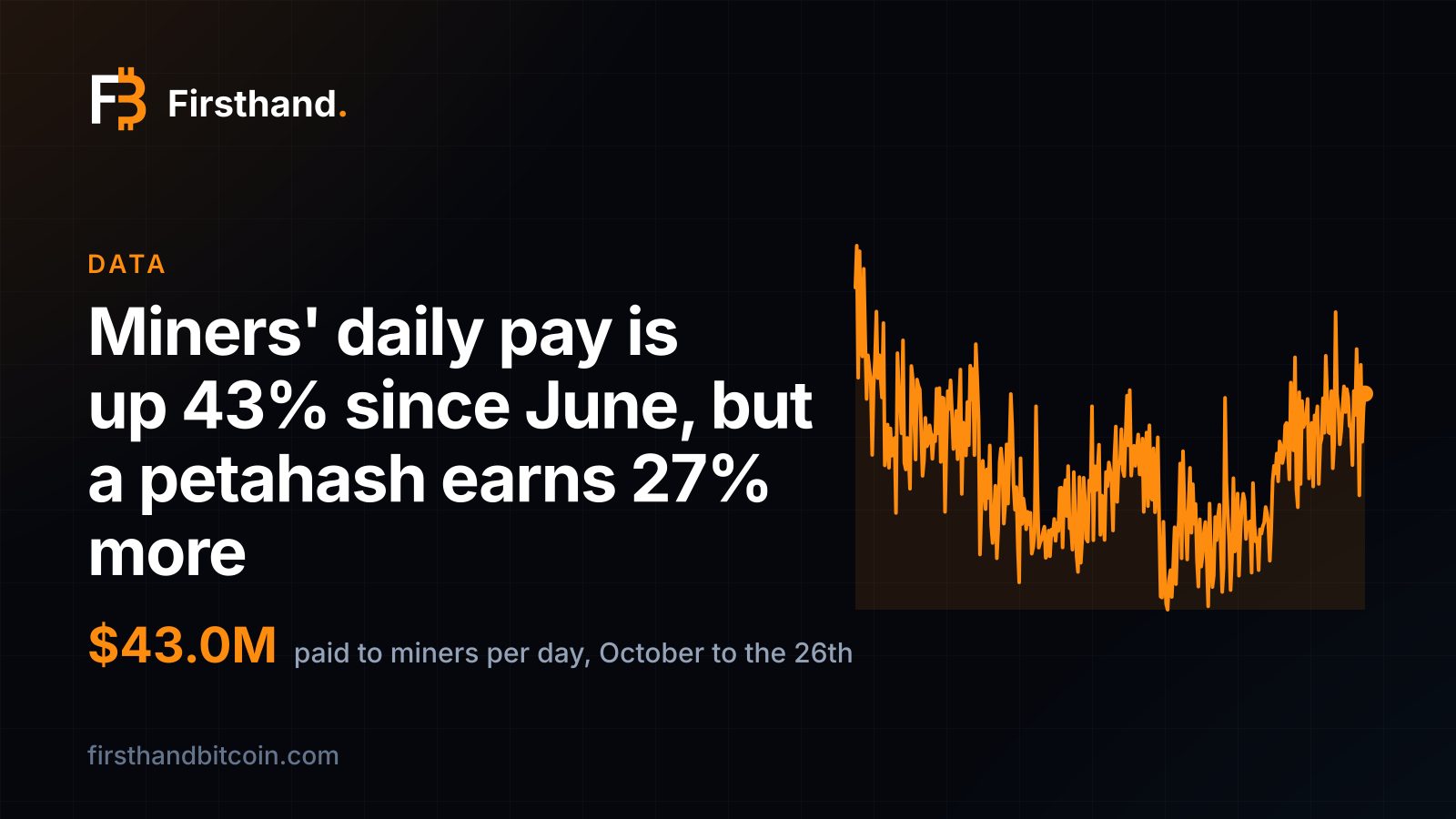
The pay pool has grown 43% since June
Our miner revenue series, the dollar value of the new coins and fees the network pays out each day, averaged $43.0 million a day from 1 to 26 October. In June it averaged $30.0 million, and the low was $23.2 million on 7 June. October is the best month since November 2025, which averaged $44.8 million.
A year ago the pool was larger still. October 2025 averaged $54.4 million a day, so this October is 21% lower, on a bitcoin price that is 27% lower: $82,886 on average against $114,290.
The price did most of it, and faster blocks did the rest
Bitcoin averaged $63,237 in June and $82,886 in October, a rise of 31%. That alone would lift the pool from $30.0 million to about $39 million.
The remainder came from coins. Blocks have arrived at 151.7 a day on average in October against 140.9 in June, so about 7% more bitcoin was issued: 476.6 a day against 443.6, counting the 3.125 coin subsidy plus fees. Blocks come faster than the 144 a day the network aims for whenever machines are added between difficulty adjustments, and the last two weeks of October have been one of those stretches.
Price lifted the pool 31%. Faster blocks added about 7% more coins.
About 10% more hashrate came back to share it
The pool grew, and so did the number of machines dividing it. Our hashrate series, an estimate drawn from how quickly blocks are found, averaged about 922 exahash a second in June and about 1,018 in October, 10% more. The 30-day average has stayed above the 60-day since 27 August, the end of the capitulation we measured on 5 October, and that is the stretch in which the machines returned.
Hashrate is the competition for a fixed number of coins. A larger pool is only good for a machine if the machines sharing it have not grown by as much.
So a petahash earns 27% more, not 43%
Hashprice is what one petahash a second of mining earns in a day. Its low this year was $27.74 on 6 June. Averaged over each month it was $30.37 in June and $38.61 in October, up 27%, against 43% for the whole pool. The gap is mostly the extra hashrate.
The peak since June was $41.31 on 22 September. On 26 October a petahash earned 0.000449 bitcoin, $35.93 at that day's close, on our hashprice chart, below the October average because bitcoin has drifted down toward $80,000 since 22 October.
Month by month, the pot stopped outgrowing the machines in October
The table shows how the two sides moved. Through September the pool grew faster than hashrate: it rose from $30.6 million in July to $40.9 million, while hashrate rose from about 900 to 944 exahash, and hashprice climbed with it. In October the pool grew 5% on September and hashrate grew about 8%, so the average hashprice slipped from $39.34 to $38.61.
That is the usual cycle in miniature. A higher price pays more per machine, more machines are switched on or plugged in until the extra pay is shared away, and the next step in difficulty makes it official. The cycle turns on how fast machines arrive, and a miner on a low power bill is paid for every coin that arrives regardless of the pace.
| Month | Pool, $M a day | Bitcoin price | Hashrate, EH/s | Hashprice, $ per PH a day |
|---|---|---|---|---|
| June 2026 | 30.0 | $63,237 | 922 | $30.37 |
| July 2026 | 30.6 | $63,709 | 900 | $31.21 |
| August 2026 | 33.9 | $69,262 | 911 | $34.63 |
| September 2026 | 40.9 | $80,390 | 944 | $39.34 |
| October 2026, to the 26th | 43.0 | $82,886 | 1,018 | $38.61 |
| October 2025 | 54.4 | $114,290 | 1,086 | $48.47 |
Nearly all of the pot is new coins, not fees
Fees are a small part of what miners are paid. Fees averaged 2.67 bitcoin a day in October against about 474 bitcoin of subsidy, 0.56% of the coins, which is why the pool tracks the price and the block count so closely. We covered that thin fee line on 29 September in Bitcoin's busiest year is paying its miners the least in a decade.
The subsidy is 3.125 bitcoin a block, and the network adjusts difficulty every 2,016 blocks so that those blocks take about two weeks. When blocks arrive faster than that, the Bitcoin developer documentation says difficulty is increased proportionally at the next adjustment. A rise of 1% in difficulty, with price and fees unchanged, takes about 1% from what a petahash earns.
A year ago a petahash earned a quarter more
In October 2025 hashprice averaged $48.47 and hashrate about 1,086 exahash. This October it averages $38.61, 20% lower, on 6% less hashrate and a price 27% lower. The network is paying a smaller pot to nearly as many machines.
That comparison is the reason the efficiency of a machine matters more now than it did at the top. The pot per petahash is what it is; the electricity a machine burns to claim its share is the part a miner chooses.
What it means for a miner
The pot per petahash is up from June and below last month. Our difficulty page estimates the next adjustment at about +6.4%, which would divide the same coins among more hashrate. A machine earns the coins the network pays out, and the coins kept are the ones that count.
On the 8.9 J/TH Antminer S23 XP Hyd, electricity at Nigeria's 3.9¢ makes a bitcoin for about $18,554, 23% of the $79,587 price on 27 October. That is electricity only, at today's hashprice, and output is not guaranteed. When the pool is shared among more machines, the machine with the lowest power bill per coin is the one that still earns a margin.
The pool grew 43%. The machines sharing it grew 10%. The power bill per coin is the part you choose.
Sources and further reading
- Block Chain (Developer Guide) — Bitcoin.org Developer Documentation, Accessed 27 Oct 2026
Disclosure
Firsthand Bitcoin sells and hosts mining hardware, including this machine. No manufacturer, distributor or affiliate programme paid for or reviewed this page and we take no commission on the links above. Historical figures are computed from daily bitcoin price and network hashprice, each day valued at its own prices. Nothing here is investment advice.