Data insight · Oct 5, 2026 · 6 min read
Miners spent 219 of the last 365 days switching machines off, the most in our record
When the network's 30-day hashrate average sits under its 60-day average, miners are turning machines off faster than new ones arrive. That happened on 219 of the last 365 days, the most of any 365 days in our record. It ended on 27 August, and the machines that stayed on now earn about 17% more coins.
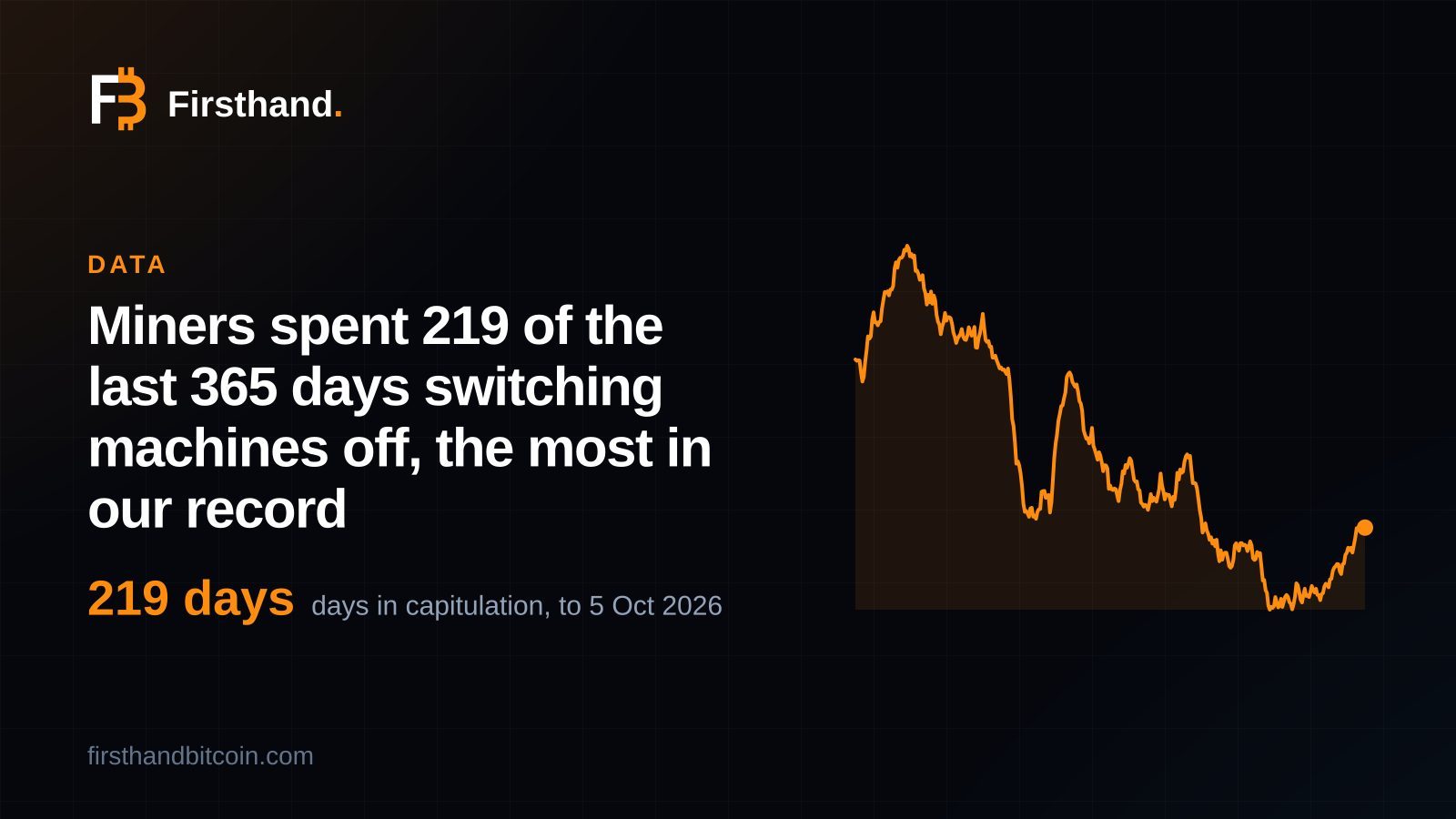
Miners were switching off for 219 of the last 365 days
Every day the network's hashrate is an estimate, and a noisy one: it can read 869 exahashes a second on a Sunday and 1,088 on the Tuesday before. Averaging smooths that out. The hash ribbon, which Charles Edwards of Capriole published as a TradingView indicator in October 2019, compares two averages: the last 30 days against the last 60. When the 30-day average falls under the 60-day one, hashrate is shrinking, and that is what is called miner capitulation.
On our hash ribbons chart the 30-day average sat under the 60-day one for 219 of the 365 days to 5 October 2026, counting only stretches of ten days or more. No other 365-day window in our record, which starts in 2013, has more. The calendar years with the most were 2022, with 104 days, and 2020, with 100. In 2026 so far it is 187 days.
Six separate capitulations in ten months
It was not one long fall. The ribbon went under on 30 November 2025 and stayed there for 35 days, recovered on 4 January for two days, and went under again on 6 January for 52 days, until 27 February. Then came 44 days from 28 March to 11 May, ten days from 14 to 24 May, 43 days from 9 June to 22 July, and a last one of 35 days from 23 July to 27 August.
Each recovery looked like the end and was not. The 30-day average crossed back above the 60-day on 27 August and, 39 days later, has stayed there. In 2022 there were three capitulations in the whole year.
About 15% of the network left, and 75 exahashes of it was a choice
The 30-day average peaked at 1,110 exahashes a second on 12 November 2025, on our hashrate chart. It bottomed at 897 on 29 July 2026, 19% lower, and stands at 945 now, 15% below the peak and 5% above the low. Difficulty follows it: at 132.7 trillion it is 14.9% under the 29 October 2025 record, a gap we followed in an earlier piece.
Some of that was machines that no longer paid. Some was a decision. A survey of 12 listed mining companies, reported by MetaEra and republished by KuCoin on 4 October, found they cut $1.5 billion of mining equipment investment and 75 exahashes of realised hashrate in the first half of 2026, with the power redirected to AI infrastructure. Seventy-five exahashes is about 8% of today's network.
The machines that stayed on earn about 17% more coins
Fewer machines sharing the same block rewards means each one earns more. On 12 November 2025 a petahash of hashrate earned 40,766 satoshis a day on our hashprice in sats chart. On 4 October 2026 it earned 47,654, 17% more. That matches the arithmetic: a network 15% smaller leaves each remaining machine about 17% more of the same rewards.
The dollar figure moved the other way, because bitcoin is lower. Hashprice was $52.22 a petahash a day on 6 October 2025, the day of the all-time high in our series, and $40.38 on 4 October 2026. A miner who counts in dollars lost 23%. A miner who counts in bitcoin gained 14% on that same comparison, from 41,946 satoshis to 47,654, because the network got smaller while the subsidy per block stayed the same.
A smaller network pays each machine that stays on about 17% more coins.
What the ribbon says about price is mixed
The ribbon is better known as a price signal than a mining one: the crossing back above is read as a buy signal, and its publisher's page claims big average returns to each cycle's peak. Our series says something more modest. Since January 2019 the 30-day average has recovered above the 60-day 17 times that left 90 days of data after it. Bitcoin was higher 90 days later in 10 of them, and the median change was +1.8%. The best was +143% after 3 December 2020. The worst was -26.5% after 4 January 2026.
The latest six recoveries, from July 2024 to May 2026, split three up and three down. Bitcoin is 6.5% higher than it was on 27 August, at $84,744 on 4 October. The ribbon has told us a lot about miners, and much less about what bitcoin does next.
What it means for a miner
Some of the miners who left did so because their power cost more than their machines earned, and some because it was worth more elsewhere. The ones who stayed on made more coins per machine for it, and kept making them while the dollar hashprice fell. That is the case for running efficient machines on cheap power through a bad year rather than switching off: the coin you mine is the one you keep.
The comparison is the same today as it was at the bottom. The most efficient machine in stock on our cheapest power makes a coin for about $18,000 in electricity, against a market price near $86,500. Hashprice is $41.22 a petahash a day and difficulty is 15% under its record, so a machine bought now starts at the better end of the network's economics. Output is never guaranteed, and the ribbon can go under again.
When machines leave, the ones that stay on earn their share. Cheap electricity is what lets them stay.
Sources and further reading
- Hash Ribbons (indicator by capriole_charles) — TradingView, 30 Oct 2019
- Listed Bitcoin mining firms cut $1.5B in miner investments in H1 2026 — KuCoin, from MetaEra, 4 Oct 2026
Disclosure
Firsthand Bitcoin sells and hosts mining hardware, including this machine. No manufacturer, distributor or affiliate programme paid for or reviewed this page and we take no commission on the links above. Historical figures are computed from daily bitcoin price and network hashprice, each day valued at its own prices. Nothing here is investment advice.