Guide · Oct 27, 2026 · 6 min read
What a bitcoin miner's power modes do, and whether high-performance mode pays
Many miners offer a normal mode, a lower one and a higher one. The higher one adds hashrate but burns far more power for every extra terahash. One sum with two numbers tells you whether it pays at your power price. In the worked example, on 26 October's hashprice, it did not.
A power mode is a setting that trades watts for hashrate
Most mining machines can run at more than one speed. Normal is the factory setting: the hashrate and wattage on the spec sheet. Low turns the machine down, so it draws fewer watts and finds fewer hashes. High turns it up, so it draws more watts and finds more. Some machines also have a sleep setting that stops hashing without switching the machine off.
Braiins' documentation for stock firmware lists exactly those four: Normal as the "Default factory mode", High as "Overclock mode (limited support)", Low as "Downclock mode (limited support)" and Sleep, which "Halts hashing". It adds that some modes may not be available for every model, and the unsupported ones are hidden. Which of them your machine has depends on the model and on its firmware.
If you have not yet met the spec-sheet numbers, the guide to the spec sheet explains the hashrate, wattage and J/TH that the modes change.
Normal is what almost everyone runs
Bitcoin Magazine put it plainly in a 2022 article on the factors miners weigh beyond the power price: "The vast majority of the time miners will choose to run their machines in normal mode". It describes normal mode as the setting that most closely matches the machine's rated hashrate at its stated wattage.
The same article gives the reason a miner might turn down: "during times of high heat it becomes preferable to run your machines in low mode", because lowering the wattage "gives an additional ambient temperature buffer to the hash boards". A lower mode is a way to take heat off the machine on a hot day. A higher mode puts heat on, and a machine that is already in a warm hall has less room to take it.
The hashrate and wattage on a spec sheet are normally given for normal mode, so a machine in another mode will not read the number on it. The guide to why a miner reads lower than its spec sheet covers the other reasons it may.
The sum that decides it: watts for each extra terahash
A mode pays if the money earned by the extra hashrate is more than the money spent on the extra power. You need two numbers. The first is how many extra joules each extra terahash costs, which you get by dividing the extra watts by the extra terahashes. The second is the break-even for your power price: hashprice divided by 24 hours times your rate in dollars per kilowatt-hour.
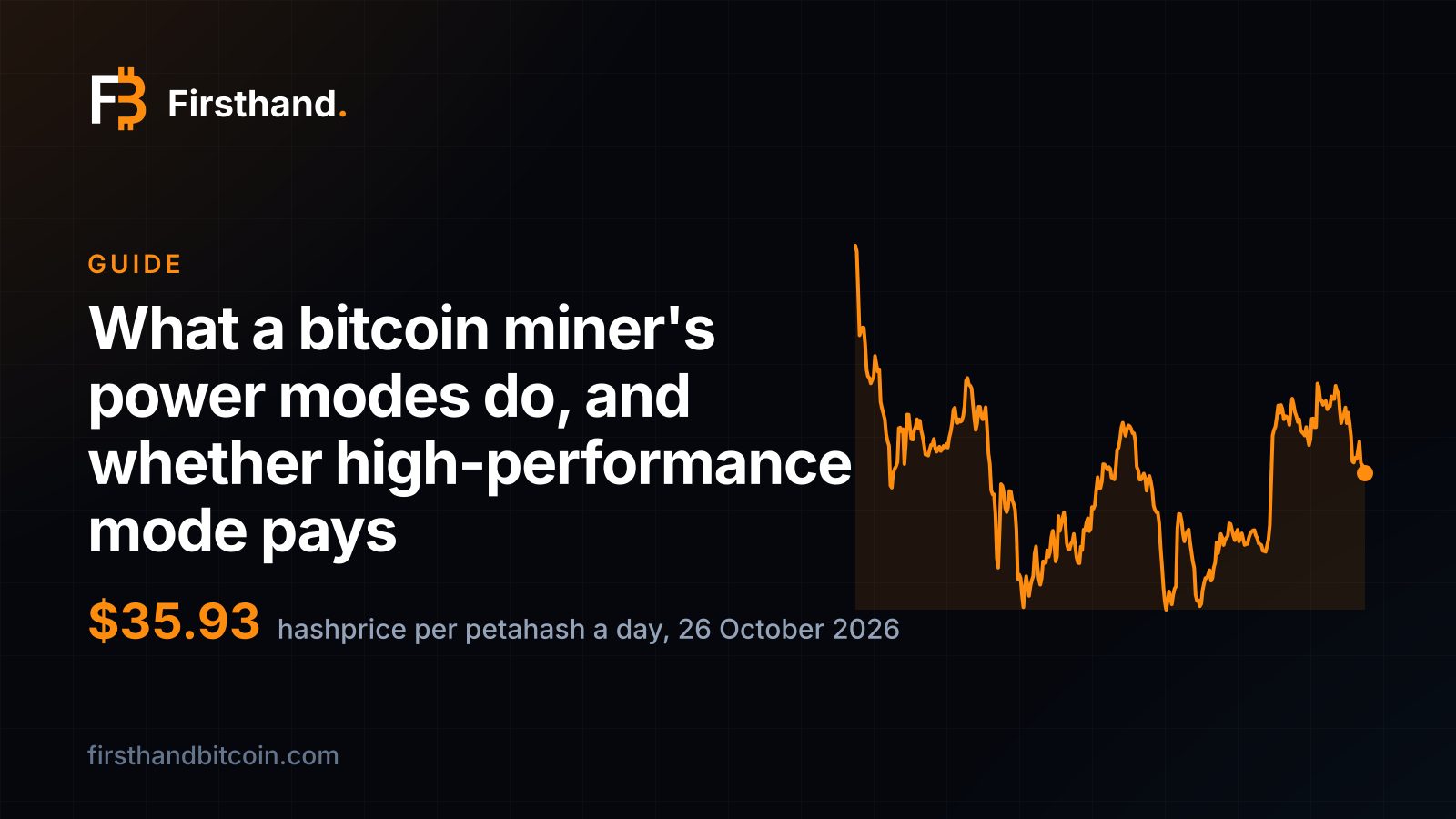
Hashprice is what one petahash a second earns in a day, which the guide to hashprice explains. On our hashprice chart it was $35.93 per petahash per day on 26 October. At 6¢ a kilowatt-hour the break-even is about 25 joules per terahash. At 3.9¢ it is about 38. If every extra terahash costs more joules than that, the extra hashrate costs more to run than it earns.
Normal-mode efficiency is not the number to use. A machine at 20 J/TH in normal mode may need 40 J/TH or more for the extra terahashes in high mode, because the last bit of speed is the most expensive, and that is the figure the break-even is tested against.
A worked example: high mode at 6¢ and at 3.9¢
Take a made-up machine, to show the sum. In normal mode it runs 200 TH/s from 4,000 W, which is 20 J/TH. In high mode it runs 220 TH/s from 4,800 W. The extra is 20 TH/s for 800 W, so each extra terahash costs 40 joules, twice what the machine costs in normal mode.
At $35.93 a petahash a day, the extra 20 TH/s earns about $0.72 a day. The extra 800 W is 19.2 kilowatt-hours a day, which costs $1.15 at 6¢ and $0.75 at 3.9¢. At 6¢ the extra hashrate costs 43 cents a day more than it earns. At Nigeria's 3.9¢ it comes out 3 cents a day short, before counting the extra heat and wear. In both cases the machine is better left where the factory put it.
Real machines differ, and the curve of watts against hashrate has a different shape on each model. The example is not a measurement of any machine. It shows the question to ask of any mode: what does the next terahash cost, against what it earns?
Ask what the next terahash costs, not what the average terahash costs.
Low mode can pay, and only at some power prices
The same sum runs the other way. Say low mode takes the example machine to 180 TH/s from 3,400 W. That gives up 20 TH/s and saves 600 W, 30 joules for every terahash given up. The hashrate it gives up would have earned about $0.72 a day. The 14.4 kilowatt-hours a day it saves are worth $0.86 at 6¢ and $0.56 at 3.9¢.
At 6¢ the lower mode is 14 cents a day ahead. At 3.9¢ it is 16 cents a day behind. The same setting pays at one power price and costs at the other, and the break-even figures from the last section are why: 30 joules is over the 25 break-even at 6¢ and under the 38 at 3.9¢.
None of that makes low mode a free gain. The coins you do not find do not come back, and hashprice moves every day. It is a reason a host may turn machines down in a hot spell, and the reason the right mode is a decision about your power price and not a rule.
What else a higher mode changes
More watts is more heat. In an air-cooled hall that means hotter exhaust and louder fans. In a water-cooled one it means more heat for the loop to move. A machine that ran in a cool hall in January may not have the room in July, which is the argument for leaving the margin alone. Low mode's temperature buffer, in the Bitcoin Magazine article, is the same fact seen from the other side.
Running hot is also hard on a machine's parts. The guide to how long a miner lasts explains what ends a working life. A higher draw also needs a supply that can carry it.
Finally, "limited support" is Braiins' own phrase for High and Low on stock firmware. The modes are real, but the machine's own firmware may offer fewer steps than a third-party one does, and not all of them on every model.
What to do as a new owner
Start in normal mode, and compare your machine's hashrate with the spec-sheet figure for that mode. If you buy a machine to host, ask your host two things: which mode the machine will run in, and who is allowed to change it. The guide to how hosting works lists what a host looks after.
If you ever want to test another mode, run the sum above with your own numbers: the extra watts, the extra terahashes, your rate and the day's hashprice. If the extra terahashes cost more joules than hashprice divided by 24 times your rate, leave the mode alone. If you are thinking about how much electricity a machine uses at all, the guide to power and profit is the place to start.
What it means for a miner
Normal mode is the efficiency the maker rated, and it is where the machine is at its best for most power prices. On the figures of 26 October, a mode that adds hashrate at 40 joules a terahash does not pay at 6¢ and only just breaks even at Nigeria's 3.9¢.
The better lever is the one set when you choose a machine and a site: a low joules-per-terahash figure and a low power price, which is why on the best machine in stock, the 8.9 J/TH Antminer S23 XP Hyd, electricity at Nigeria's 3.9¢ makes a bitcoin for about $18,554, 23% of the $79,587 price on 27 October. That is electricity only, at today's hashprice, and output is not guaranteed.
A mode that adds hashrate at 40 joules a terahash does not pay at 6¢.
Sources and further reading
- Managing Miner Performance in Braiins Manager — Braiins Academy, 2026
- Beyond The kWh: Factors That Bitcoin Miners Need To Consider — Bitcoin Magazine, 15 Jul 2022
Disclosure
Firsthand Bitcoin sells and hosts mining hardware, including this machine. No manufacturer, distributor or affiliate programme paid for or reviewed this page and we take no commission on the links above. Historical figures are computed from daily bitcoin price and network hashprice, each day valued at its own prices. Nothing here is investment advice.