Home / Blog / MicroBT Whatsminer M60S
Field report · Oct 4, 2026 · 4 min read
Two years with the Whatsminer M60S, and a successor that needs nearly a fifth less power
MicroBT unveiled the M60S in October 2023. We bought one in June 2024, two months after the halving, and it has run at 18.5 J/TH since. Here is what it kept, what a coin costs it today, and what each later bin of the line buys.
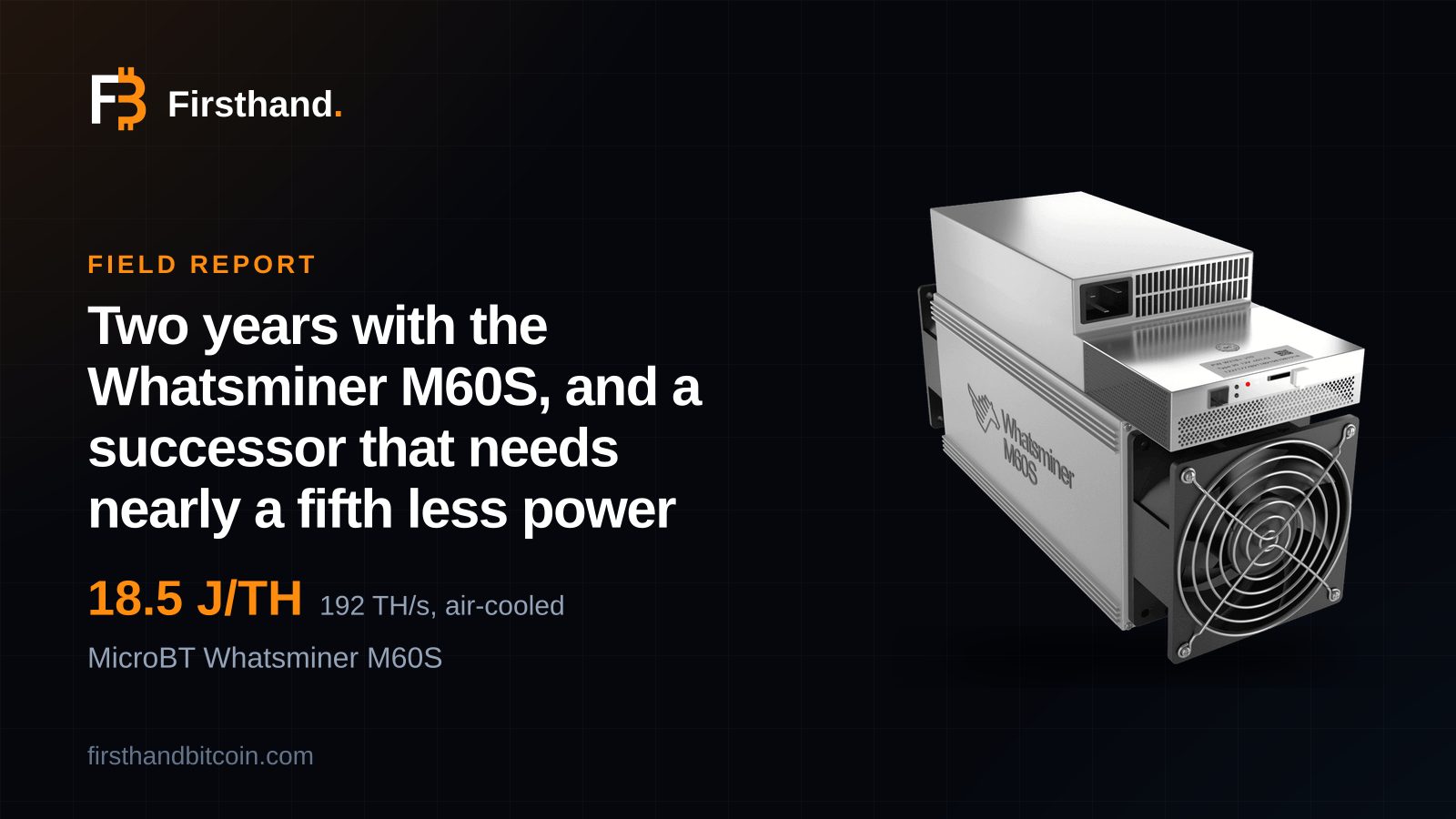
MicroBT Whatsminer M60s (192 TH/s)
Unveiled in October 2023, bought in June 2024, two months after the halving
MicroBT unveiled the M60S on 26 October 2023 at Blockchain Life in Dubai: the air-cooled step above the M60, at 170 to 186 TH/s and 18.5 J/TH against the M60's 19.9. The M60S family page lists bins up to 192 TH/s. Ours is that one, drawing 3,552 W.
We bought it on 19 June 2024 at $3,568 and landed it in Argentina for $5,338, 50% more than the machine alone, which is the usual gap between the price of a miner and the price of the box. Our price record for it starts that day, so this is the story of June 2024 onward, not of the launch.
It began hashing two months after the April 2024 halving. The Whatsminer M60 reached our floor six weeks after it and had the same experience: a sound machine arriving into the least forgiving market a new one could meet.
A machine that starts hashing after the halving has no cheap months to bank. It has to earn everything at the new subsidy.
What it was like to own: nothing we could open and quote
The only Bitcointalk thread on the M60S that we could find is its launch thread: four posts in October 2023, with the specifications, a question about the launch event and a request to test one. No owner reports a failure or a month of running.
So its failure record is unknown, and we score it as unknown rather than good. MicroBT's own shop lists a one-year warranty on the M60S++, in the same 430 by 155 by 226 mm case the catalogue gives every M60S bin.
What a fault costs here is a parts bill: repairs at our Argentina site are billed at the cost of the parts and nothing else, which makes a board failure a line item, not a catastrophe.
Argentina for 761 days, then Nigeria on 20 July 2026
It spent 761 days in Argentina at 6¢, the whole of its time after the halving up to the crossing. On 20 July 2026 it went to Nigeria, the one move it will make, and it has run there for 77 days.
The crossing matters most to a machine at this efficiency. Today a coin costs it about $38,100 in electricity in Nigeria and $58,600 in Argentina, with bitcoin at $85,199. A unit racked in Nigeria would return about 39% in its first year, against 29% in Argentina.
At 18.5 J/TH, the site does more of the work than the machine does.
The tally: 0.0837 BTC kept for $4,232 of electricity
In 838 days it has mined and kept 0.0837 BTC, worth $7,072 today. Averaged over its whole run a coin cost $50,600 in electricity. That lifetime figure carries two years at 6¢, so the number to plan on is today's $38,100 at the Nigeria rate.
Valued at today's price, the coins less every dollar of power come to $2,840 of cashflow, 53% of the $5,338 landed cost. Between now and the April 2028 halving it has about 0.038 BTC still in it at today's difficulty, worth roughly $4,742 with bitcoin back at its previous high of $124,493. That high is an assumption, not a forecast. It puts the machine at 1.4× its hardware by the halving, still hashing.
What each step up the line bought
The M60 ran at 19.9 J/TH and the M60S at 18.5. The M60S+ followed in July 2024 at 17 J/TH, and the M60S++ was unveiled in December 2024 at 15.5. TheEnergyMag reported a tested M60S++ at 218 TH/s and 15.57 J/TH.
In Nigeria today a coin costs the M60S about $38,100. The M60S+ in its 204 TH/s bin makes it for $35,000 and lists at $1,778, $8.72 a terahash. The M60S++ in its 226 TH/s bin, rated 15 J/TH, makes it for $30,900 and lists at $2,136, $9.45 a terahash. The M60S's own last price was $1,512, $7.88 a terahash.
First-year returns at today's price sit within a few points of each other: 39% for the M60S, 39% for the M60S+ and 41% for the M60S++. What the later bins add is more coins from every kilowatt-hour for longer. At 15 J/TH a terahash draws about a fifth less power than at 18.5, and efficiency is what decides how many halvings a machine survives.
Every step cut the electricity in a coin. Every step also raised the price of a terahash.
- MicroBT Whatsminer M74S+ (332 TH/s) — 12 J/TH, In stock, $37,982 of electricity per bitcoin, 36% year one
- MicroBT Whatsminer M73S (560 TH/s) — 13 J/TH, In stock, $41,147 of electricity per bitcoin, 42% year one
- MicroBT Whatsminer M7DS (672 TH/s) — 13.5 J/TH, In stock, $42,729 of electricity per bitcoin, 44% year one
What it means for a miner
The output of this machine has not changed in 838 days. What changed is the entry price: its last price, $1,512, is the best entry it has had, though it is sold out now and the M60S+ and M60S++ are the bins on the shelf. The M60S price history and profitability pages hold its month-by-month figures.
If you own one, keep the coins: nobody sells them to pay the power bill. If you are buying, buy for the halving in front of you. The later bins make the same coin on less electricity, and the cheaper the power, the more of that difference you keep.
Sources and further reading
- MicroBT debuts WhatsMiner M60 series in Dubai — GlobeNewswire, 26 October 2023
- The new M60s Whatsminer — Bitcointalk, October 2023
- WhatsMiner M60S++ product page — MicroBT shop, October 2026
- Review: WhatsMiner M6XS++ Targets 15.5 J/TH — TheEnergyMag, 9 December 2024
Which machines this covers
- MicroBT Whatsminer M60s (192 TH/s)
- MicroBT Whatsminer M60s (190 TH/s)
- MicroBT Whatsminer M60s (188 TH/s)
- MicroBT Whatsminer M60s (184 TH/s)
Disclosure
Firsthand Bitcoin sells and hosts mining hardware, including this machine. No manufacturer, distributor or affiliate programme paid for or reviewed this page and we take no commission on the links above. Historical figures are computed from daily bitcoin price and network hashprice, each day valued at its own prices. Nothing here is investment advice.