Home / Blog / MicroBT Whatsminer M61S
Progress report · Oct 5, 2026 · 3 min read
A year in, the Whatsminer M61S has crossed to Nigeria, the rate that carries it to the halving
At 18.5 J/TH the Whatsminer M61S needs a hashprice near $27 to cover its power at 6¢, and 2026 took hashprice to within $1.10 of that. It was never switched off, and after a year in Argentina it crossed to cheaper power. Here is what it has banked and what the forward figures say.
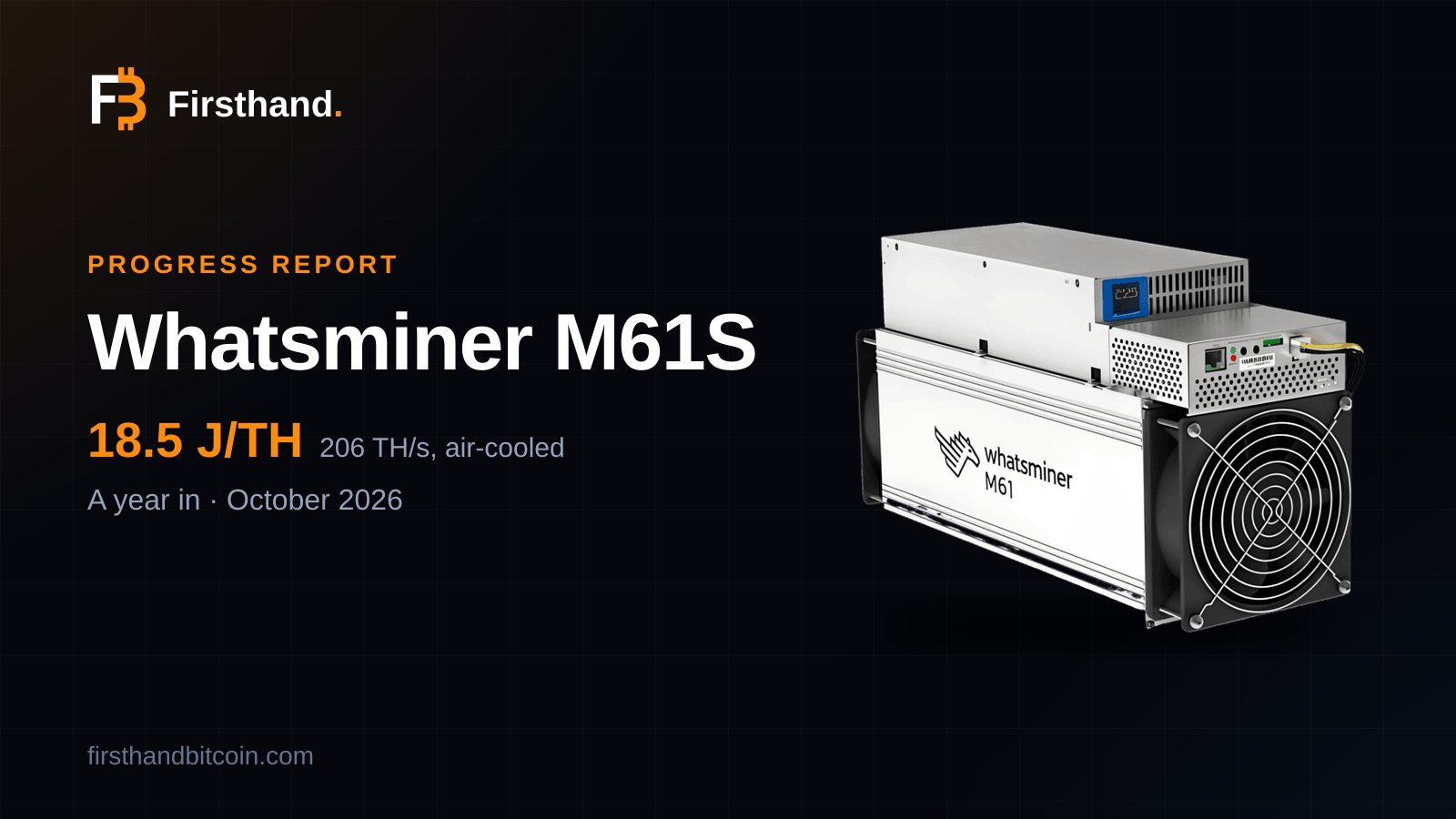
MicroBT Whatsminer M61S (206 TH/s)
A year and a few weeks in
The Whatsminer M61S is an air-cooled MicroBT machine; the unit we list is 206 TH/s from 3,811 W, which is 18.5 J/TH, and our store record dates its announcement to December 2024. Bought at the first price we hold for it, $2,596 in July 2025, and landed at $4,075 at our Argentina site, it has now run 435 days.
In that time it has mined and kept 0.0390 BTC, worth $3,308 today, for $2,266 of electricity: about $58,100 a coin over its whole run, a lifetime average that includes the weeks before the crossing. That is $1,042 of cashflow, or 26% of what it cost to land, under a third of the way through a four-year life.
Never switched off, though June came close
At 18.5 J/TH a petahash uses 444 kWh a day, which is $26.64 at 6¢. Hashprice was $58.93 a petahash a day on 28 July 2025, when the machine was bought. The low on the hashprice chart was $27.74 on 6 June 2026, $1.10 above the machine's line at 6¢.
Our engine switches a machine off when its trailing month at its current site would lose money, and it never did here. A machine that is switched off keeps every coin it has already mined, and this one did not need to stop. It had the margin, narrowly, in the worst month for hashprice in our record.
In the worst hashprice month on record, the M61S's power line at 6¢ was $1.10 below it.
It crossed to Nigeria on 27 July 2026
After 364 days in Argentina it made the one move every machine we host makes: on 27 July 2026 it went to Nigeria, where power costs 3.9¢ instead of 6¢. The rule is a trailing year in which cheap power is decisively better, and a year after it was bought, with bitcoin at $64,973 on the day it moved, the year said so. It has spent 71 days there since.
Nigeria's uptime is lower than Argentina's, 73.6% against 98.7% on our sites page, so it mines fewer coins a day. It also pays 35% less for the power. Today a coin costs this machine about $38,100 in Nigeria against $58,600 in Argentina, and its first-year return at today's price is about 46% against 35%. The guide to crossing once explains why it is made only once.
What is left in it
At today's difficulty, and with bitcoin back at its previous high of $124,493, it has another 0.041 BTC in it before the April 2028 halving, worth about $5,064. That would leave it at roughly 1.5× its landed cost covered by the halving, and still running.
The halving is where the crossing earns its keep. Network hashprice was $40.38 on 4 October, and halved at an unchanged price and difficulty it would be near $20.19. That is below this machine's $26.64 line at 6¢ and above its $17.32 line at 3.9¢, with break-even at about 4.5¢. At 18.5 J/TH it is a Nigeria machine from here on, which is where it is.
It is not the machine we would point a new buyer at for a 6¢ site today. But at $1,276 a unit, $6.19 a terahash, against $2,596 when we first held a price for it, it is a proven machine at a settled price. How efficiency decides how many halvings a machine survives shows where the line sits.
- MicroBT Whatsminer M74S+ (332 TH/s) — 12 J/TH, In stock, $38,042 of electricity per bitcoin, 36% year one
- MicroBT Whatsminer M73S (560 TH/s) — 13 J/TH, In stock, $41,212 of electricity per bitcoin, 43% year one
- MicroBT Whatsminer M70S (260 TH/s) — 13.5 J/TH, In stock, $42,797 of electricity per bitcoin, 36% year one
Which machines this covers
Disclosure
Firsthand Bitcoin sells and hosts mining hardware, including this machine. No manufacturer, distributor or affiliate programme paid for or reviewed this page and we take no commission on the links above. Historical figures are computed from daily bitcoin price and network hashprice, each day valued at its own prices. Nothing here is investment advice.