Home / Blog / 12 November 2026
News · Nov 12, 2026 · 4 min read
Bitcoin today: MSCI drops Strategy from its indexes, and difficulty is set for a 7% cut
The largest listed holder of bitcoin leaves the world's most tracked equity indexes at the end of the month, under a rule that never mentions bitcoin. Bitcoin closed at its lowest since August, Germany's biggest bank began holding BTC for clients, Russia opens exchange trading on Monday, and the network is about to pay every petahash 8% more.
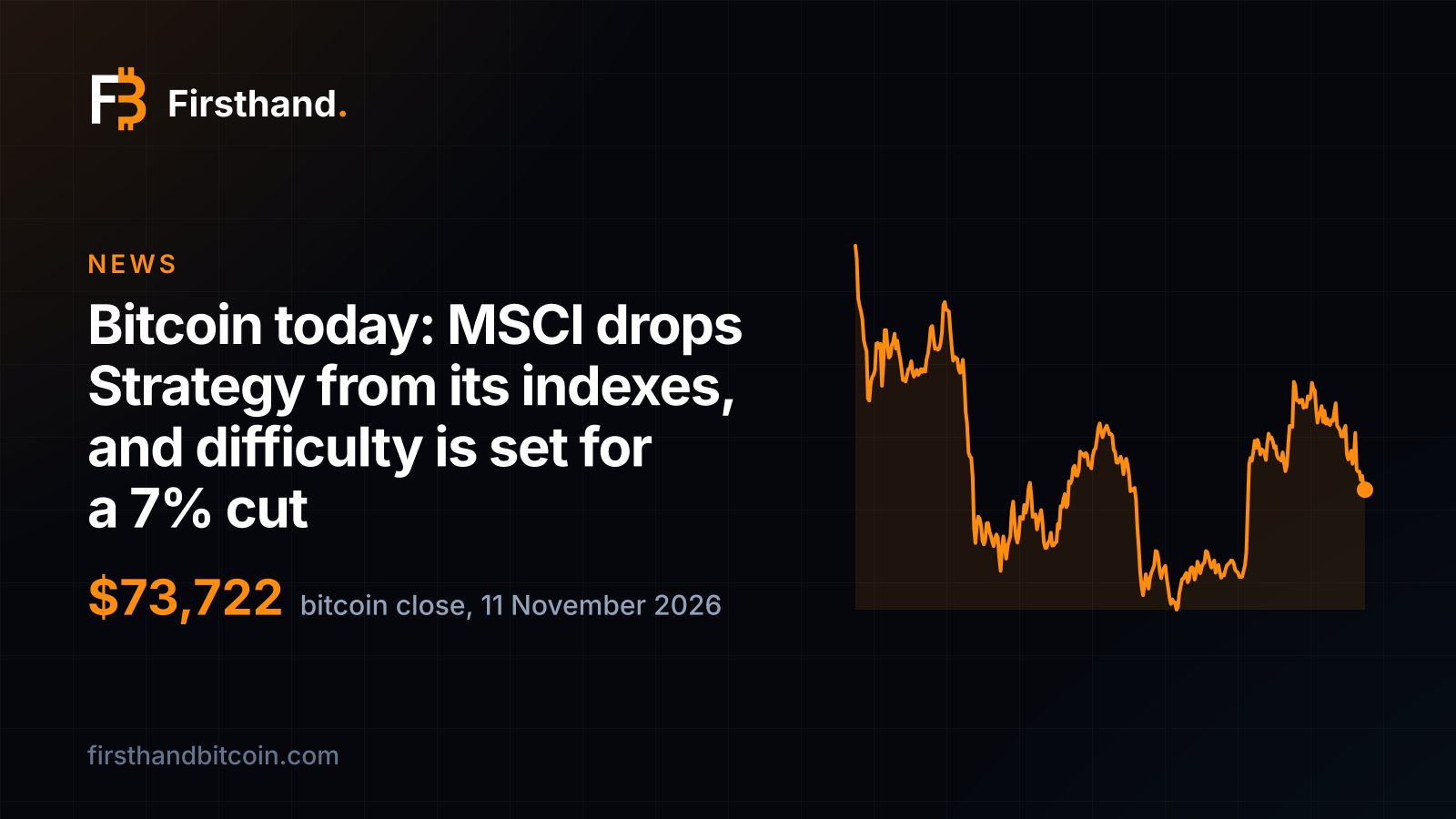
MSCI removes Strategy from its indexes at the close of 30 November
MSCI published the results of its November index review on Wednesday evening, and Strategy, the company that holds 850,364 bitcoin, is being deleted from the MSCI USA Index. Because the USA index feeds the MSCI World and ACWI indexes, it leaves those too. The change takes effect at the close of 30 November, as MSCI set out when it adopted the rule on 15 October.
The rule is a two-step screen for what MSCI calls non-operating companies. A company is first tested on whether it has substantial operating assets. One that fails is then checked against five financial ratios, and is out if it is flagged on four or more. The same screen removed Metaplanet in Japan, the uranium holder Yellow Cake in the UK, Skel in Iceland and Upexi in the US micro-cap index, Bitcoin Magazine reported.
What it forces is narrower than the headlines suggest. Funds that track MSCI's global indexes hold about 13 million Strategy shares, 3.1% of the company, according to the consultation response CoinDesk cites. Those have to be sold by the end of the month. The $2.8 billion outflow figure JPMorgan published a year ago was an estimate for MSCI's first, bitcoin-specific proposal, not the rule adopted. Nothing in the decision delists the stock or obliges Strategy to sell one BTC. "This outcome has been widely expected, so most of it is already priced in," Markus Thielen of 10x Research told CoinDesk.
The rule never mentions bitcoin. It asks whether a company has operating assets, and Strategy does not.
Bitcoin's lowest close since August as the December hike firms up
Bitcoin closed at $73,722 on 11 November, down 2% on the day and the lowest close on our price chart since 20 August. It was at $73,537 this morning, 15% below the $86,488 close of 5 October.
The pressure is the same as yesterday's: October's consumer prices rose 0.4% on the month and 0.3% excluding food and energy, both a tenth hotter than forecast, in a Bureau of Labor Statistics release that carries no 12-month figures because October 2025 was never collected during the shutdown. CME futures put the odds of a quarter-point rise on 9 December at about 89%, with a small chance of half a point, Investing.com reported, after two Fed officials called for higher rates.
The money keeps leaving the spot ETFs. Our flows chart shows net outflows on seven of the eight trading days from 30 October to 10 November, $2.2 billion in all, and the funds hold about 21,000 fewer bitcoin than they did on 28 October. The Fear & Greed Index read 29 on Wednesday, fear.
Deutsche Bank starts holding bitcoin for institutions
Deutsche Bank's digital asset custody service took its first paying clients on Wednesday, Decrypt reported, under an authorisation from BaFin, the German regulator, within the EU's MiCA framework. The bank holds the wallets and private keys for institutional and corporate clients in Europe, and for now the service covers custody and transfers only.
It starts with bitcoin, ether and three stablecoins, USDC, EURC and EURAU, the list the bank announced in September when it said it would go live this year once the regulatory steps were done.
Russia opens exchange trading of bitcoin on Monday
The Bank of Russia's ordinance on cryptocurrencies for ordinary investors takes effect on 17 November, the central bank said on 6 November. From that day bitcoin, ether and USDT can be traded publicly on Russian exchanges, chosen as the only assets that met the law's tests on market value, daily volume and at least five years of price history abroad.
Retail investors buy through brokers, trust managers or licensed crypto exchange offices, capped at 300,000 roubles a year per intermediary, and must pass a test first. Qualified investors have no limit.
Difficulty is set for a 7% cut, the largest since June
Blocks have been slow. The seven-day average of network hashrate on our hashrate chart has fallen from 1,081 EH/s on 27 October to 938 EH/s this morning, about 13% in two weeks, as machines that only cleared their power at $80,000 bitcoin went quiet. With 217 blocks left in the period, the next adjustment is on course for a cut of about 7.4%, which would be the largest since the 10.1% cut of 14 June.
Our piece on Monday expected a 6% cut; the week since has made it bigger. In bitcoin terms a petahash earns 0.000427 BTC a day today; after a 7.4% cut it earns about 8% more. In dollars, hashprice is about $31 per petahash a day, down from $36 at the end of October, because the price fell faster than the network did.
What it means for miners
An index rule that forces the sale of 3.1% of one company's shares does not change what a block pays. The number that does is a few days away: a 7% difficulty cut hands every machine still running about 8% more bitcoin for the same electricity, and the machines that caused it by switching off were the least efficient on the network. That is the usual shape of a drawdown, and it is why efficiency decides how many of these a machine survives.
At today's hashprice the most efficient machine in stock, the Antminer S23 XP Hyd at 8.9 J/TH, makes a bitcoin for about $19,500 of electricity at our Nigeria site, against about $73,600 to buy one. After the cut that cost falls again. Lower prices are when efficient machines on cheap power stack the most BTC. Output is not guaranteed, and the BTC are worth whatever bitcoin is on the day you choose to sell them.
Sources and further reading
- MSCI announces results of the consultation on the eligibility of non-operating companies in the MSCI Global Investable Market Indexes — MSCI, 15 Oct 2026
- MSCI dumps Strategy, putting its bitcoin-buying model on the line — CoinDesk, 12 Nov 2026
- MSCI removes Strategy (MSTR) from its USA Index, forcing index funds to sell by Nov. 30 — Bitcoin Magazine, 11 Nov 2026
- Consumer Price Index – October 2026 — Bureau of Labor Statistics, 10 Nov 2026
- Bitcoin weakens to $73.6k as hot CPI data spurs rate hike bets — Investing.com, 11 Nov 2026
- Deutsche Bank goes live with crypto custody after a five-year buildup — Decrypt, 11 Nov 2026
- Deutsche Bank to launch digital asset custody solution for institutional and corporate clients — Deutsche Bank, 16 Sep 2026
- Bank of Russia approves the list of cryptocurrencies available to non-qualified investors — Bank of Russia, 6 Nov 2026
Disclosure
Firsthand Bitcoin sells and hosts mining hardware, including this machine. No manufacturer, distributor or affiliate programme paid for or reviewed this page and we take no commission on the links above. Historical figures are computed from daily bitcoin price and network hashprice, each day valued at its own prices. Nothing here is investment advice.