Data insight · Nov 12, 2026 · 4 min read
The ETFs sold 21,000 bitcoin in a fortnight, three and a half times what miners made
Between 28 October and 11 November the US spot bitcoin ETFs let go of 21,013 BTC, while the whole network mined about 5,900. The run is a third the size of May’s, and it lands two days before a difficulty cut that pays a petahash 8% more BTC.
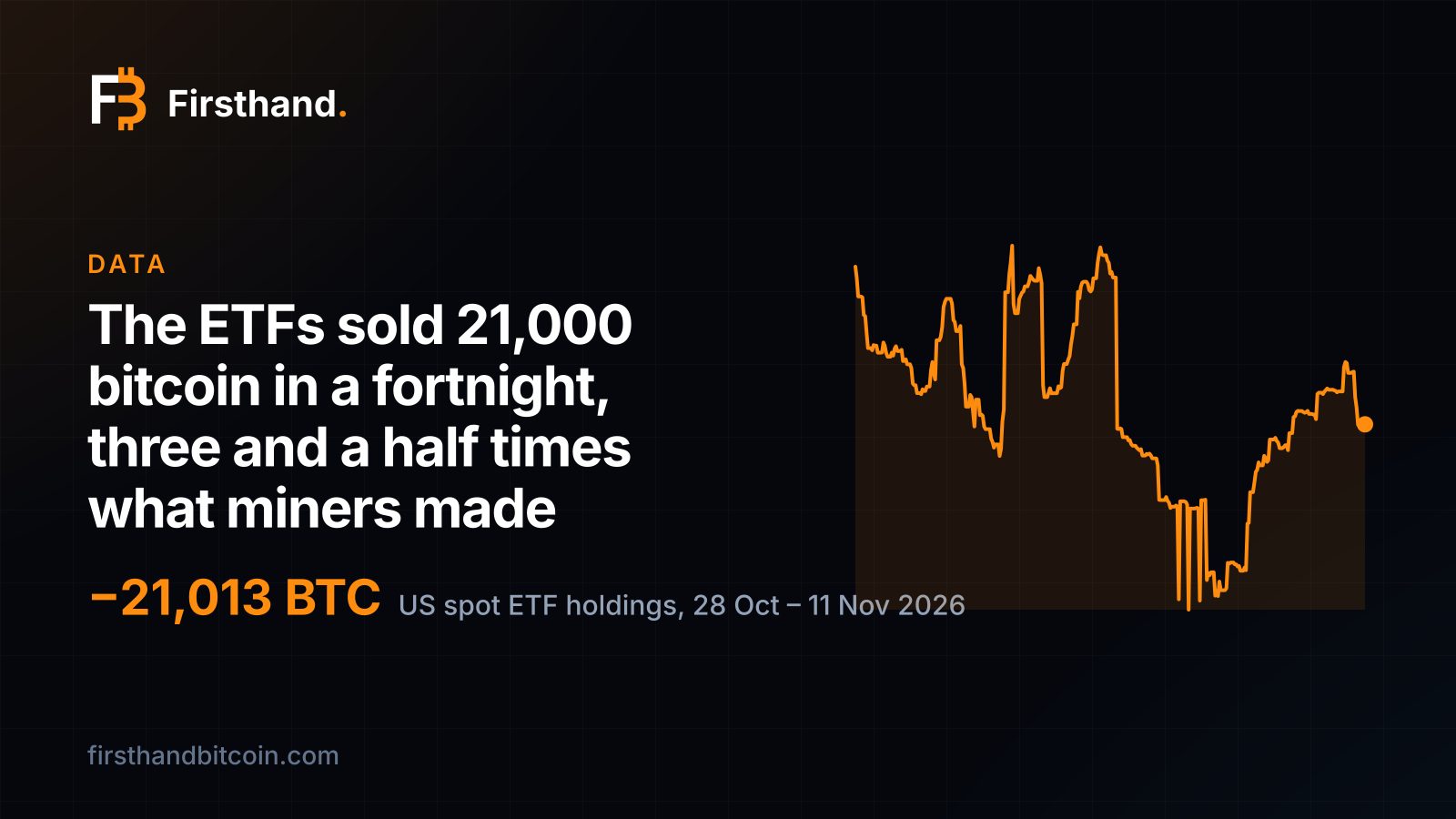
Three and a half BTC out for every one in
On 28 October the US spot bitcoin ETFs held 1,297,980 bitcoin between them, the most since the summer. On 11 November they held 1,276,967. In fourteen days 21,013 BTC left the funds, a fall of 1.6%, and our ETF holdings chart now reads its lowest since 20 September.
Set that against what the network produced over the same fourteen days. The chain advanced 1,878 blocks between the two readings, each paying a 3.125 bitcoin subsidy: 5,869 new BTC, plus about 40 bitcoin in fees. Call it 5,900. For every BTC every miner in the world made, the funds sold three and a half.
The funds still hold 94.7% of their peak, which was 1,348,977 BTC on 13 October 2025. Three weeks ago that figure was a sign of how little the funds had sold through a 40% fall in the price. The last fortnight has taken a first slice out of it.
Over fourteen days the funds sold 21,013 bitcoin. Every miner on earth, together, made about 5,900.
Seven selling days out of nine
The selling started on Friday 30 October, the day after the Binance hack became public, when the funds let go of $643 million. CryptoSlate, working from Farside Investors’ daily table, counted five funds selling and none buying: BlackRock’s IBIT $234 million, Fidelity’s FBTC $201 million, ARK and 21Shares’ ARKB $130 million.
It has not stopped since. Of the nine trading days from 30 October to 10 November, seven were net outflows: $643 million, $399 million, $116 million, then $430 million on 5 November and $412 million on 6 November, $201 million on 9 November and $95 million on 10 November, on our ETF flows chart. The two inflow days added $75 million between them. The net over the nine days is $2.22 billion out. Bitcoin.com News put November’s running total at roughly $1.58 billion of outflows after 10 November, which matches our series to the million.
That has turned the year red. After $3.5 billion came in during August and $2.6 billion in September, the funds’ 2026 net flow stood at about $1.1 billion in by late October. It is now about $1.1 billion out. Bitcoin closed at $81,275 on 29 October and at $73,722 on 11 November, down 9%, its lowest close since 20 August.
A third the size of May
Before calling this a flood, check it against the record. The largest fourteen-day fall in the funds’ holdings came between 8 and 22 May 2026, when 61,342 BTC left, three times this run, on the way to June’s $4.5 billion of outflows, the worst month the funds have had. The heaviest ten trading days ever were in February and March 2025, when $3.35 billion went out, and the ten days from 22 May to 5 June this year came close at $3.24 billion.
On both measures this fortnight is middling: a 21,000-coin drop has happened in about a dozen separate episodes since the funds launched. What makes it worth reading is the direction of travel. From mid-August to late October the funds bought faster than the network could mine, and we wrote in October that a year on from their peak the funds held 60,000 fewer BTC while miners made 163,000. The two weeks since 28 October added 21,000 to that gap in one go.
The network is about to pay a petahash more
While the funds were selling, the network was doing something that matters more to anyone running a machine. Two difficulty rises of 5.9% and 5.5% on 16 and 29 October cut what a petahash earns: our hashprice chart shows a petahash-day paying 0.000449 bitcoin on 28 October and 0.000427 on 11 November, 5% fewer BTC.
That is now reversing. The seven-day average of network hashrate fell from 1,081 EH/s on 27 October to 938 EH/s on 12 November, and blocks have been arriving slowly: with 217 blocks left in the retarget period this morning, our difficulty page has the next adjustment at −7.4%, which would be the largest cut since June’s −10.1%. We flagged the cut three days ago at −6%; it has grown since. At −7.4%, every petahash earns 8% more bitcoin from the moment it lands, within about two days at the current block pace, until the retarget after it.
The two stories pull a miner in opposite directions in dollars and the same direction in BTC. A petahash earned fewer dollars this fortnight because the price fell. It is about to earn more BTC because other miners switched off, which is the only one of the two a machine owner can bank.
The funds decide who holds the BTC. The difficulty adjustment decides how many a machine makes.
What it means for a miner
A fund selling bitcoin is a change of hands. A machine mining bitcoin is a change in how many exist, and only one of those is something an owner controls. The 21,013 BTC the funds sold did not stop being bitcoin; they moved to whoever was buying at $74,000 to $78,000, and a miner who keeps every BTC was not among the sellers.
What a miner should look at instead is the cost of making one. On the most efficient machine in stock, the 8.9 J/TH Antminer S23 XP Hyd at our Nigeria site, a bitcoin costs about $19.5k of electricity to make today against $73.6k to buy, at today’s hashprice and before the machine itself. When the −7.4% adjustment lands, the same machine makes 8% more BTC for the same power, and that cost falls with it.
The funds will buy again or sell again; their chart is updated every trading day on the Data section. The difficulty cut is arithmetic, and it arrives this week whether they do or not. Output is never guaranteed, but the direction of the next fortnight’s BTC per petahash already is.
Sources and further reading
- Bitcoin ETFs lose $643 million in outflows, erasing the week’s gains — CryptoSlate, 31 Oct 2026
- Bitcoin ETFs Bleed for a 4th Straight Day as 2026 Outflows Top $1B — Bitcoin.com News, 11 Nov 2026
- Spot Bitcoin ETF flows — The Block, 10 Nov 2026
Disclosure
Firsthand Bitcoin sells and hosts mining hardware, including this machine. No manufacturer, distributor or affiliate programme paid for or reviewed this page and we take no commission on the links above. Historical figures are computed from daily bitcoin price and network hashprice, each day valued at its own prices. Nothing here is investment advice.