Home / Blog / Bitmain Antminer S23e Hyd 2U
Machine review · Nov 12, 2026 · 8 min read
Antminer S23e Hyd 2U review: 865 TH/s at 10 J/TH in two rack units, built for hydro sites
Bitmain's S23e Hyd 2U packs 865 TH/s at 10 J/TH into a 29 kg server chassis that only runs on three-phase power and a coolant loop. It has been shipping since May, its price per terahash has roughly halved since January, and no public failure record exists for it yet. Here is what that adds up to for a buyer today.
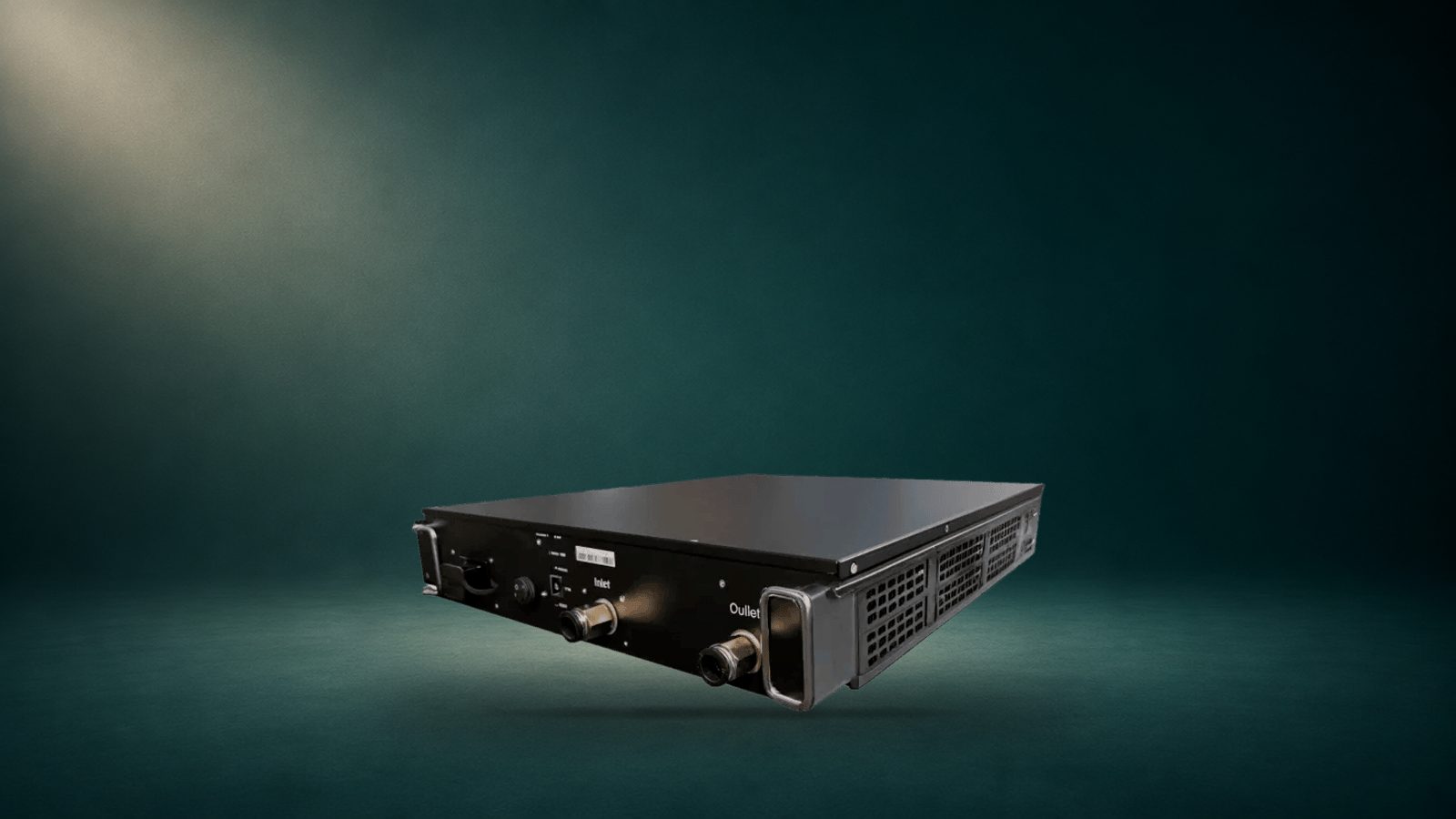
Bitmain Antminer S23e Hyd 2U (865 TH/s)
The bottom line
The S23e Hyd 2U, Bitmain's S23e U2H, is 865 TH/s from 8,650 W at a 35 °C coolant inlet: 10 J/TH, hydro-cooled, in a 600 × 483 × 86 mm chassis that bolts into a standard 19-inch rack. At our UAE hydro site it makes a bitcoin for about $36,200 of electricity and returns roughly 39% in its first year at today's price, which puts it among the strongest first-year returns of anything we host.
Bought at the first price we hold for it, $20,981 in January 2026, and landed in the UAE at $23,730, it has mined and kept 0.1246 BTC for $4,106 of power in 309 days: $5,083 of cashflow, 21% of its landed cost, which is what the first year of a four-year machine looks like when the box was bought at launch. Between now and the 2028 halving it has another 0.192 BTC in it, worth about $23,947 with bitcoin back at its previous high, roughly 1.2× its hardware by the halving for a unit bought when we bought ours. A unit bought at today's $9,627 gets there far sooner.
What you are buying is the S23 generation's efficiency at the lowest price per terahash it has been sold for, in a shape that spreads one chassis, one power feed and one pair of coolant fittings across 865 terahashes. What you are not buying is a record: it has shipped for six months and nobody has published a failure on it yet, or a repair. It works at 6¢ with a wide margin and at 3.9¢ with a wider one. It does not work at all without three-phase 380–480 V, a coolant loop and a rack rated for 29 kg units, which is why ours lives in the UAE.
Scores
| Criterion | Score | Why |
|---|---|---|
| Cashflow | 9/10 | Makes a bitcoin for about $36,200 of electricity at 6¢ and returns roughly 39% in year one at today's price. Our launch-priced unit has covered 21% of its hardware in 309 days; one bought at $9,627 today starts from a far lower landed cost. |
| Longevity | 8/10 | At 10 J/TH its 6¢ line is $14.40 a petahash a day. Hashprice has not been within $13 of that since the 2024 halving, and the 2028 halving still leaves it clearing at 3.9¢ with room. |
| Efficiency | 8/10 | 10 J/TH, half a joule behind the S23 Hyd and 1.1 behind the S23 XP Hyd, and a full generation ahead of the 13 J/TH rack units that share its shape. |
| Quality control | 5/10 | Scored as unknown, not as good. The launch thread has no owner reports, and we found no published failure on a 2U unit in six months of shipping. That is an absence of evidence, and a 5 says so. |
| Serviceability | 6/10 | Bitmain's standard 365-day warranty from shipment, and in the UAE a manufacturer warranty centre near the facility. Against that, no published repair guide for the S23 boards yet, and a 29 kg rack unit that only a site with the right racks can handle. |
Weighted on what an owner gets back per dollar over a four-year life. The entry price and the 10 J/TH carry it; the two unknowns, a chassis without a public failure record and a bench trade that has not seen it yet, are scored as unknown rather than as faults.
Buy it if
- You want the current generation's efficiency and the lowest price per terahash it has been sold at, and you are happy to host it where the water plant already exists.
- Your power is at or below 6¢. At 6¢ it makes one BTC for about $36,200; at 3.9¢, about $23,600.
- You are buying several machines' worth of hashrate and would rather rack, cable and monitor one 2U chassis than three single boxes.
- You plan to hold through the 2028 halving: at 10 J/TH its power line sits at $14.40 a petahash a day at 6¢, less than half of today's hashprice.
Walk away if
- You have no coolant loop, no three-phase 380–480 V supply or no 19-inch racks. Without all three it will not start, at any price.
- Your power is above 6¢. Between 6¢ and about 9¢ it still clears today with room; between 9¢ and 13¢ it clears but leans on the price of bitcoin after the halving; above 13¢ hashprice would have to rise from here for it to pay.
- You need a machine with a bench history behind it. The S23 generation's boards are new and the repair trade has not published a guide for them yet; the S21 generation has years of both.
- You want the lowest electricity per BTC regardless of price. The S23 XP Hyd at 8.9 J/TH makes a cheaper BTC; this makes more cashflow per dollar.
What Bitmain shipped
The S23e U2H was announced in January 2026 and its launch thread on Bitcointalk opened on 28 January with the same three numbers everyone has repeated since: 865 TH/s, 8,650 W, 10 J/TH. The first units reached buyers in May. We wrote the outlook in September, when the question was why a machine this efficient was selling for half the price per terahash of its sibling; this piece is about what it is now that it has shipped and run.
Bitmain's own product manual, version 1.1 from May 2026, is the spec source. The chassis is 600 × 482.6 × 86 mm, two rack units high and a standard 19-inch rack width, and weighs 29.0 kg net, 32.5 kg in the box. It runs on three-phase 380–480 V at 47–63 Hz, up to 20 A, through an LP34 power port, with a single 10/100 Ethernet connection. The coolant goes in between 20 °C and 50 °C at 16 to 20 litres a minute and no more than 3.5 bar, through UQD08 quick-disconnect couplings; antifreeze, pure water or deionised water, each at its own pH band. Bitmain rates every headline figure as typical: hashrate within ±3%, power and efficiency within ±5%.
The easiest way to read the box is as a density play. One control board, one power feed and one pair of coolant couplings serve 865 terahashes, where a single-box hydro miner of the same generation serves 563 or 600. That is where the price per terahash comes from, and it is also the first constraint: the machine is only as useful as the rack and the loop it sits in.
Why it is priced where it is
The first price we hold for it is $20,981, on 8 January 2026, about $24 a terahash. By September the market price had settled near $11 a terahash, and it is $9,627 today, $11.13 a terahash, for the same 865 TH/s at the same 10 J/TH. That is the best entry price the machine has ever had, and the reason the S23 generation's efficiency is suddenly reachable for a buyer who would not have paid launch money for it.
Nothing about the machine explains the move. The market does. A rack unit that needs three-phase power, a coolant loop and 19-inch racks can only be bought by the small number of operators who already run all three, and a product with that few possible buyers clears at a lower price than its specification would earn in a single box. Bitmain then shipped the S23 XP Hyd at 8.9 J/TH above it, and everything below the new flagship repriced to make room.
Put the three S23 water machines side by side and the shape of the market is plain. The S23 Hyd at 9.5 J/TH asks $23.52 a terahash; the S23 XP Hyd at 8.9 J/TH asks $26.36. This machine asks $11.13 for 10 J/TH. The efficiency gap between the three is about one joule end to end. The price gap is not.
The same 865 terahashes, for about half of what they cost in January.
The honest gap: nobody has published a fault yet
Every ASIC develops faults, and the useful question about any machine is what they are and what they cost. On this one the first half of that question has no answer yet. The launch thread had no replies when we read it, ten months after it opened. We searched the operator boards and the repair guides for the S23e, the U2H and the S23 generation's hashboards and found neither an owner reporting a dead chain nor a bench publishing a repair guide for the board. The S21 generation has both in quantity; the S23 generation, shipping since the start of this year, has not yet.
That is why quality control and serviceability are scored as unknown, at 5 and 6, rather than as good. Six months of shipping with nothing published is not evidence of a problem. It is not evidence of the absence of one either, and we score what we do not know as what we do not know.
What a fault costs an owner here is the half we can answer. Bitmain's standard warranty on current miners runs 365 days from the shipment date, and it is voided by the things that void every Antminer warranty: a removed sticker, third-party disassembly, unauthorised firmware or an over-frequency setting. Hosted in the UAE, the manufacturer's warranty centre is close to the facility, so an in-warranty unit is a short trip rather than a shipment, and the whole of the first year is covered. For a machine whose record is still being written, that is the right room to write it in. A failed hashboard is a line item on a hosted machine, and the arithmetic of a fault does not change because the chassis is new.
What one BTC costs it
At the UAE's 6¢ the S23e Hyd 2U makes a bitcoin for about $36,200 of electricity today, against a bitcoin price of $72,752. At Nigeria's 3.9¢ the same box would make one for about $23,600. Those are electricity-only figures at today's difficulty with each site's uptime counted, which is how every cost per BTC on this site is written.
The machine's line is the hashprice at which it stops covering its own power. A petahash at 10 J/TH draws 240 kWh a day: $14.40 at 6¢ and $9.36 at 3.9¢. On our hashprice chart network hashprice was $31.37 a petahash a day on 12 November, so the machine clears the 6¢ line by about $17 and Nigeria's by about $22. Since the 2024 halving the lowest day in our series was $27.74, on 6 June 2026, still $13 above this machine's 6¢ line. The 2028 halving roughly halves the BTC a petahash earns; at today's price and difficulty that puts hashprice near $15.70, which still clears 6¢, narrowly, and 3.9¢ with room. At 10 J/TH the question of switching off does not arise at any rate we charge.
Over its run so far, since January 2026, electricity has averaged $32,900 one BTC at 6¢. That is a short lifetime average; the figure to plan on is today's.
At 6¢ its power line is $14.40 a petahash a day. Hashprice has not come within $13 of it since the 2024 halving.
Does it still make sense against the machines either side of it?
Yes, and the comparison is the whole point of the box. In the same UAE room the S23 Hyd makes one BTC for about $34,900 and the S23 XP Hyd for about $32,700, both cheaper BTC than this machine's $36,200, as a lower J/TH should give. But they cost $23.52 and $26.36 a terahash against this machine's $11.13, and so they return roughly 21% and 20% in their first year to this machine's 39%.
That is the trade in one line. The more efficient boxes buy a lower BTC cost and a longer runway past 2028; this one buys more cashflow per dollar now, at a line that the halving still clears. A generation back, the S21e XP Hyd 3U, the same rack idea at 13 J/TH, makes one BTC for about $46,900: three joules dearer per terahash of work, every day, for as long as both run.
The arithmetic only holds in a building that can take the machine. Air-cooled sites cannot run it, and a hydro site without 380–480 V three-phase at the cabinet cannot either. Hosting follows the cooling: our UAE site is the water plant, with the highest uptime of our three sites and the warranty centre nearby, and it is where every unit of this machine we host lives. A rack unit draws the load of several ordinary machines from one position in the loop, which is why it is quoted as more than one hydro position of infrastructure; spread across 865 terahashes, that is still a small cost per terahash.
Our two cents
This is the machine we would put someone into who wants the S23 generation at the lowest price per terahash it has been sold for, has a hydro site to put it in, and is comfortable that the chassis is still writing its own record. We will not pretend the record exists, because it does not, and a review that filled the gap with confidence would be worth less than one that says so.
What we can say with the numbers in front of us is that it makes one BTC for about $36,200 at 6¢, returns roughly 39% in its first year, and sits so far above its power line that half of today's hashprice still clears it. If a public failure history matters more to you than the price, the S21j XP Hyd is the generation behind it with one. If the cheapest BTC matters more than the first year, the S23 XP Hyd is one step up. If you have the rack and the loop and want the most hashrate per dollar this generation sells, this is it.
Sources and further reading
- S23e U2H Product Manual, V1.1 — Bitmain, May 2026
- BITMAIN Launches ANTMINER S23e U2H (launch thread) — Bitcointalk, 28 Jan 2026
- ASIC Miner Warranty & RMA Matrix: Terms, Void Clauses and Who Pays Freight — D-Central, 2026
Which machines this covers
The other side of this machine
The Antminer S23e Hyd 2U is suspiciously cheap. Is it too good to be true? — Same generation as the S23 Hyd, almost the same efficiency, and a fraction of the price per terahash. We went looking for the catch.
Disclosure
Firsthand Bitcoin sells and hosts mining hardware, including this machine. No manufacturer, distributor or affiliate programme paid for or reviewed this page and we take no commission on the links above. Historical figures are computed from daily bitcoin price and network hashprice, each day valued at its own prices. Nothing here is investment advice.