Data insight · Nov 9, 2026 · 3 min read
Difficulty is set to fall 6%, the first cut over 5% since July, lifting a petahash's coins 7%
Blocks have arrived slowly since the last reset on 29 October, and the estimate for the next one stands at −6.3%, the first fall of more than 5% since July. A petahash has earned fewer coins than at any point in 2026, and a cut of this size would hand about 7% of them back.
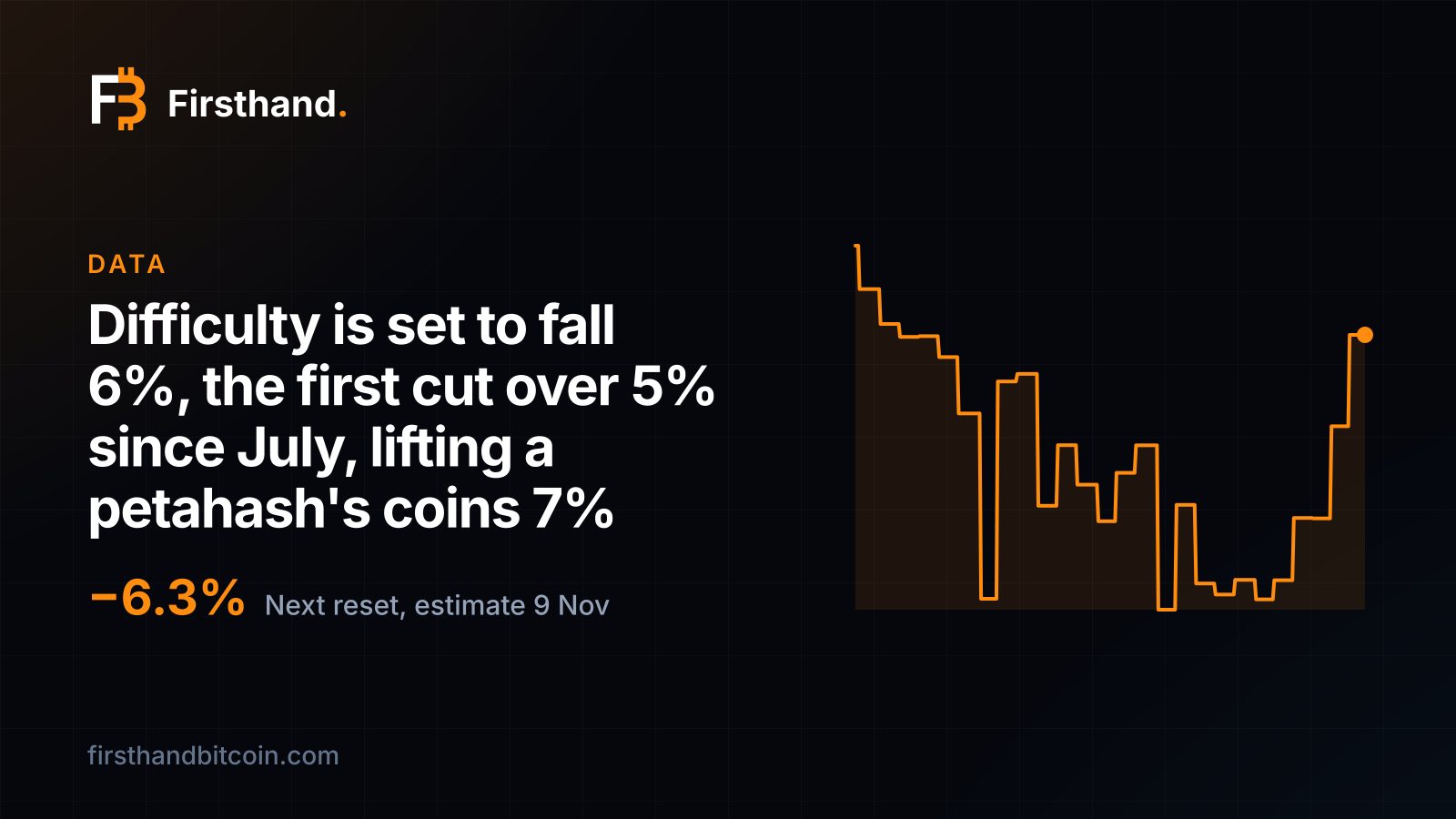
Blocks have been slow since 29 October, so difficulty is set to fall
Every 2,016 blocks the network resets its difficulty to bring blocks back to one every ten minutes. The last reset, on 29 October, raised it 5.54%, after a 5.92% rise on 16 October. Since then blocks have come in slower than ten minutes, and the estimate for the next reset has gone the other way: on 9 November our data puts it at −6.28%, with 600 blocks, about four days, still to come.
A 6.28% cut means blocks have been averaging about 10 minutes 40 seconds. Slow blocks are what too little hash power looks like from the outside. The final figure is set by those last 600 blocks, so it will move, but the direction has held since 30 October. If you want the mechanics in plain words, our guide to difficulty has them.
A cut of this size has happened six times since the 2024 halving
Since the April 2024 halving there have been 68 resets and 26 of them were falls. Only six of those were 5% or more: 9 May 2024 (−5.6%), 29 June 2025 (−7.5%), 7 February 2026 (−11.2%), 20 March 2026 (−7.8%), 14 June 2026 (−10.1%) and 11 July 2026 (−5.0%).
At −6.28% the coming cut would be the seventh, and the fifth largest of the 68. It would be the first over 5% since 11 July. The falls since then were all small: 25 July (−0.7%), 23 August (−1.3%) and 3 October (−0.03%).
We wrote about the two October rises as they happened: blocks running 6% fast before the first, and two 5% rises in 13 days after the second. The cut is the other half of the same cycle.
Of 68 resets since the halving, only four were cuts bigger than this one.
A petahash is earning the fewest coins of 2026
Difficulty is the number that divides the block rewards among all the machines, so when it rises, every petahash earns fewer coins. After the two October rises a petahash earned 0.000426 bitcoin a day on 1 November, the lowest reading of 2026. On 28 October, before the last rise, it was 0.000449. By 9 November it was 0.000426 again, 5.1% lower.
The slide has been steady. Across the last four reset periods a petahash averaged 0.000477, 0.000477, 0.000451 and 0.000428 bitcoin a day, the last one running from 29 October to 9 November. Two rises of about 5.5% each took roughly a tenth off a petahash's coins in a fortnight, and nothing has given them back yet. A cut is the first thing that would.
That is the bitcoin side of hashprice, and it is the side a miner who keeps the coins lives on. It does not depend on what the market is paying for bitcoin on any given day. If you are new to the term, our guide to hashprice is the place to start.
The dollar side fell with the price
Bitcoin closed at $80,431 on 5 November and was $73,721 on the morning of 9 November, 8.3% lower and its lowest level since 20 August in our series. Hashprice in dollars was $36.19 per petahash a day on 29 October and is $31.44 on 9 November, the lowest since 16 August.
Leveraged longs took the first hit. Our liquidations chart shows $294 million of bitcoin longs force-closed on 5 November and $222 million on 8 November. Both are small beside the $802 million of 2 June, the largest day in the six months we hold.
What a 6% cut hands back to each petahash
A cut in difficulty is arithmetic for a miner. If difficulty falls 6.28% and nothing else moves, each petahash earns 1 ÷ (1 − 0.0628) of what it did, which is 6.7% more. That takes the 0.000426 bitcoin a day to about 0.000455, above where it stood on 28 October. At today's price of $73,721 it is $33.55 a petahash a day instead of $31.44.
The power bill does not move, so the cost of making a coin falls by the same 6.28%. On the most efficient machine in stock, the S23 XP Hyd at 8.9 J/TH on Nigeria's 3.9 cents a kilowatt-hour, a coin cost about $19,533 in electricity on 9 November. After a 6.28% cut that is about $18,300, a quarter of the $73,721 market price.
The same machine, the same power bill, 7% more coins.
What it means for a miner
A fall in difficulty is the network saying there is less hash power than there was. For a miner who is still running, it is the other side of the October rises: the share of each block that goes to one petahash is about to grow by roughly a fifteenth.
This is why the machine matters more than the month. An efficient machine on cheap power keeps earning through the days when hashprice is thin, and collects the larger share when the cut arrives. A machine near its power line is the one that gets switched off, and its switching off is part of what makes difficulty fall. Earnings are not guaranteed, and all of the figures above hold today's conditions flat, but the direction of the next reset is a good day for anyone who kept their coins and their machine running.
Sources and further reading
- Difficulty adjustments and the next-retarget estimate — Firsthand Bitcoin data, 9 Nov 2026
- Hashprice in bitcoin, per petahash per day — Firsthand Bitcoin data, 9 Nov 2026
- Bitcoin futures liquidations — Firsthand Bitcoin data, 9 Nov 2026
Disclosure
Firsthand Bitcoin sells and hosts mining hardware, including this machine. No manufacturer, distributor or affiliate programme paid for or reviewed this page and we take no commission on the links above. Historical figures are computed from daily bitcoin price and network hashprice, each day valued at its own prices. Nothing here is investment advice.