Data insight · Nov 10, 2026 · 5 min read
The network paid miners 23% less in a fortnight; a petahash earned 5% fewer coins
Miners as a group took home $33.3 million a day over the last week, down from $43.3 million two weeks earlier, and the lowest seven days since 22 August. Most of the fall is slow blocks, not the price, and one petahash lost far less than the network did.
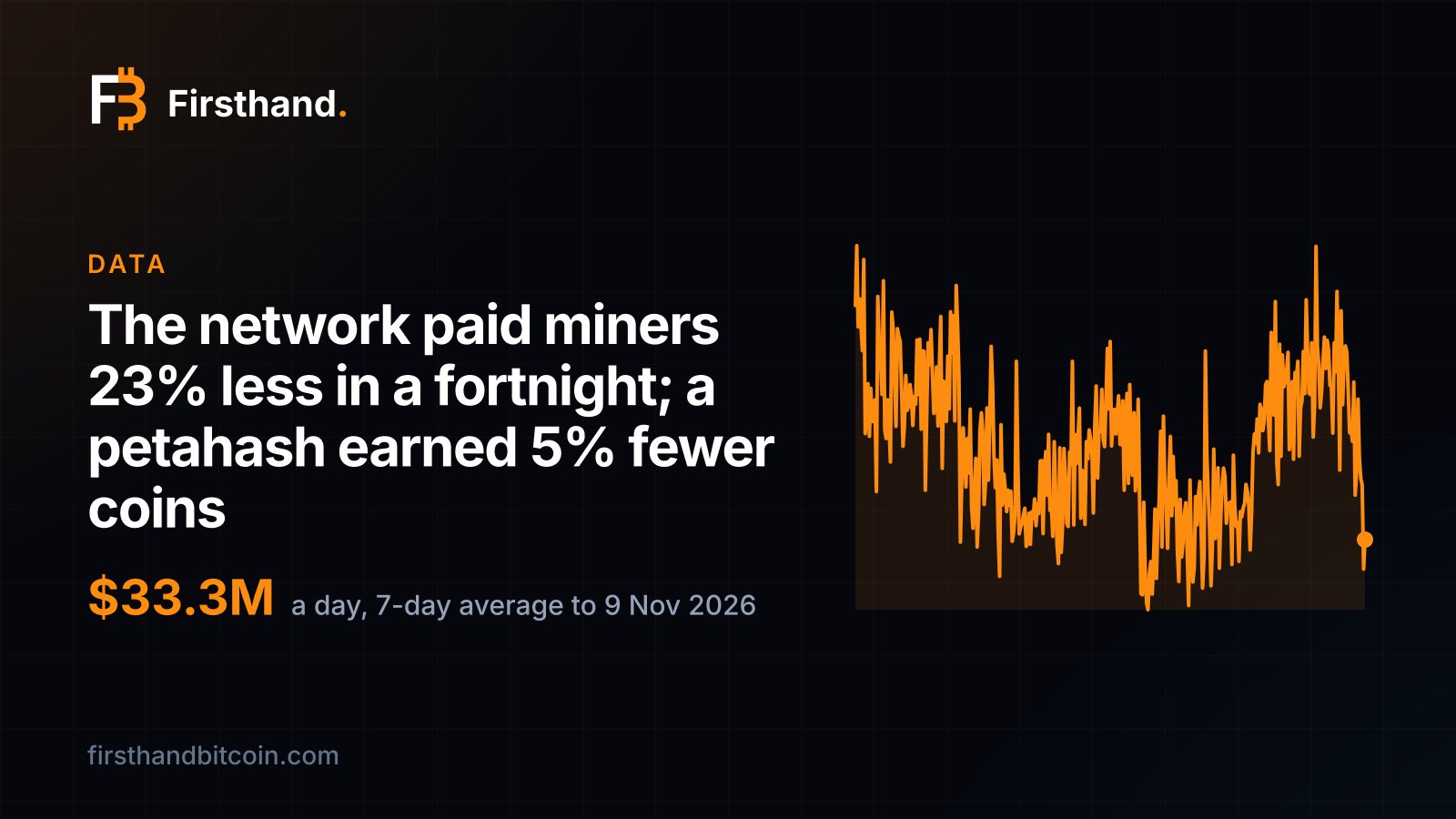
Miners were paid $33.3 million a day, down from $43.3 million
The bitcoin network pays its miners in two ways: newly issued coins from each block, and the fees users attach to transactions. Our miner revenue chart adds both up in dollars. Over the seven days to 9 November the average was $33.3 million a day. Over the seven days to 26 October it was $43.3 million. That is a fall of 23% in two weeks.
It is the lowest seven-day average since the week to 22 August, when it was $33.0 million. The single day of 9 November, at $28.9 million, was lower again. For most of October the line sat between $42 million and $43 million for week after week, so the drop is recent and sharp.
The price took a quarter of it; the blocks took most of the rest
Daily pay is blocks found, times coins per block, times the price of a coin. Two of those three moved. Bitcoin's average price over the seven days to 9 November was $76,664, against $81,714 over the seven days to 26 October: 6.2% lower.
The number of coins paid out fell by more. Taking blocks found per day, 3.125 coins of subsidy per block and the fees on top, the network issued about 408 bitcoin a day in the latest week against 485 two weeks before, a fall of 16%. A 6% lower price on 16% fewer coins is most of the 23%.
Fees did not cause it. They averaged 2.96 bitcoin a day in the latest week, a little more than the 2.39 of two weeks earlier, and they are still less than 1% of what miners earn, as we showed in the piece on fees.
Blocks ran slow because machines went dark
The network is built to find a block every ten minutes, 144 in a day. When machines switch off, blocks come slower and fewer coins are issued each day until difficulty is reset. Our blocks per day chart shows the average fell from 154.6 in the week to 26 October to 129.6 in the week to 9 November. On 8 and 9 November it found 111 each day, the fewest since 3 June, when it found 108.
Our estimate of network hashrate agrees, but it is a noisy reading, so we compare averages. The seven-day average was about 1,073 exahash per second in the week to 26 October and about 970 in the latest week, roughly 10% lower.
The cause sits in the retargets. Difficulty rose 5.92% on 16 October and 5.54% on 29 October, which took about a tenth off what each petahash earned in a fortnight. Machines that were comfortably above their power line in September were suddenly nearer to it. Slow blocks are what that looks like from the outside: some of those machines were switched off, and the network found fewer blocks while they were dark.
On 8 and 9 November the network found 111 blocks a day, the fewest since 3 June.
One petahash lost 5%, not 23%
Pay to the whole network is the wrong number for an owner. A miner is paid in proportion to its share of the hashrate, so when other machines leave, the coins they would have mined are shared among those that remain.
That is why the figure that matters moved so much less. Our hashprice in bitcoin chart gives the coins one petahash is expected to earn in a day at the current difficulty. Its seven-day average was 0.000449 bitcoin to 26 October and 0.000427 to 9 November, a fall of 4.9%. The network's pay fell by nearly five times as much as a petahash's.
In dollars the story is the price. Hashprice was $36.19 per petahash a day on 29 October and $31.93 on 9 November. The coins are the part a miner who holds keeps.
The next reset is the first thing that pays the coins back
Slow blocks are the signal that tells the network to lower difficulty. Our estimate for the next reset, as of 10 November, stands at −6.58% with 470 blocks to go. If it holds, each petahash earns about 7% more coins, on the same arithmetic we set out in the difficulty piece. The final figure is set by the blocks still to come.
The machines that stayed on through the two weeks are the ones that collect it. The ones that switched off were not paid during the slide, and they are not paid in the recovery either. A cut also lowers the electricity behind each coin by the same share for everyone still running, which is why we watch the next reset as closely as the price.
What it means for a miner
The network's pay is a headline. A petahash's coins are your income, and they moved a twentieth, not a quarter. The cost of a coin is the other half. On 10 November the most efficient machine in stock, the S23 XP Hyd, makes a bitcoin for about $19,489 in electricity at Nigeria's 3.9 cents a kilowatt-hour, against a market price of $74,784: about a quarter of the price.
A falling dollar pay is when low-cost machines stack the most coins per dollar spent, and the machines that fall out of the race hand their share to those that stay. Earnings are not guaranteed, and these figures hold today's conditions flat, but the electricity behind a coin does not move with the daily pay.
Sources and further reading
- Miner revenue — Firsthand Bitcoin data, 9 Nov 2026
- Blocks mined per day — Firsthand Bitcoin data, 9 Nov 2026
- Hashprice in bitcoin — Firsthand Bitcoin data, 9 Nov 2026
- Difficulty adjustments — Firsthand Bitcoin data, 29 Oct 2026
Disclosure
Firsthand Bitcoin sells and hosts mining hardware, including this machine. No manufacturer, distributor or affiliate programme paid for or reviewed this page and we take no commission on the links above. Historical figures are computed from daily bitcoin price and network hashprice, each day valued at its own prices. Nothing here is investment advice.