Data insight · Nov 3, 2026 · 5 min read
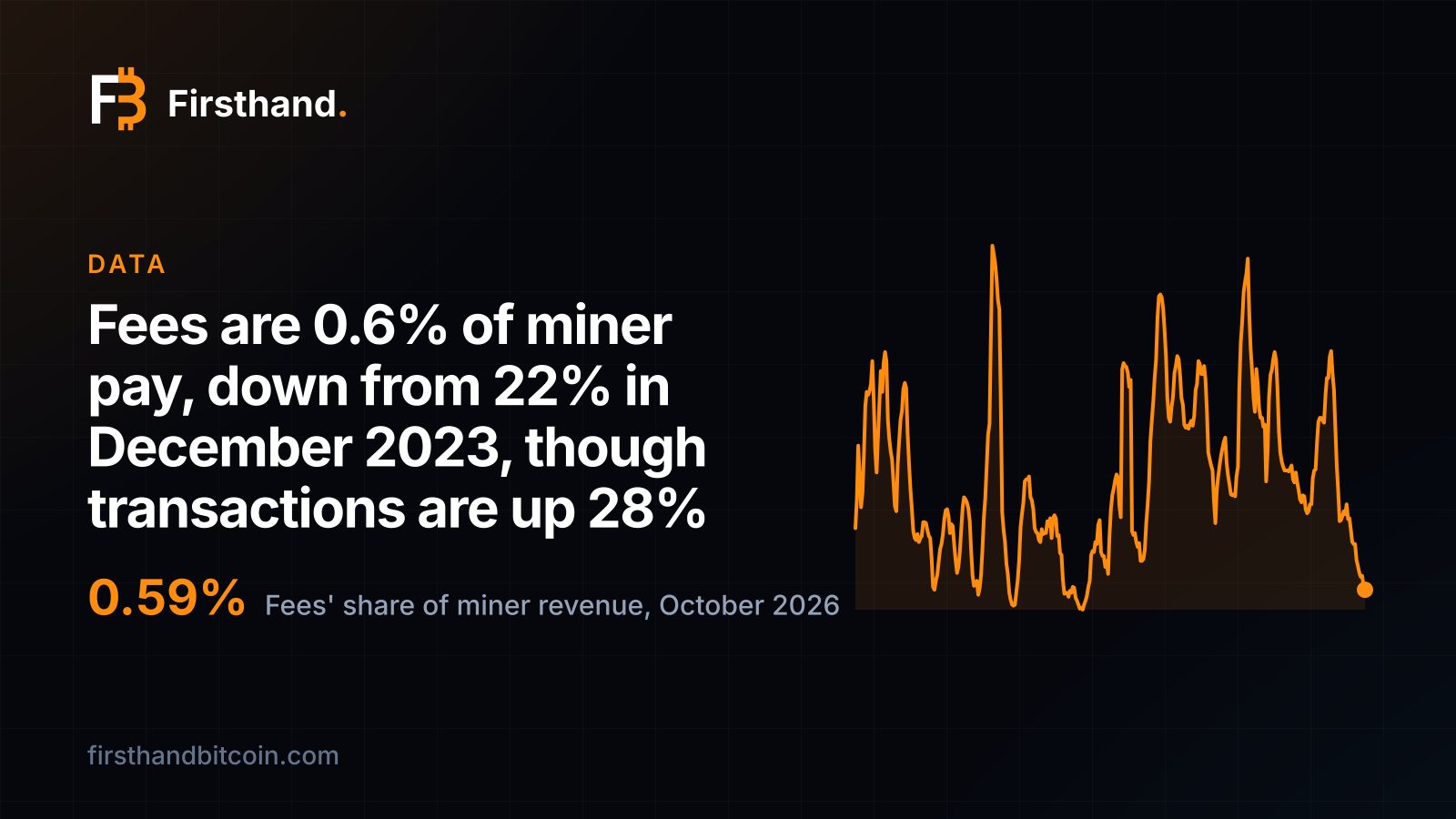
Fees are 0.6% of miner pay, down from 22% in December 2023, though transactions are up 28%
Bitcoin confirmed 722,000 transactions a day in October, 28% more than in December 2023, and paid miners 99% less in fees on each one. Fees have been under 1% of miner revenue for 15 months, so what a machine earns is the block subsidy.
Fees paid miners $10.9 million a day in December 2023
Every block pays its miner two things: the new coins of the subsidy, and the fees users attached to their transactions. In December 2023 the second part was large. Fees came to 7,914 bitcoin that month, 255 a day, and made up 22.1% of everything miners were paid. At that month's prices it was about $10.9 million a day. If the two parts are new to you, our guide to where a miner's bitcoin comes from explains them in plain words.
The halving month was the last time fees were large. April 2024 paid 4,312 bitcoin in fees, 16.4% of miner revenue, and then the share fell away. It was 2.8% by December 2024, 0.7% by October 2025, and has stayed under 1% in every month since August 2025.
October: 0.59% of the pay, 15 months under 1%
The latest month in our data is October 2026, which runs to 28 October. Fees came to 74 bitcoin over those 28 days, 2.65 a day, which is 0.59% of miner revenue. On top of the 3.125 bitcoin subsidy, the average block carried about 0.018 bitcoin of fees.
That is not the lowest month. April 2026 was 0.54%, the lowest since June 2015, when the subsidy was 25 bitcoin and fees were an even thinner slice of it. The point is the run: August 2025 to October 2026 is 15 months in a row below 1%, after a July 2025 that sat at 1.01%.
Across 2026 so far, to 28 October, fees have added up to 854 bitcoin, against 135,450 of subsidy over the same 301 days. December 2023 alone paid 9 times as much in fees as the first ten months of 2026 put together.
In dollars the gap is wider than in bitcoin, because the price has risen. December 2023 fees averaged $10.9 million a day. October 2026 fees averaged about $220,000 a day, one-fiftieth of that.
Fifteen months in a row under 1%: a miner's income is the subsidy.
The network is busier, and each transaction pays far less
It is easy to assume fees fell because nobody is using bitcoin. The transactions chart says the opposite. The network confirmed 722,000 transactions a day in October, against 566,000 in December 2023: 28% more. We looked at that rise in a piece on 20 October.
What changed is the price of each one. Dividing the month's fees by its transaction count, the average transaction paid 45,119 satoshis in December 2023 and 367 in October 2026. That is about 30 cents at October's prices, against an average of roughly $19 in December 2023. The fastest-confirmation fee estimate in our data was between 1 and 9 satoshis per virtual byte on every day of October.
Each block has a fixed amount of room, and there are about 144 blocks a day. When more people want in than fit, fees climb until some give up. In October they did not climb: the fee estimate never left single digits, which means the room was there.
What the subsidy does with that
With fees this small, a petahash's income is the subsidy times the price, shared among every machine on the network. The hashprice chart is that, and the bitcoin-denominated version shows it in coins. A fee spike is a bonus when it arrives, as December 2023 showed, but nothing about October's income depends on one.
That is also why the daily income of the network moves with the bitcoin price and the number of machines, and the number of machines competing for it. The fee market is a separate story, and it has not been the main one for 15 months.
Past the next halving the arithmetic changes
At the next halving the subsidy falls from 3.125 to 1.5625 bitcoin a block, which is 225 bitcoin a day instead of 450. Held flat at October's 2.65 bitcoin a day, fees would be 1.2% of miner revenue, up from 0.59%, with no change in how much anyone pays. That is today's conditions held flat, not a forecast of what fees will do.
Two plain facts follow. A fee market that is 1% of the pay cannot replace a subsidy that is 99% of it, so the halving is made up by the bitcoin price and by efficiency, which is what our efficiency guide is about. And fees are cheap upside: when blockspace fills again, every machine on the network is paid more that day.
What it means for a miner
A machine on cheap power earns what the subsidy and the price pay it, in coins that arrive in your wallet every day. Fees do not figure in that today, and a miner who keeps the coins is not waiting for them to come back.
The cost to make a bitcoin is set by your power rate and by what a petahash earns, and fees are 0.6% of that. When fees do rise again, it will show up as a bonus in the same coins, and the only decision it asks of a miner is the one already made: keep the machine running and keep what it mines.
Sources and further reading
- Fees paid to miners, daily and as a share of miner revenue — Firsthand Bitcoin data, 28 Oct 2026
- Transactions per day — Firsthand Bitcoin data, 28 Oct 2026
Disclosure
Firsthand Bitcoin sells and hosts mining hardware, including this machine. No manufacturer, distributor or affiliate programme paid for or reviewed this page and we take no commission on the links above. Historical figures are computed from daily bitcoin price and network hashprice, each day valued at its own prices. Nothing here is investment advice.