Home / Blog / Canaan Avalon A1466
Field report · Oct 17, 2026 · 3 min read
Bought 72 days before the halving, the Avalon A1466 paused once and now runs in Nigeria
Canaan's 21.5 J/TH Avalon A1466 was bought in February 2024 and kept a fifth of its coins before that April's halving. Argentina's 6¢ held for two years, until hashprice dipped under it in February 2026, and the machine crossed to Nigeria once.
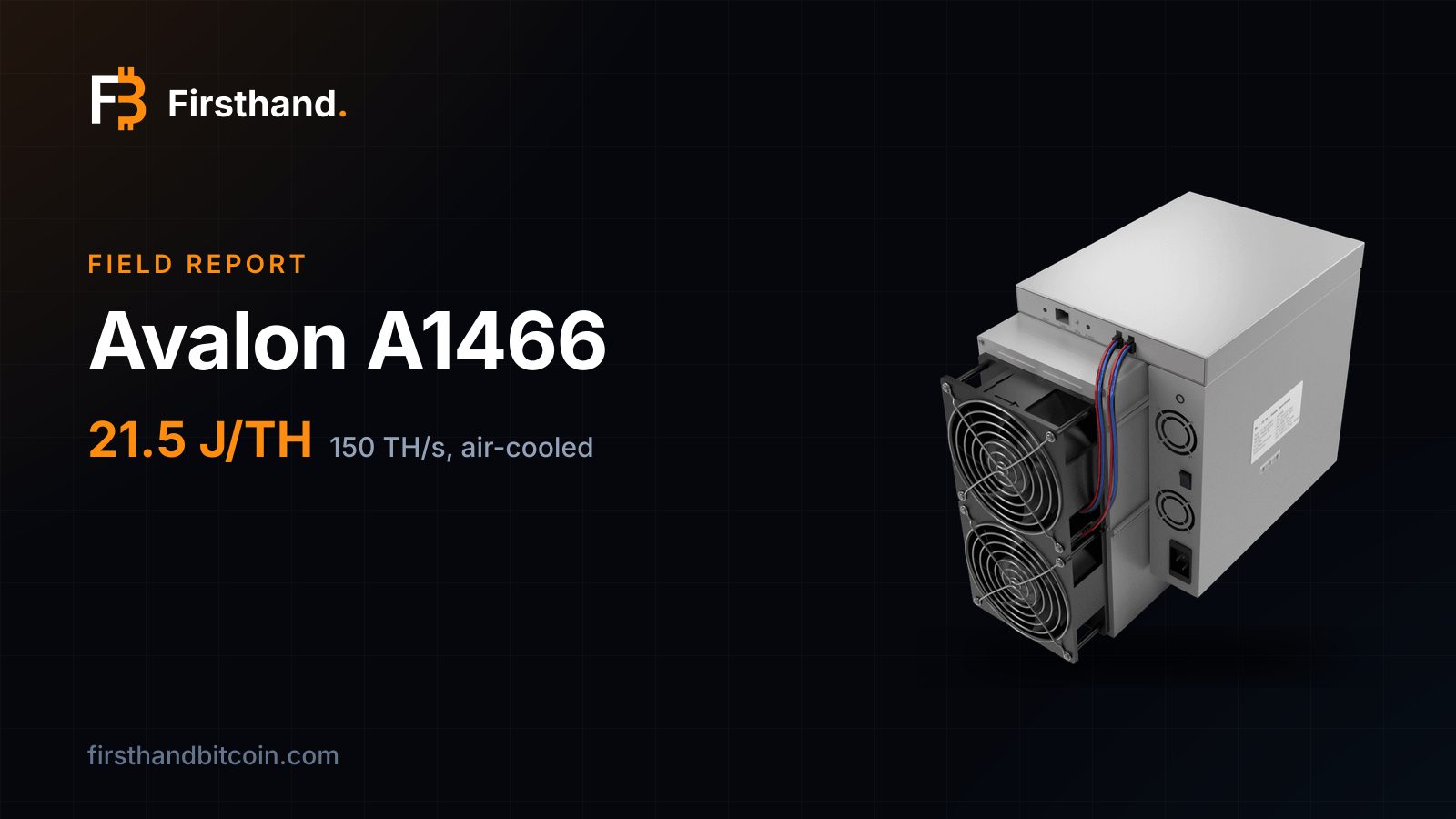
Canaan Avalon A1466 (150 TH/s)
A box bought for $2,009 has kept 0.0880 bitcoin
The Avalon A1466 is Canaan's air-cooled machine of 2023: 150 TH/s at 21.5 J/TH and 3,230 W in a 13 kg chassis, on our store's record of it. Canaan's own shop page could not be opened from our tooling, so the specification here is the store's.
Bought once its price settled, on 8 February 2024, it cost $2,009. Landed at our Argentina site, the all-in cost was $3,312. In 968 days since it has mined and kept 0.0880 BTC, worth about $7,177 today, for $4,130 of electricity. That is $3,047 of cashflow, or 92% of its landed cost, with every coin kept.
The halving came 72 days in, and a fifth of its coins came before it
The machine was bought two and a half months before the April 2024 halving. In the 72 days before it, it kept 0.0173 BTC, 20% of everything it has mined, in 7% of its life so far. A petahash earned $80.08 a day on the day we bought it and $139.13 on 20 April 2024, the day of the halving, on our hashprice chart.
After it, the machine kept 0.0707 BTC in 896 days. Its cash margin, after electricity, was about $10.15 a day before the halving and about $2.29 a day after. A halving takes the coins per petahash in half in one night; the machine bought before it was paid in advance for part of that.
At 21.5 J/TH, 6¢ was enough for two years
A machine's line is the hashprice at which it stops covering its own power. At 21.5 J/TH a petahash uses about 517 kWh a day: $31.00 at Argentina's 6¢, and $20.15 at Nigeria's 3.9¢. Between the day it was bought and its last day in Argentina, hashprice was under the Argentine line on 11 of 752 days, and all 11 were in February 2026.
The machine stood switched off for 15 days from 28 February 2026, and on 16 March 2026 it made its one move, to Nigeria, after 752 days in Argentina. A crossing is freight, customs and downtime at both ends, so a machine makes it once and does not shuttle, which is the rule in a machine crosses to cheap power once. It has run 216 days there.
For 741 of its 752 days in Argentina, 6¢ covered the power. In February 2026 it stopped doing so.
Nigeria's line has never been touched
Since the move, hashprice has been under the Argentine line on 33 of 216 days, so at 6¢ the machine would have run at a loss on roughly one day in seven. It has not once been under Nigeria's line, on any day since the machine was bought. The lowest day was $27.74 on 6 June 2026, which cleared it by 38%.
The same coin that costs the machine about $45,100 of electricity at 3.9¢ would cost about $69,400 at 6¢, against a bitcoin price of $81,601. Over its whole life a coin has averaged $46,934 of electricity, a lifetime figure rather than today's, because most of its power was bought in Argentina.
What is left, and what the halving does to it
Taken fresh today, a first year would return 21% in Nigeria and 9% at 6¢.
The April 2028 halving halves the coins a petahash earns. At today's price and difficulty that puts hashprice near $19.44, a little under even the Nigerian line of $20.15. A machine that no site can pay for is switched off rather than mined at a loss, and it keeps every coin it has made. The forward figures to that date add 0.029 BTC, worth about $3,611 with bitcoin back at $124,493, which would take cashflow to about 2.0× the landed cost. That is today's conditions held flat, apart from the price, which every forward projection assumes recovers.
What it says about the next machine you buy
Machines are the roof, not the building, as the roof guide puts it: the test is whether a machine earned enough to buy its replacement. The A1466 has banked $3,047 after electricity against a $3,312 landed cost. The chart above shows where that lands at the halving. We found no operator threads or repair write-ups on this machine to cite, so its reliability is unknown rather than good.
The arithmetic for its replacement is plain. A machine at 12.5 J/TH has a line of $18.00 at 6¢, so it keeps clearing at Argentina's rate after the halving where the A1466 cannot clear even at Nigeria's. The figure below ranks what we would put in its place today, on cost per coin and then year-one return.
- MicroBT Whatsminer M74S+ (332 TH/s) — 12 J/TH, In stock, $38,681 of electricity per bitcoin, 32% year one
- MicroBT Whatsminer M73S (560 TH/s) — 13 J/TH, In stock, $41,905 of electricity per bitcoin, 37% year one
- MicroBT Whatsminer M70S (260 TH/s) — 13.5 J/TH, In stock, $43,516 of electricity per bitcoin, 32% year one
Which machines this covers
Disclosure
Firsthand Bitcoin sells and hosts mining hardware, including this machine. No manufacturer, distributor or affiliate programme paid for or reviewed this page and we take no commission on the links above. Historical figures are computed from daily bitcoin price and network hashprice, each day valued at its own prices. Nothing here is investment advice.