Data insight · Oct 17, 2026 · 5 min read
Mining hardware costs 133 to 213 days of what it earns, the least since April 2024
In September a terahash of the newest machines cost $8.42, and one from the 19 to 25 joule class cost $5.25, the lowest in our record. Set against what a terahash earns in a day, that is the least since April 2024. The cheaper class is cheap for a reason, and the power price shows it.
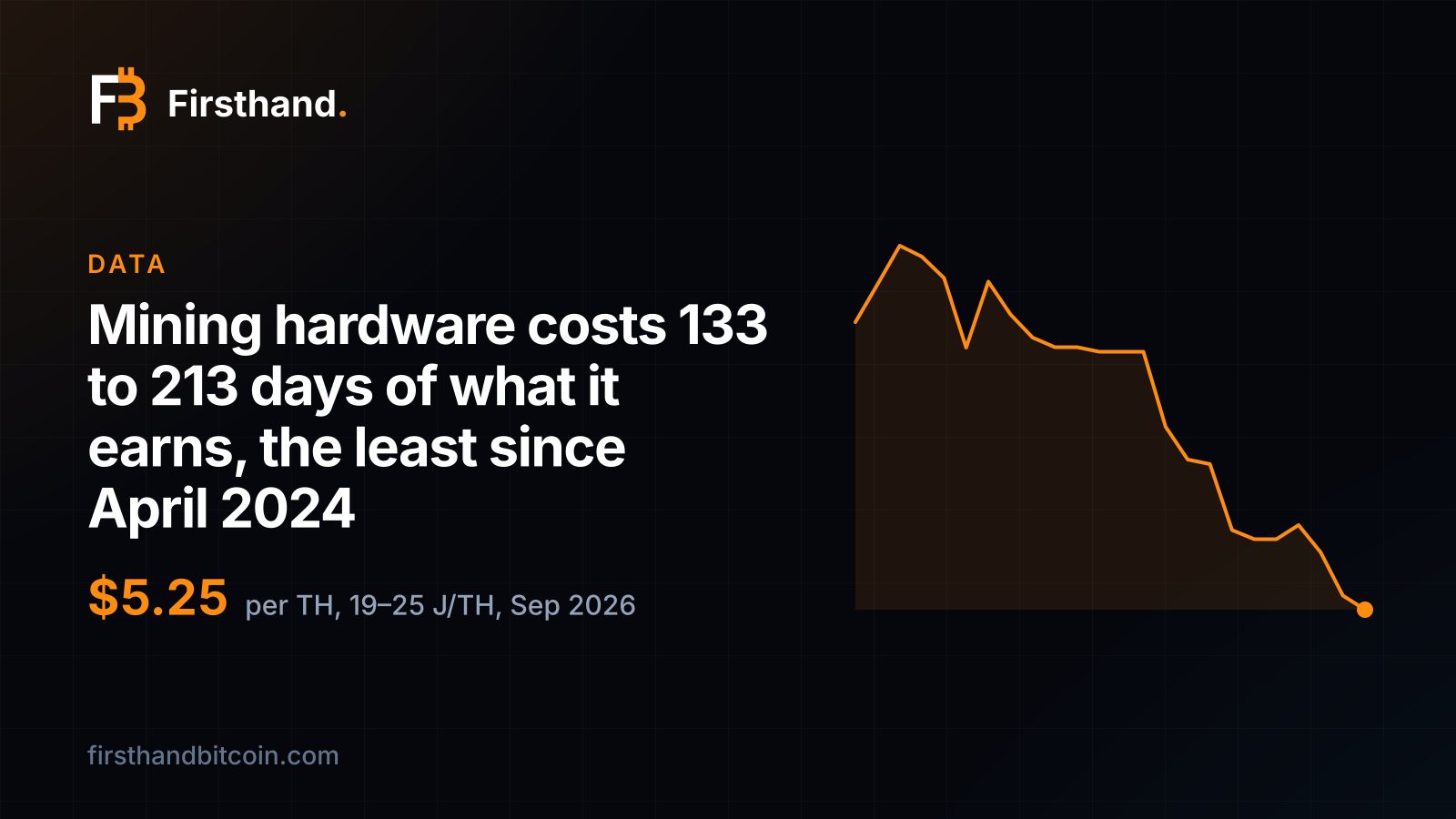
A terahash cost $8.42 in the newest class and $5.25 in the one below
Our miner price chart follows what a terahash of hashing costs to buy, split by how efficient the machine is. In September 2026 a terahash in the newest class, machines under 19 joules per terahash, cost $8.42. In the class one step down, 19 to 25 joules, it cost $5.25, the lowest reading in a series that starts in January 2018.
A year earlier the two classes cost $14.31 and $10.92. A terahash is now 41% cheaper to buy in the newest class and 52% cheaper in the older one. The newest class found its floor in April at $7.81 and has stayed between $8.42 and $8.82 since June. The older class has kept moving down, from $7.11 in June to $5.25.
The series is monthly. Until March 2025 it is a wholesale index; from April 2025 it is our own price collection, averaged by month. Both are what a terahash costs to enter, which is the figure that matters to someone buying.
The newest class has held near $8.42 a terahash since June. The class below it keeps getting cheaper.
What a terahash earns came down by less, and in bitcoin it went up
Hashprice is what one petahash a second earns in a day, and a terahash earns a thousandth of that. In September 2025 it averaged $52.06 a petahash a day on our hashprice chart. In September 2026 it averaged $39.53, 24% less. The bitcoin price averaged $113,009 in September 2025 and $80,390 in September 2026, 29% less.
So the dollars a terahash earns came down by 24%, while the dollars it costs to buy came down by 41% in the newest class and 52% in the older one. Counted in bitcoin the picture is better. A petahash earned 0.000461 bitcoin a day in September 2025 and 0.000492 in September 2026, 6.8% more, on our hashprice in bitcoin series. Our piece on a petahash earning 13% more than at the 2025 record reads the same series from a different starting day.
That is what a low entry price looks like in numbers: the price of a terahash has come down further than what it earns, and what it earns in coins has gone up.
Against what it earns, hardware has not been this cheap since April 2024
A price per terahash means more beside what a terahash earns. Divide one by the other and you get the days of earnings it takes to equal the price of the hardware. In September 2026 the newest class cost $8.42 against $0.0395 a terahash a day, which is 213 days. The 19 to 25 joule class cost $5.25, or 133 days. A year earlier the two classes took 275 and 210 days. That is 23% fewer days in the newest class and 37% fewer in the older one.
The days count earnings before electricity, so they say how cheap the hardware is, not how soon it pays back. On that measure 213 days is the lowest for the newest class since April 2024, when it was 209, and 133 days is the lowest for the older class since the same month, when it was 126. The cheapest months in the record were March 2024, at 185 days and 109, both from the wholesale index.
Hardware is the part of the bill paid once. The next section is the part paid every day.
| Efficiency class | Sep 2025, $ per TH | Sep 2026, $ per TH | Days of earnings, Sep 2025 | Days of earnings, Sep 2026 |
|---|---|---|---|---|
| Under 19 J/TH | $14.31 | $8.42 | 275 | 213 |
| 19 to 25 J/TH | $10.92 | $5.25 | 210 | 133 |
The cheaper class is cheap because power takes more of what it earns
A lower price per terahash says nothing about the electricity. The 19 to 25 joule class runs up to 25 joules per terahash, and the power price at which a machine stops covering its electricity is its hashprice divided by its energy use, drawn on our break-even chart. At 17 October's hashprice of $38.87 a petahash a day, a 25 J/TH machine breaks even at 6.5¢ a kilowatt-hour. At 19 J/TH, the top of the newest class, it is 8.5¢. At 13.5 J/TH it is 12.0¢. These are the least efficient machines in each class; the rest of each class sits better than its line.
Our sites charge 3.9¢ in Nigeria and 6¢ in Argentina and the UAE. At 6¢ a 25 J/TH machine keeps 7% of what it earns after power, and at Nigeria's 3.9¢ it keeps 40%. A 19 J/TH machine keeps 30% at 6¢ and 54% at 3.9¢. A 13.5 J/TH machine keeps 50% and 67%.
The price gap between the classes says the same thing. The older class costs 38% less per terahash than the newest, against 24% less a year ago. Put the other way, a terahash in the newest class costs 60% more than one in the class below it, up from 31% in September 2025. A lower hashprice hits the machines that burn the most power first, and that is the direction the gap moved.
| Efficiency | Break-even power price | Share of earnings left at 3.9¢ | Share left at 6¢ |
|---|---|---|---|
| 13.5 J/TH | 12.0¢ | 67% | 50% |
| 19 J/TH | 8.5¢ | 54% | 30% |
| 25 J/TH | 6.5¢ | 40% | 7% |
A coin on the best machine still costs about $18,000 to make
The most efficient machine we stock, the Bitmain Antminer S23 XP Hyd at 8.9 J/TH, running at our Nigeria site, makes a coin for about $17,900 in electricity at today's hashprice. The market price on 17 October was $81,532, so a coin costs 22% of its price to make on the best case. That counts electricity only and leaves out the machine and the pool fee.
It is the best case, not an average. It sits in the newest class, the one that costs $8.42 a terahash. What a buyer pays for a machine in full, with freight and setup, is in the price of a miner is not the price of the box. What a coin costs the machine every day after that is the electricity above.
What it means for a miner
Hardware is cheaper to enter than at any time since April 2024, and the power bill is the part that does not shrink with it. A terahash that costs $5.25 and burns 25 joules is a different purchase from one that costs $8.42 and burns 13.5. The efficient machines on the cheapest power keep the most coins, and they are the machines the 2028 halving will test. Why efficiency decides how many halvings a machine survives is the longer argument.
To run the sum for one machine, our payback guide takes it in four steps. What the data says today is narrower: the entry price of hashing has come down by more than what it earns, and a petahash mines more bitcoin a day than it did a year ago. Electricity is the cost to watch, and the coins you keep are what it buys.
Sources and further reading
- Miner prices per terahash — Firsthand Bitcoin Data, Sep 2026 reading
- Hashprice — Firsthand Bitcoin Data, 17 Oct 2026
Disclosure
Firsthand Bitcoin sells and hosts mining hardware, including this machine. No manufacturer, distributor or affiliate programme paid for or reviewed this page and we take no commission on the links above. Historical figures are computed from daily bitcoin price and network hashprice, each day valued at its own prices. Nothing here is investment advice.