Home / Blog / Bitmain Antminer S19j XP
Field report · Oct 29, 2026 · 5 min read
Two years in, the Antminer S19j XP stopped once in the 2026 trough and crossed to Nigeria once
The S19j XP is a 21.5 J/TH air-cooled Bitmain machine, and the price we first hold for it is from October 2024. It ran in Argentina through the 2026 trough, was switched off for 16 days when hashprice fell under its power line, then crossed to Nigeria, where the line has never been reached.
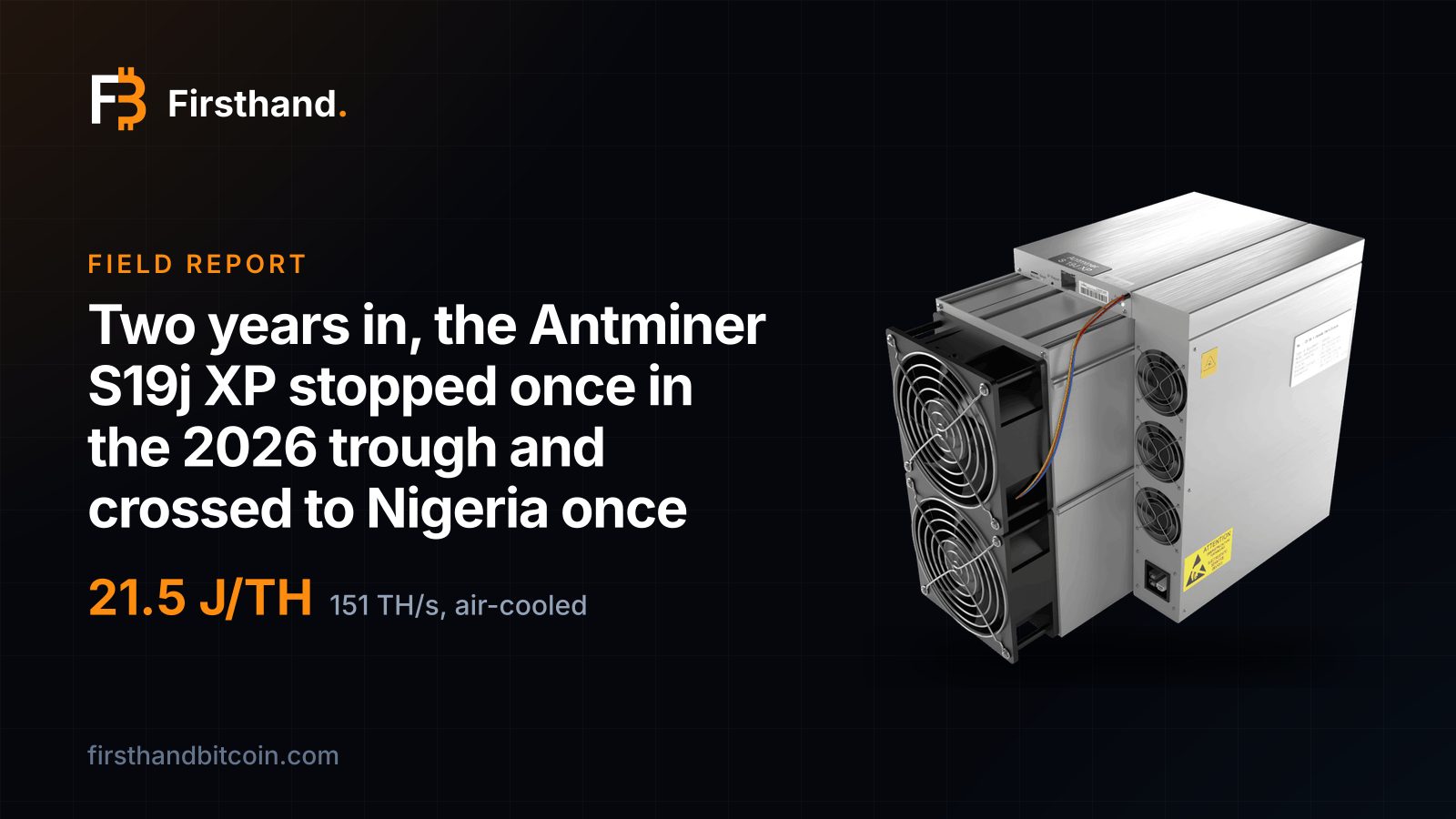
Bitmain Antminer S19j XP (151 TH/s)
Two years, one stop and one move
The S19j XP is a 151 TH/s air-cooled Bitmain machine rated at 21.5 J/TH and 3,247 W in our store record, launched in July 2023 according to the same record. The first price we hold for it is from 11 October 2024, so that is the day this run starts. Bought once its price settled, it cost $1,570. Landed at our Argentina site, with freight, duty, setup and its place in a rack, the all-in cost was $2,513.
In 735 days since it has mined and kept 0.0513 BTC, worth about $3,988 today, for $2,990 of electricity. That is $998 of cashflow, or 40% of its landed cost, and an average of about $58,300 of power per coin over the whole run. Not one coin was sold. The review of the S19j XP has the machine as it stands today; this is what it did to get here.
It started after the halving, when a petahash paid $44.75 a day
The machine was bought six months after the April 2024 halving. Hashprice, what a petahash earns, was $44.75 on 11 October 2024 and $36.31 on 28 October 2026, on our hashprice chart. Bitcoin was $61,514 then and $80,809 on 28 October 2026, but difficulty rose from 92.05 trillion to 140.58 trillion, so each petahash earns fewer coins.
From the day it was bought to the end of January 2026, hashprice never fell under the machine's 6¢ power line. The first day under it was 5 February 2026, which is why the cashflow line below climbs for fifteen months before it flattens.
February to July 2026: 55 days under its line
A machine's line is the hashprice at which it stops covering its own power. At 21.5 J/TH a petahash uses 516 kWh a day, which is $30.96 at Argentina's 6¢ and $20.12 at Nigeria's 3.9¢. Hashprice was under the 6¢ line on 55 days between 5 February and 11 July 2026, with a low of $27.74 on 6 June, $3.22 under.
The machine was switched off on 28 February 2026 and stayed off for 16 days, with hashprice at $29.15 that day. No coins were mined in between and none were lost. It is the only stop in its record. The older S19j Pro, at 29.5 J/TH, sat out seven weeks in 2024, when its line was $42.48. Eight J/TH is the difference between seven weeks off and 16 days.
Its line was $30.96 a petahash a day at 6¢. Hashprice touched $27.74.
One move, to Nigeria, on 17 March 2026
After the stop it made its one move, to Nigeria, where it has run 229 days at 3.9¢. It spent 506 days in Argentina before. A crossing is freight, customs and downtime at both ends, so a machine makes it once and does not shuttle, which is the rule in a machine crosses to cheap power once.
At Nigeria's 3.9¢ its line fell to $20.12. Hashprice's lowest day since the move was $27.74, on 6 June 2026, and its lowest 30-day average $30.09, to 3 July 2026. Both are above the line by $7 or more, and the machine has not been switched off since.
Where it stands now
Hashprice was $36.31 on 28 October. That is above the Nigerian line of $20.12 and above the Argentine line of $30.96 by $5.35, which is why today's cost per coin is $48,500 at 3.9¢ and $74,600 at 6¢, and why one bought at today's price returns 33% in a year in Nigeria and 4% in Argentina.
The forward figures to the April 2028 halving add 0.025 BTC, $3,172 with bitcoin back at $124,493. That is today's conditions held flat, not a forecast. Held flat, the halving puts hashprice near $18.16, under even Nigeria's $20.12 line by $1.96: at 21.5 J/TH the machine's work after April 2028 depends on power cheaper than Nigeria's.
What it says about the next machine you buy
Nothing about this machine failed. It mined every day it was on, it kept every coin, and it has covered 40% of its landed cost. The one stop came from its efficiency: a few J/TH separate the machine that pauses from the machine that does not, and that margin is set at purchase. The guide to efficiency and halvings is the long version.
The same logic runs forward. A machine at 15 J/TH has a line of $21.60 at 6¢, and one at 9 J/TH, $12.96. The figure below ranks what we would put in its place today, on cost per coin and then year-one return.
- MicroBT Whatsminer M74S+ (332 TH/s) — 12 J/TH, In stock, $41,644 of electricity per bitcoin, 26% year one
- MicroBT Whatsminer M73S (560 TH/s) — 13 J/TH, In stock, $45,114 of electricity per bitcoin, 30% year one
- MicroBT Whatsminer M70S (260 TH/s) — 13.5 J/TH, In stock, $46,850 of electricity per bitcoin, 25% year one
Which machines this covers
The other side of this machine
Antminer S19j XP review: a low box price for 21.5 J/TH, and Nigeria is where it pays — Bitmain's 151 TH/s air-cooled S19j XP costs a fraction of any newer machine per terahash. Its 21.5 J/TH means a coin costs far more to make than on an S21, so the case rests on a cheap box and cheap power, and it holds after the 2028 halving only at Nigeria's rate.
Disclosure
Firsthand Bitcoin sells and hosts mining hardware, including this machine. No manufacturer, distributor or affiliate programme paid for or reviewed this page and we take no commission on the links above. Historical figures are computed from daily bitcoin price and network hashprice, each day valued at its own prices. Nothing here is investment advice.