Home / Blog / Guide for first-time buyers
Guide · Oct 3, 2026 · 6 min read
How hosting a bitcoin miner works, step by step, from checkout to first payout
Hosting means your machine lives in an industrial building while the coins are paid to your own wallet. Seven steps take it from checkout to first payout, and after checkout the only regular bill is the electricity.
Hosting exists because a miner does not belong in a house
A modern miner is built to run flat out, day and night. The air-cooled Antminer S21 XP, which the store lists at 270 TH/s, draws 3,645 watts and is rated at 76 decibels. Nearly every watt it draws leaves as heat, so it is a space heater that never switches off, with a fan noise to match.
That is a lot to ask of a garage. It needs a heavy electrical supply, somewhere for the heat to go, a network line that does not drop and someone to notice when it stops. Water-cooled and immersion machines are quieter, but they need a loop or a tank that very few buyers have.
Hosting is the answer. You own the machine, and a host provides the building around it: rack or tank space, electrical capacity, cooling, network, security and monitoring. The rest of this guide follows one machine through seven steps, from checkout to the first payment in your wallet.
You own the machine and the coins. The host provides the building.
Step 1: choose the machine and the place it will live
The first step is really two choices. A machine's cooling decides where it can live: air-cooled machines sit on racks with fans, water-cooled machines connect to a loop of pumped water, and immersion machines are lowered into tanks of fluid. The spec sheet guide shows where the cooling line is on the page.
The site then decides what you pay for power. On our sites page, as of 3 October 2026, hosting starts at 3.9¢ per kilowatt-hour in Nigeria and at 6¢ in Argentina and the UAE. The shop prices every machine against every site, so you can compare them before you spend anything.
Cheapest is not automatically best. A site with cheaper power can have fewer hours of uptime, and what a day offline costs is worth working out first. A machine can also move later: it crosses to cheap power once, when the saving has become large enough to justify the freight.
Step 2: pay one price, once
At checkout you pay the all-in price: the machine, freight, import duty, customs, setup and a hosting deposit, which is electricity paid in advance and held against your bills. The price of a miner is not the price of the box takes each line in turn.
Ask for the deal in writing and check what it records. At Firsthand the Order Confirmation lists the make, model and quantity, the serial numbers once they are allocated, your rate per kilowatt-hour, the estimated start date and any deposit. Those are the five things you will want to point back to if anything is ever unclear.
Step 3: the machine travels, is racked and is switched on
Once the order is paid, the machine ships to the site, clears customs and is unpacked and inspected. Then it is racked or lowered into its tank, plugged into power and the network, and switched on. You do none of this yourself, which is the point.
Our Hosting Agreement sets a target of around two to four weeks from purchase to switch-on. It is a target and not a promise, because freight and customs can run over, so plan for the range rather than the best case.
Hosting fees start on the day the machine is energised and pointed at your pool and wallet, not on the day you paid. Until then the machine earns nothing and you are billed nothing for power.
Step 4: give it a pool and a wallet
A single machine on its own would wait decades for a block, so it mines through a pool, which shares the work and pays each machine for its part. What a mining pool is explains why. The pool needs two things from you: an account to mine under and a bitcoin address to pay.
A bitcoin address is a long string of letters and numbers that works like an account number that can only receive. You can share it with anyone, and it lets them send you bitcoin but not take any of yours. Copy it from your wallet rather than typing it.
Have both ready before the machine lands. A machine with nowhere to send its coins earns you nothing, and you will not want to be sorting out an address on switch-on day. Once they are set, the pool pays your wallet directly. The host never holds your coins.
A machine with nowhere to send its coins earns you nothing. Have the pool account and the address ready first.
Step 5: watch it from the pool, once a week
Your pool account is the plainest check on your machine, because it shows the hashrate your machine is really delivering. A machine that is running looks like a steady line near its rating. A stopped machine is a gap, and one with a failed board is a lower step.
Take the 2 October 2026 close on our hashprice chart as a yardstick. One petahash earned 0.00047767 bitcoin that day, so a 270 TH/s machine, which is 0.27 petahash, earned about 0.000129 bitcoin, worth $10.94 at the day's close of $84,862. A healthy machine should be in that neighbourhood, before the pool's fee.
Read it weekly rather than hourly. A pool's hashrate figure is an estimate and moves around from one reading to the next, so one low reading means little. A gap of hours, or a week whose average sits well below the rating, is worth a message to your host.
Step 6: the one regular bill is the electricity
After checkout, the regular bill is the hosting fee for the power your machine used. At Firsthand it is invoiced monthly in arrears, on the first of the month for the month before, and it is due within five days. The invoice shows the figures for each machine. You can pay by bank transfer, ACH or wire, or in crypto.
Work out where the money comes from before the first invoice. The coins themselves are not part of the bill, so you can pay it from income, from a reserve or in advance, and keep every coin. Nobody sells the coins to pay the power bill shows why that matters over a halving.
One safety habit is worth keeping. Payment details should come from your dashboard only, and a real host will never ask you to change where you send money by email, message or phone. Treat any request like that as a fraud.
Step 7: when something breaks, and when you want out
Every machine develops faults eventually, and a host is there to deal with them. Machines come with the manufacturer's twelve-month warranty, and a dead or failing unit inside it goes to the manufacturer through your host. After the warranty, a failed hashboard is a parts bill rather than an emergency. The repair guide covers who fixes what at each site.
Leaving is meant to be plain. Hosting runs month to month with no minimum term, either side can end it on thirty days' written notice, and there is no termination fee. Once what you owe is paid, the machine is yours to collect: the host's staff de-rack and pack it, and you pay a small per-machine fee and the carrier, quoted before anything ships.
That is the whole arrangement. The machine and the coins are yours, and the host runs the building and bills for the power.
Six questions to put to any host before you pay
Ask what the monthly fee includes, and whether the rate per kilowatt-hour is written down and can only change by agreement. Ask how long it takes to switch the machine on, and from which day fees begin.
Ask where your coins go. The right answer is straight from the pool to a wallet you control. Ask for the site's uptime over the last twelve to twenty-four months and how a machine running at half speed is counted.
Finally, ask what leaving looks like: the notice period, any fee, and how the machine gets back to you. A host that answers all six in a line each is easy to trust, and easy to check once your own graph is running.
What it means for a miner
Hosting turns mining into one choice and one bill. Pick the machine and the site, keep the pool account and the address ready, read your graph weekly and pay the electricity. Everything else is the host's job.
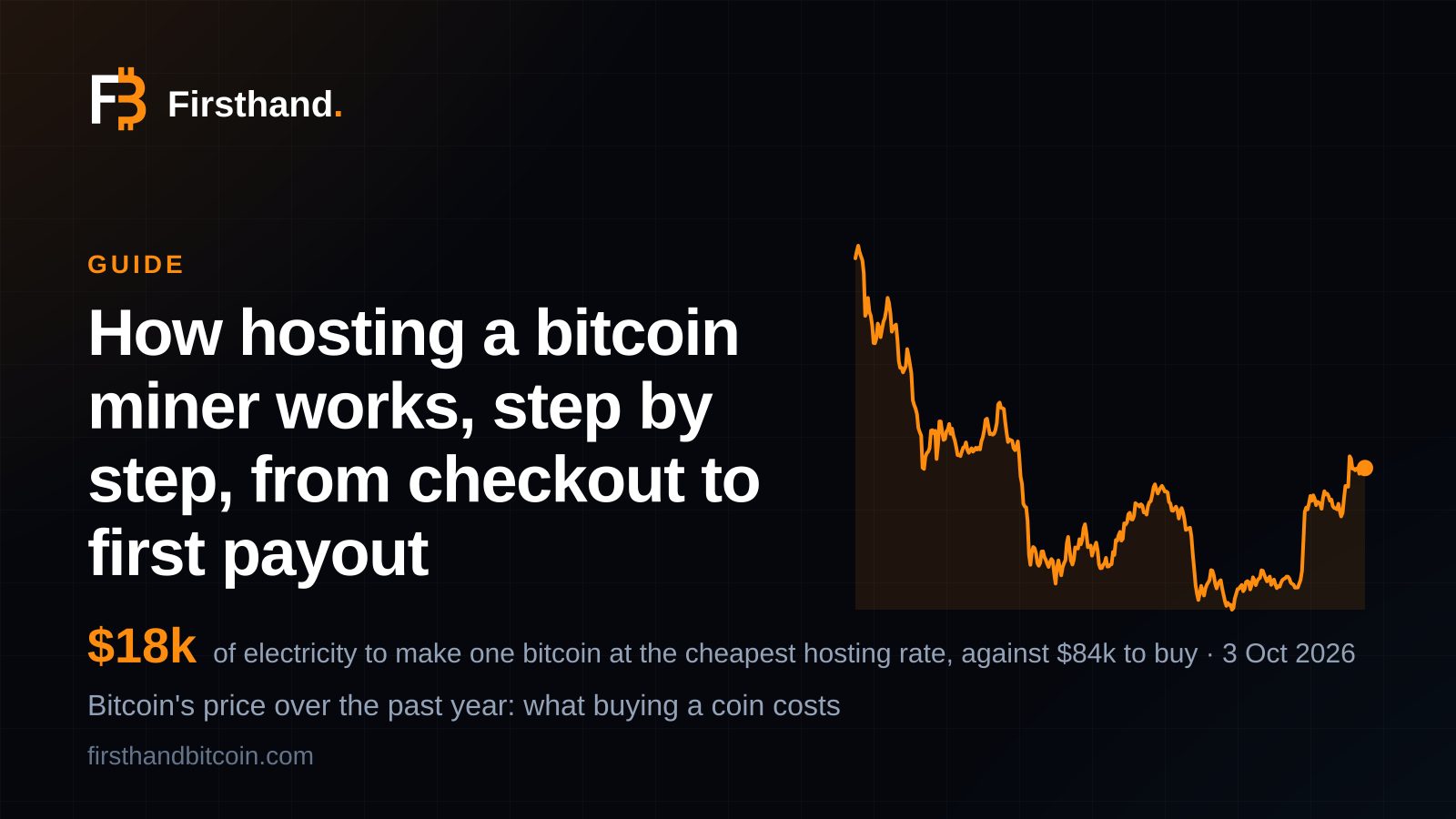
The electricity is what a coin costs to make, and it is why the arrangement is worth setting up. On today's numbers the most efficient machine in stock, at the cheapest site that can run it, comes to about $18k to make, $84k to buy. That is electricity only, at today's hashprice, before the machine and the pool fee. Hosting is what lets a first-time buyer reach it without building a power plant.
Mining output depends on bitcoin's price, network difficulty and uptime, and is not guaranteed. Nothing here is investment advice.
Disclosure
Firsthand Bitcoin sells and hosts mining hardware, including this machine. No manufacturer, distributor or affiliate programme paid for or reviewed this page and we take no commission on the links above. Historical figures are computed from daily bitcoin price and network hashprice, each day valued at its own prices. Nothing here is investment advice.