Home / Blog / Bitmain Antminer T19 Hyd
Field report · Oct 20, 2026 · 6 min read
A year in the UAE, then Nigeria: the Antminer T19 Hyd has paid for its box several times over
Bitmain's liquid-cooled T19 Hyd was bought in December 2022, ran a year in the UAE and crossed once to Nigeria. Most of its coins came before the April 2024 halving. In 2026 hashprice sank under even Nigeria's break-even line for the first time, and it stood switched off in two stretches.
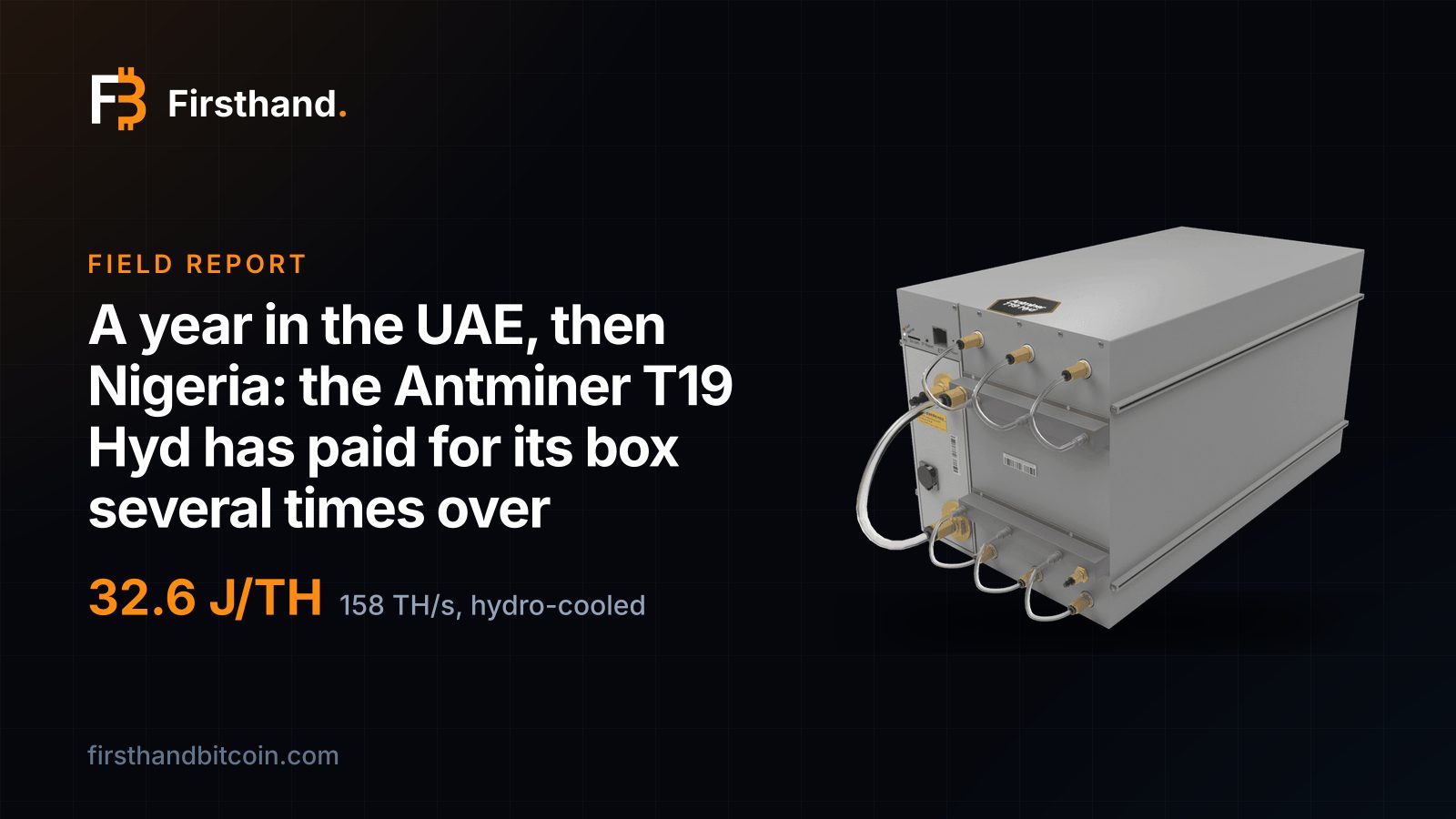
Bitmain Antminer T19 Hyd (158 TH/s)
A box bought for $2,214 has kept 0.2367 bitcoin
The Antminer T19 Hyd is a liquid-cooled SHA-256 machine from Bitmain at 32.6 J/TH. Bitmain put the T19 Hydro on sale on 13 June 2022, according to ForkLog's report of the launch. The unit we follow is the 158 TH/s version, which our store lists at 5,151 W in a 15.8 kg chassis, 410 mm long, 170 mm wide and 209 mm tall.
Bought once its price settled, on 10 December 2022, it cost $2,214. Landed at our UAE site, the all-in cost was $3,425. In 1,278 days since it has mined and kept 0.2367 BTC, worth about $19,306 today, for $6,462 of electricity. That is $12,844 of cashflow, or 375% of its landed cost, with every coin kept: it has paid for its box 3.8× over.
Most of its coins came in the first 497 days
The T19 Hyd was bought 16 months ahead of the April 2024 halving. In the 497 days before it, the machine kept 0.1846 BTC, 78% of everything it has mined, in 39% of its life so far. Those coins are worth about $15,058 today, against a landed cost of $3,425.
A petahash earned $63.90 a day on the day we bought it, when bitcoin was $17,158, and $139.13 on 20 April 2024, the halving day, on our hashprice chart. After the halving the machine kept 0.0522 BTC in 781 days. Its cash margin after electricity, at the prices of each day, was about $4.38 a day before the halving and about $1.73 a day after. A machine bought well ahead of a halving is paid for in advance by the months before it, and the T19 Hyd was.
The T19 Hyd kept 78% of its coins in the first 39% of its life, before the subsidy halved.
One year in the UAE, then a single move
A hydro machine starts in the UAE for the reasons in air, hydro or immersion: the cooling plant is there and so is a manufacturer warranty centre. The T19 Hyd ran 364 days at the UAE's 6¢ without a day off. At 32.6 J/TH a petahash uses 782 kWh a day, so its line, the hashprice below which it stops covering its own power, was $46.95 at 6¢. Hashprice never touched it that year.
Then it made its one move. On 9 December 2023 it crossed to Nigeria, on a day when hashprice was $93.48, nearly twice the UAE's line. It was not forced out. But a year of figures said that cheap power was the better home for a 32.6 J/TH machine, and a crossing is freight, customs and downtime at both ends, so a machine makes it once and does not shuttle. That is the rule in a machine crosses to cheap power once. It has run 914 days in Nigeria since.
2026 took hashprice under Nigeria's line for the first time
Since the halving, hashprice has been under the 6¢ line of $46.95 on 479 of 914 days, just over half of them, so at 6¢ the machine would have been losing money on more days than not. Under Nigeria's line of $30.51 it has been on 43 days, all of them between 6 February and 10 July 2026. The lowest was $27.74 on 6 June 2026, 9% under it.
The machine stood switched off for 133 days in 2026, in two stretches: from the end of February to the end of April, and from mid-June to the end of August. Before 2026 it had not stood idle for a single day. Switching off a machine that no longer clears its power is the rule, not a failure, and every coin it had made stayed where it was.
Hashprice was under Nigeria's line on 43 days, all in 2026. Before that, the T19 Hyd had never stood idle.
What is left, and what the halving does to it
Today a coin costs it about $74,100 of electricity at Nigeria's 3.9¢, against a bitcoin price of $81,488. That is today's difficulty; over its whole life the average has been $27,302 a coin. At the UAE's 6¢ a coin would cost about $114,000, which is more than a coin is worth. A new owner would see 3% in a first year in Nigeria.
Hashprice was $38.89 a petahash a day on 15 October, the last day not marked as an estimate: 27% above Nigeria's line and 17% under the 6¢ line. The April 2028 halving halves what a petahash earns. At today's price and difficulty that puts hashprice near $19.44, well under Nigeria's $30.51. The forward figures assume what every forward projection does, that bitcoin returns to its previous high. At $124,493 a halved hashprice would be about $29.68, 3% under Nigeria's line. So even on that assumption the T19 Hyd would be at the edge of what Nigeria's power can carry. The forward figures to the halving add 0.030 BTC, worth about $3,783 at that price, which would take cashflow to about 4.9× the landed cost.
A machine that no site can pay for is switched off rather than mined at a loss, and it keeps every coin it has made.
What it says about the next machine you buy
Machines are the roof, not the building, as the roof guide puts it: the test is whether a machine earned enough to buy its replacement. The T19 Hyd has banked $12,844 after electricity against a $3,425 landed cost, so it has, several times over.
We found no operator survey of this machine to cite, so reliability is unknown rather than good. What exists is a repair shop's guide to hydro Antminers. D-Central says that "a large share of hydro faults are hydraulic, not electronic": no flow, a closed valve, coolant over temperature or a trapped air pocket, in its list of hydro miner faults. That is general guidance and not a failure rate for the T19 Hyd.
The arithmetic for its replacement is plain. A 13.5 J/TH machine has a line of $12.64 at Nigeria's 3.9¢, far under a halved hashprice, and the best machine we stock makes a coin for about $20,200 of electricity against $81,488 to buy one, as the S23 XP Hyd page shows. The figure below ranks what we would put in the T19 Hyd's place today, on cost per coin and then year-one return.
- Bitmain Antminer S23 Hyd (563 TH/s) — 9.5 J/TH, In stock, $21,559 of electricity per bitcoin, 22% year one
- Bitmain Antminer S21j XP Hyd (495 TH/s) — 12 J/TH, In stock, $27,133 of electricity per bitcoin, 37% year one
- Bitdeer SealMiner A3 Pro Hyd (666 TH/s) — 12.5 J/TH, In stock, $28,000 of electricity per bitcoin, 30% year one
Sources and further reading
- Bitmain launches Antminer T19 Hydro with 145 TH/s hashrate — ForkLog, 13 Jun 2022
- Hydro miner troubleshooting: identifying and resolving issues — D-Central, 2026
Which machines this covers
Disclosure
Firsthand Bitcoin sells and hosts mining hardware, including this machine. No manufacturer, distributor or affiliate programme paid for or reviewed this page and we take no commission on the links above. Historical figures are computed from daily bitcoin price and network hashprice, each day valued at its own prices. Nothing here is investment advice.