Data insight · Oct 20, 2026 · 5 min read
Bitcoin confirms 49% more transactions than a year ago, from 12% fewer active addresses
In the 30 days to 14 October, bitcoin confirmed 702,000 transactions a day, 49% more than a year earlier, while active addresses fell 12%. Each address now accounts for more transactions than in any year of our data. Fees did not follow, and a miner's income is still the subsidy.
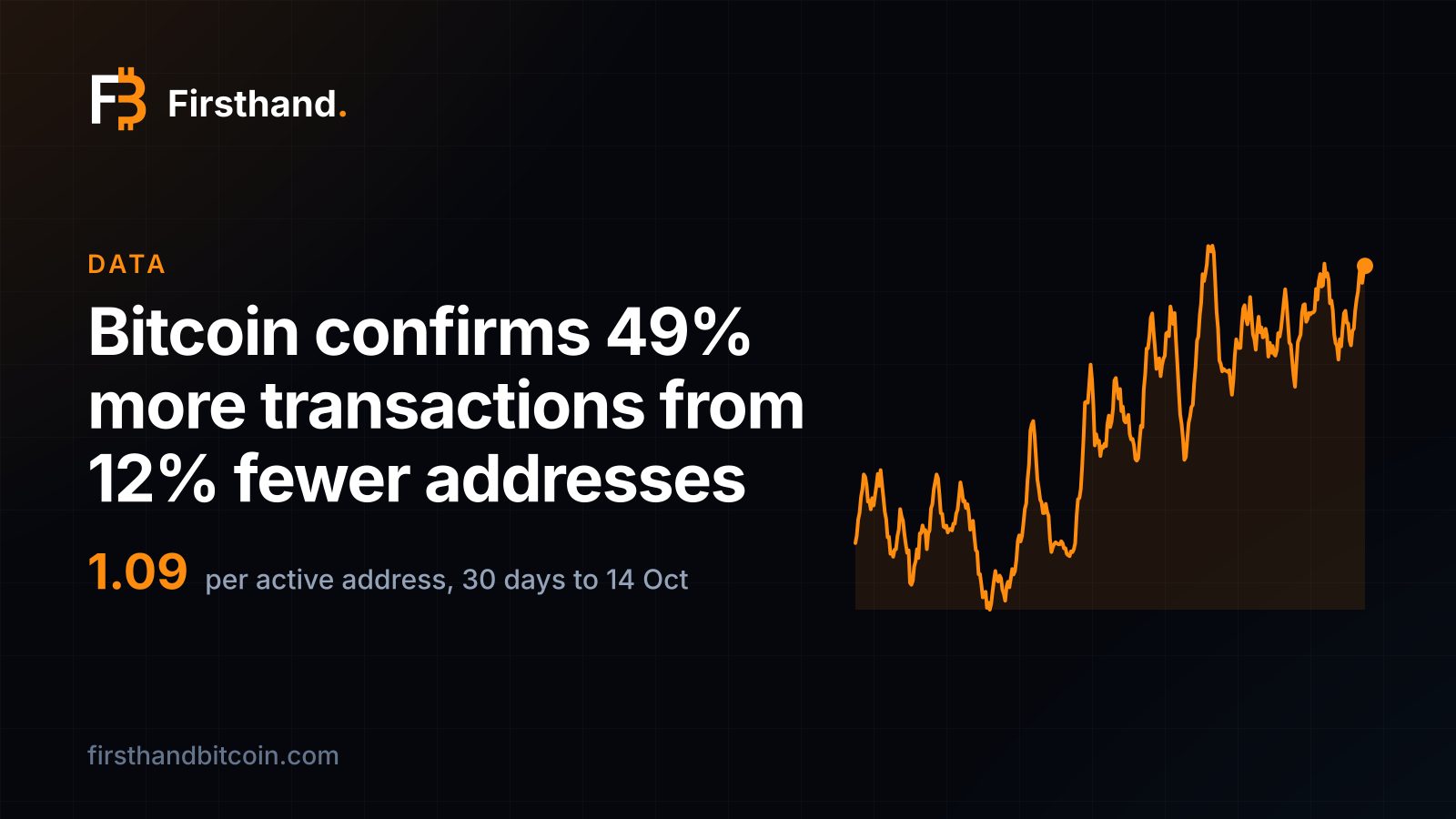
More transactions, from fewer addresses
In the 30 days to 14 October 2026, bitcoin confirmed an average of 701,660 transactions a day. In the same 30 days a year earlier it was 469,638, so the chain is 49% busier. Over the same two windows, the number of addresses active each day fell from 729,972 to 644,263, down 12%.
Divide one by the other and each active address was involved in 1.09 transactions a day in the latest window, against 0.64 a year earlier. We have a busiest-year piece on how much that traffic pays. This one is about who is generating it, and the answer in the data is: fewer parties, doing more each.
For 13 years, more traffic meant more addresses
Averaged over each calendar year, transactions per active address were 0.27 in 2021 and 0.28 in 2022. They rose to 0.44 in 2023, 0.68 in 2024 and 0.58 in 2025. For 2026 to 14 October the figure is 0.92, the highest of any year since our data starts in 2013.
On a rolling 30-day basis, from mid-June 2013 onward the ratio never reached 1.0 until 30 May 2026. The highest 30 days before this year ended on 8 September 2024, at 0.99. The highest this year ended on 20 September, at 1.12.
The addresses themselves have thinned. The 2026 average to 14 October is 635,569 a day, the lowest of any calendar year since 2016, and 36% below 2021's 990,065. In the same comparison, transactions are 2.2 times higher: 587,134 a day against 267,935.
Transactions per active address: 0.27 in 2021, 1.09 in the 30 days to 14 October.
The third-busiest day ever had half the addresses of 2021
On 5 October 2026 the chain confirmed 899,894 transactions, the third-largest day in our record. Only 927,010 on 23 April 2024 and 910,083 on 8 September 2024 were bigger. That day, 660,864 addresses were active.
The most active day for addresses in our data was 15 April 2021, with 1,366,494, when bitcoin traded near $62,700. The 5 October count is 52% lower, on a day when the chain handled about two and a half times the transactions (359,440 on 15 April 2021).
The record day itself, 23 April 2024, had 927,010 transactions from 547,174 addresses, so a busy day on thin address counts is not new. What is new is that ordinary days look like that now: 206 of the 287 days of 2026 to 14 October topped 500,000 transactions.
The Data section holds both series. Our figures count confirmed transactions and the addresses that sent or received in them. They show more activity per participant. They do not say who is behind it.
The blocks barely grew. The transactions inside them shrank
The extra traffic did not need extra space. Average block size in the 30 days to 14 October was 1.58 MB, up 6% from 1.49 MB a year earlier. Transactions per block rose 48%, from 3,201 to 4,723. Spread across the block, the average transaction is about 335 bytes now against about 466 bytes a year earlier, more than a quarter smaller.
In the 30 days to 14 May 2021 a block averaged 1.34 MB and 1,906 transactions, about 700 bytes each. Blocks have carried 1.3 to 1.6 MB in each of these windows, and what changed is how many transactions fit in them. The block-size chart shows both series.
That is the mechanical reason the fee queue is empty. When blocks fill up, users outbid each other and miners are paid for it. When each transaction takes less room, the same blocks hold more of them and nobody has to bid.
The fees did not follow
Users paid miners an average of 2.95 bitcoin a day in fees over the 30 days to 14 October, against 3.51 a year earlier, a fall of 16% on 49% more transactions. Per transaction that is 421 satoshis, down from 747. The block subsidy is 3.125 bitcoin a block, about 450 a day, so fees are under 1% of what miners are paid. Glassnode's co-founder Rafael Schultze-Kraft said in August that fees had been under 1% of miner revenue for almost a year, according to Cointelegraph.
Compare the 30 days to 14 May 2021, when fewer than 275,000 transactions a day paid miners 144.29 bitcoin a day, or 52,622 satoshis each. Then the extra demand was a pay rise for miners. This time more transactions arrive and the fee chart barely moves, because blocks are not short of space for them.
Transactions up 49%. Fees paid to miners down 16%.
What it means for a miner
A busier chain is good for bitcoin's use, and it is not income for a machine. Miners are paid almost entirely in new coins, and that subsidy halves again in April 2028. Fees have been under 1% of the pay for about a year, and 49% more traffic did not lift them.
What decides a machine's return is what it costs to make a coin. On our best case, an Antminer S23 XP Hyd on Nigeria's power, that is about $18,000 for electricity, against a market price of about $82,000 on 20 October. See the machine and the hashprice chart. That gap, and keeping the coins, is what a miner builds on. The transaction count is something to watch, and it is not something to count on.
Sources and further reading
- Bitcoin miners earn under 0.7% of revenue from fees in new 10-year low — Cointelegraph, 12 Aug 2026
Disclosure
Firsthand Bitcoin sells and hosts mining hardware, including this machine. No manufacturer, distributor or affiliate programme paid for or reviewed this page and we take no commission on the links above. Historical figures are computed from daily bitcoin price and network hashprice, each day valued at its own prices. Nothing here is investment advice.