Data insight · Oct 16, 2026 · 5 min read
Blocks ran 6% fast for two weeks, so bitcoin's difficulty is about to rise 6%
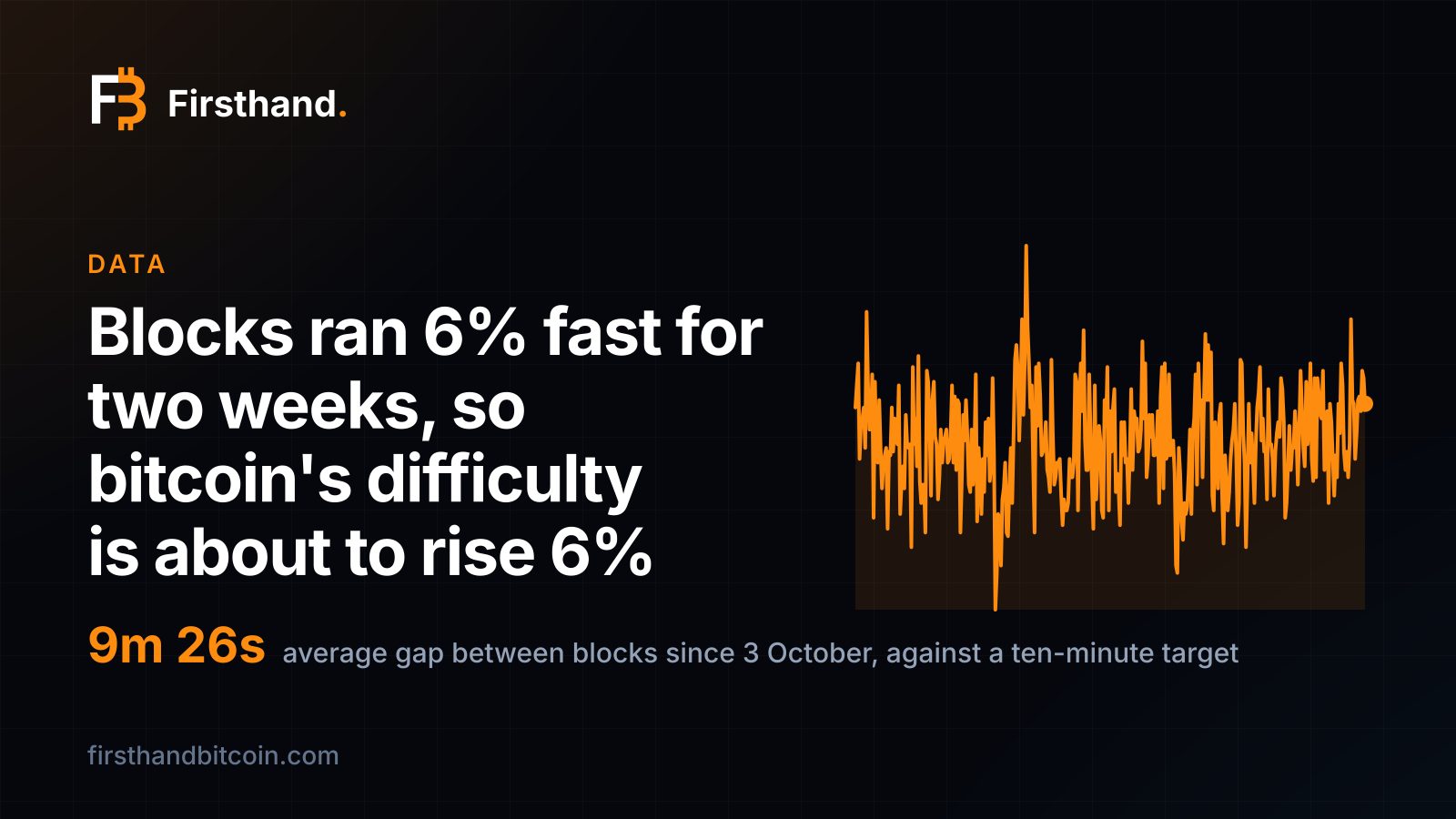
Hashrate rose about 6% over the last two weeks, so blocks arrived 9 minutes 26 seconds apart instead of ten, and difficulty is due to reset about 6% higher on 16 October. Here is the arithmetic, how rare a step this size is, and what it does to a machine.
The last window ended exactly on schedule
Bitcoin is built to find one block every ten minutes, which is 144 a day. Every 2,016 blocks it checks how it did and resets the difficulty of the puzzle. The reset on 19 September raised difficulty 4.2%, and for the next two weeks the chain did what it was told: from 19 September to 2 October it averaged 143.9 blocks a day, against a target of 144, on our blocks-per-day chart.
The network's hashrate averaged 951 exahashes a second over those 14 days. That is almost exactly what the difficulty then in force assumed: a difficulty of 132.8 trillion is the puzzle that a network of about 950 exahashes solves in ten minutes. The following reset, on 3 October, moved difficulty by 0.03%, the smallest in six years, because there was nothing to correct, as we covered in the retarget that barely moved.
Then hashrate grew 5.6%
From 3 to 15 October the network's hashrate averaged 1,005 exahashes a second on our series, 5.6% above the previous two weeks. The machines did not need to be told the puzzle had not changed. They found blocks faster: 153 a day on average over the 13 days, with 10 of them above the 144 target. The fastest day was 5 October, with 177.
mempool.space has the exact count. On the morning of 16 October the chain stood at 1,989 blocks of the 2,016 in the window. At ten minutes a block it would have mined 1,877 in the 13 days since the last reset. It mined 6% more, which makes the average gap between blocks 9 minutes 26 seconds instead of ten.
Hashrate is estimated from how quickly blocks are found, so a single day swings by 10% or more on luck alone. In this window the daily reading ran from 869 exahashes on 4 October to 1,177 on 6 October. That is why this piece compares two-week averages and block counts, not days.
The machines found 1,989 blocks in the time the schedule allowed for 1,877.
The retarget is arithmetic, not a vote
The rule is in the Bitcoin developer guide: "Every 2,016 blocks, the network uses timestamps stored in each block header to calculate the number of seconds elapsed", and "the ideal value is 1,209,600 seconds (two weeks)." If the window took less, difficulty rises by the same ratio.
This window will have taken about 1,141,000 seconds. Divide 1,209,600 by that and you get 1.06: difficulty rises about 6%. mempool.space puts the estimate at +6.0% with 25 blocks to go, at block 971,712, due around midday UTC on 16 October. The final number will differ by a few tenths, because the last blocks still have to be found, and the timestamps in them are what count.
Big upward steps are rare, and this is the fourth in a year
Of the 27 retargets since October 2025, 12 raised difficulty and 15 lowered it, and the average move was 3.8% in either direction. Only three were 6% or more upward: 6.3% on 29 October 2025, 14.7% on 19 February 2026 and 7.2% on 27 June 2026. A rise of 6.0% would be the fourth.
Two of them followed a large cut: the 14.7% in February came after a fall of 11.2%, and the 7.2% in June after a fall of 10.1%, when machines had switched off and then came back. This one is different. The window before it was flat, at 0.03%, so it is hashrate growing on top of a window that was already on schedule.
What it does to a machine
Difficulty is the other half of every machine's share. The same hashrate against a puzzle 6% harder finds 5.7% fewer coins. A petahash earned 0.000477 bitcoin a day on 15 October on our hashprice chart. After the reset it would earn about 0.000450, at an unchanged price and fees.
The effect on a cost per coin is the same in the other direction. The most efficient machine we stock, the Antminer S23 XP Hyd at 8.9 J/TH, makes a bitcoin for about $17,900 of electricity at Nigeria's 3.9¢ today. A 6% harder puzzle takes that to about $19,000, against a market price of about $82,100. That is electricity only, and output is not guaranteed.
Difficulty will then stand at about 140.7 trillion, roughly 10% below the record of 156.0 trillion set on 29 October 2025. We followed that gap in difficulty is still below its peak; this reset closes about a third of it.
What it means for a miner
A retarget is the network telling every machine how many others joined in the last two weeks. More hashrate is more competition, and the coins a machine earns shrink by the same share. The answer is in the machine, not the timing: a lower J/TH keeps the cost of a coin down when difficulty steps up, and a machine on cheap power stays above its line through every step. Our guide to what difficulty is has the long version.
The reset also tells you what the network is doing: it grew by about 5.6% in two weeks, while the price held between $81,100 and $86,600 from 19 September. Miners are adding machines, not leaving.
A harder puzzle is the cost of a network that keeps growing.
Sources and further reading
- Difficulty adjustment — mempool.space, 16 Oct 2026
- Block Chain: Proof Of Work — Bitcoin developer guide, 2026
Disclosure
Firsthand Bitcoin sells and hosts mining hardware, including this machine. No manufacturer, distributor or affiliate programme paid for or reviewed this page and we take no commission on the links above. Historical figures are computed from daily bitcoin price and network hashprice, each day valued at its own prices. Nothing here is investment advice.