Data insight · Oct 15, 2026 · 5 min read
Bitcoin's price fell 45% from October to June. Making one on the best machine got 11% cheaper
Between October 2025 and June 2026 the average price of a bitcoin dropped from $114,290 to $63,237. The electricity to make one on the most efficient machine we stock fell from $20,147 to $17,831, and it is about $18,000 today. The reason is the network, not the market.
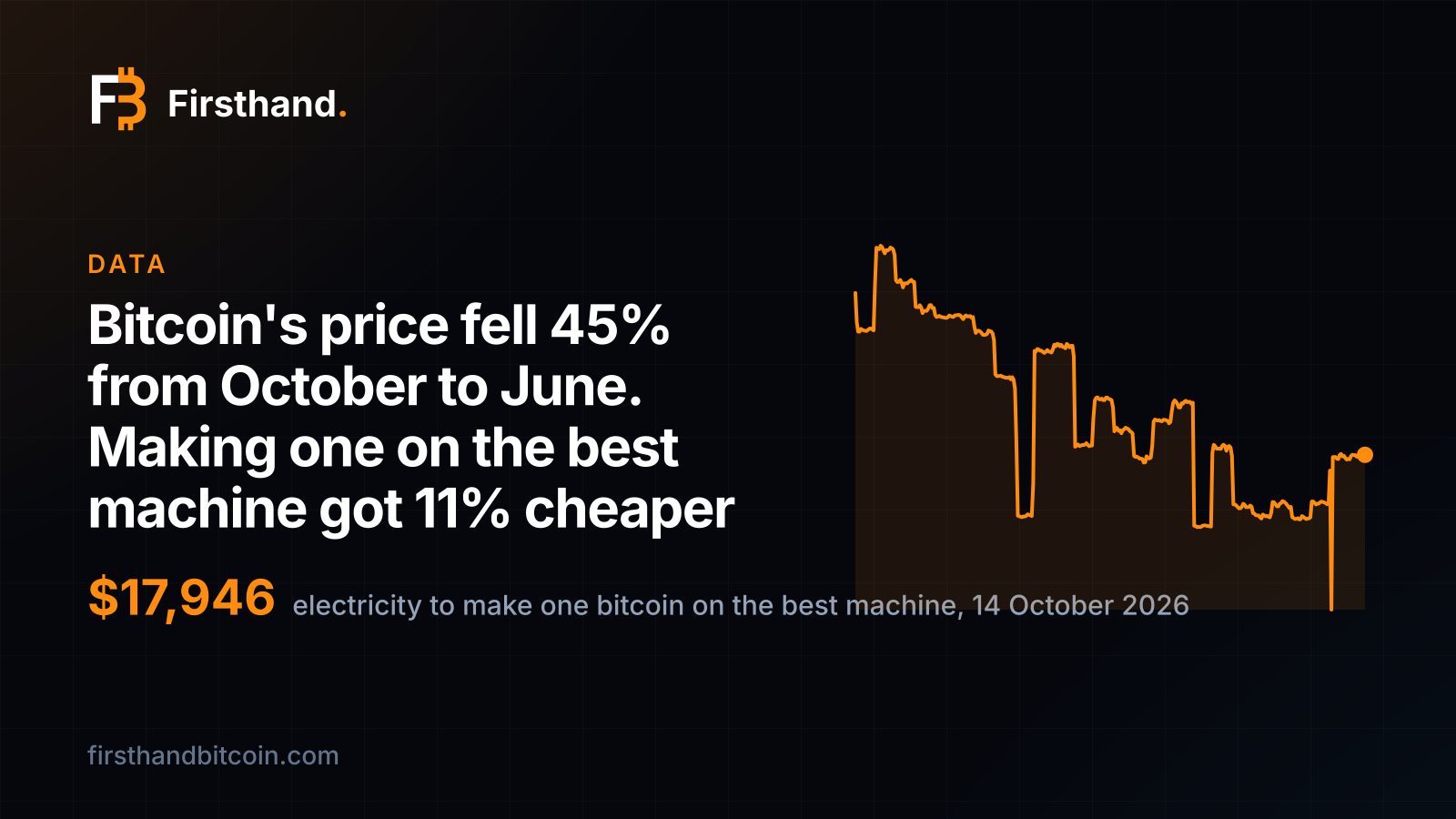
The price fell 45%. The cost of making a coin fell 11%
Bitcoin's average price in October 2025 was $114,290. By June 2026 it was $63,237, a fall of 45% on our price chart. Over the same eight months the electricity needed to make one bitcoin on the best machine, held fixed, went from $20,147 to $17,831. That is 11% less.
Nobody planned that. A coin costs what the network lets it cost, and in the months the market was weakest, the network was easiest to mine on. On 14 October the figure was $17,946, against a price of $83,094: a coin made on the best machine cost about 22% of a coin bought.
The yardstick is one machine at one site, held still
The figures here are for the most efficient machine in our store, the Antminer S23 XP Hyd at 8.9 J/TH, at Nigeria's 3.9¢ per kWh. They are electricity only, divided by the bitcoin a petahash earns that day on our hashprice chart. The machine is held the same for the whole year so that only the network can move the figure.
That machine did not exist in October 2025, so this is a yardstick, not a record of what anyone paid. It answers one question: if you had the best machine on the cheapest power, what did a coin cost you each day? Hardware is separate, as it is in every piece we write about keeping the coins.
The network got easier as the price fell
A petahash earned 0.000424 bitcoin a day on average in October 2025 and 0.000480 in June 2026, a rise of 13%. The cost of a coin moves the other way from that number, so it fell by about the same amount. The cause was difficulty, which averaged 149.6 trillion in October and 132.2 trillion in June.
Difficulty follows the hashrate behind it. When the price fell, machines that no longer covered their power were switched off, and the network re-set itself lower at each fortnightly adjustment, as we showed in the year's count of days miners switched machines off. Every machine still running then earned more coins. Every adjustment of the year is listed on mempool.space.
Since the August low the process has run the other way. The price recovered to an average of $83,889 in October and the cost rose to $17,926, still 11% below where it stood a year ago.
Lower prices pushed machines off, and a smaller network pays each machine more coins.
| Period | Average price | Cost to make one | Difficulty | Coins per petahash a day |
|---|---|---|---|---|
| October 2025 | $114,290 | $20,147 | 149.6T | 0.000424 |
| November 2025 | $96,532 | $20,697 | 153.2T | 0.000413 |
| June 2026 | $63,237 | $17,831 | 132.2T | 0.000480 |
| August 2026 | $69,262 | $17,095 | 126.7T | 0.000500 |
| October 2026, to the 14th | $83,889 | $17,926 | 132.7T | 0.000477 |
On no day of the year did the price meet the cost
From 15 October 2025 to 14 October 2026, bitcoin traded between $59,014 on 30 June and $115,115 on 27 October. Over those 365 days the cost of making a coin on the best machine never rose above $21,100, reached on 2 November, and the price was above it every day.
The closest the two came was 30 June. Bitcoin read $59,014, the cost was $18,040, and the cost was 31% of the price. On 6 June the ratio was 30.8%. On the year's highest day, 27 October, the cost was $19,837, or 17% of the price. Today's 22% sits between the two.
Put the other way round, bitcoin sold for between 3.2 and 5.8 times what it cost to make on the best machine, every day of the year. A buyer paying the market price for a coin was paying, at the very least, more than three times the electricity bill of a miner who made it.
Dearer power narrows the gap and does not close it
The headline is the best case, because the best case is what the cheapest power buys. For anyone paying more, the same machine's coin costs more, in the same proportion every day. At the 6¢ our UAE and Argentina sites charge, it costs about $27,600 today. At 7.5¢, a normal industrial hosting rate almost anywhere else, it costs about $34,500.
Even then the price stayed ahead. On the year's closest day, 6 June, a coin at 7.5¢ cost 59% of the price, and on no day of the year did it cost more than the price. Power is the lever that moves the whole line, which is why the site you host at matters more than almost anything else you choose.
| Power price | Cost to make one, 14 October | Share of the price that day | Highest share in the year |
|---|---|---|---|
| 3.9¢ | $17,946 | 21.6% | 30.8% |
| 6¢ | $27,610 | 33.2% | 47.4% |
| 7.5¢ | $34,512 | 41.5% | 59.2% |
What it means for a miner
The cost of making a coin did not fall because anyone was clever. It fell because the network got smaller when the price fell, and it left every machine still running with more coins. That is the part of the business that adjusts itself, and it is why efficient machines on cheap power keep stacking through a weak market. The price sets what a coin is worth. The network, and the machine, set what it costs.
Today a petahash earns 0.000476 bitcoin a day, 14% more than a year ago. The best machine we stock makes a coin for about $18,000 of electricity against a market price of about $83,000. That is electricity only, at 14 October's hashprice, and output is not guaranteed: difficulty rises too, and the cost with it.
The choice that stays in a miner's hands is the machine and the power. A lower J/TH cuts the cost in proportion, which is the argument of efficiency and halvings, and cheaper power cuts it again, as the table above shows. Everything else on the line is the network's, and it eased in the miner's favour while the price was weakest this year.
A coin that costs $18,000 to make is a different asset to one that costs $83,000 to buy.
Sources and further reading
- Difficulty adjustments, one year — mempool.space, 15 Oct 2026
Disclosure
Firsthand Bitcoin sells and hosts mining hardware, including this machine. No manufacturer, distributor or affiliate programme paid for or reviewed this page and we take no commission on the links above. Historical figures are computed from daily bitcoin price and network hashprice, each day valued at its own prices. Nothing here is investment advice.