Data insight · Oct 3, 2026 · 5 min read
Bitcoin's difficulty moved 0.03% on 3 October, the smallest retarget since 2020
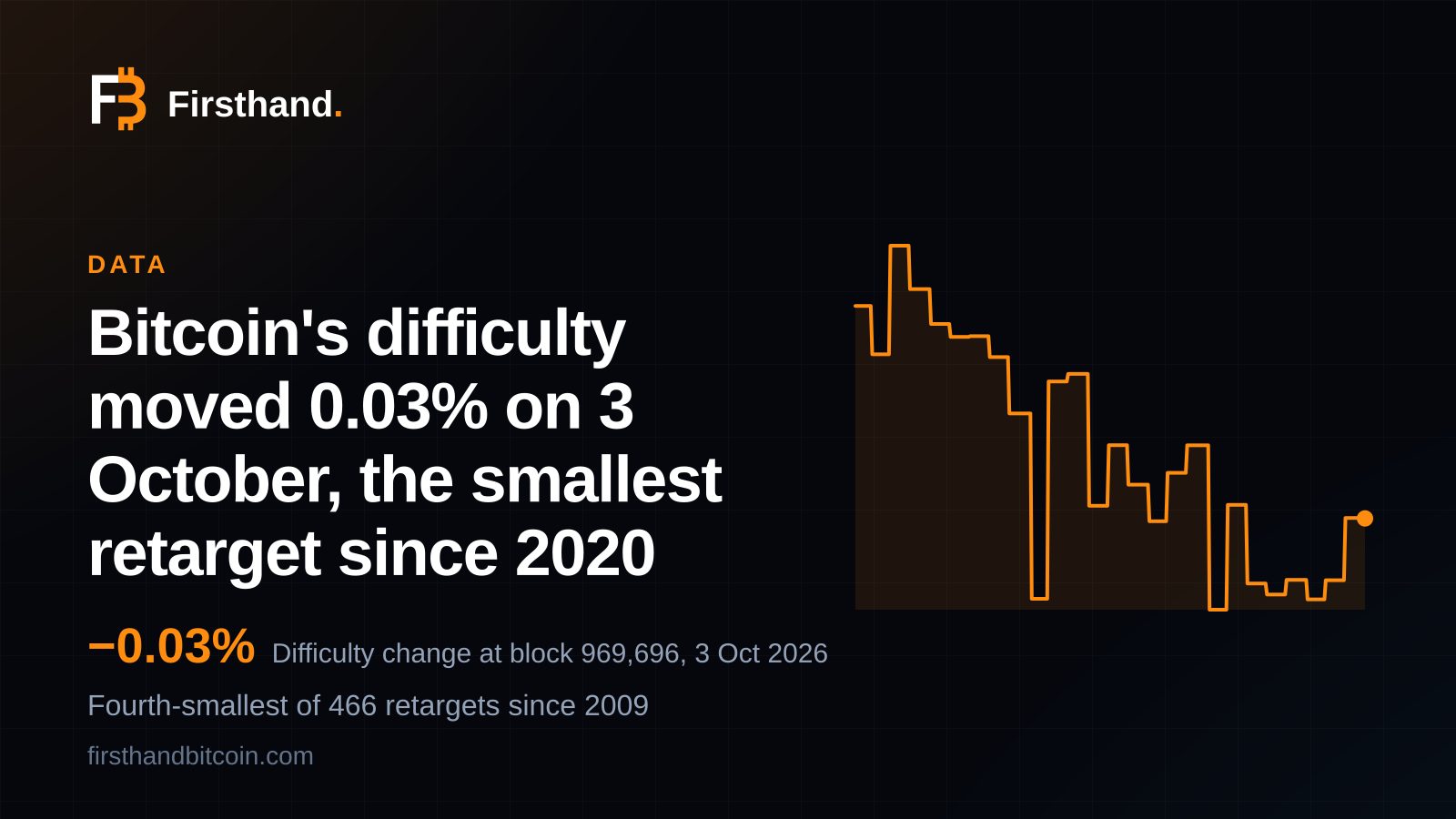
Mining difficulty was reset by just 0.03% on 3 October, the smallest retarget since June 2020 and the fourth-smallest of 466. The 19 before it this year averaged 4.4%. Here is what a flat retarget means for the coins a machine makes.
TL;DR
- A retarget that did almost nothing. Difficulty fell 0.03%, from 132.76 to 132.72 trillion, at block 969,696 on 3 October.
- Fourth-smallest of 466. Only three retargets since 2009 were smaller, the last in June 2020. The 19 before it in 2026 averaged a 4.4% move.
- Same coins per machine. A petahash earned 47,767 sats a day on 2 October, which is $40.54, and that does not change.
- Still 14.9% under the record. Difficulty is 6.2% above its June low while bitcoin is up 33% since then.
Difficulty barely moved: down 0.03% at block 969,696
At 07:16 UTC on 3 October the network mined block 969,696, the last of its 2,016-block retarget epoch, and mining difficulty was reset from 132.76 trillion to 132.72 trillion. That is a cut of 0.03%. It is the smallest adjustment since 30 June 2020 and the fourth-smallest of the 466 retargets since the first, in December 2009, according to mempool.space's record of every adjustment.
Difficulty is the number that sets how hard it is to find a block. Every 2,016 blocks the network measures how long they took and rescales it: up if blocks came faster than the ten-minute target, down if they came slower. The epoch that ended on 3 October took 14 days and 7 minutes against a target of exactly 14 days, so there was almost nothing to correct.
Difficulty is one half of what a machine earns per terahash. The bitcoin price is the other, and our guide to hashprice shows how the two combine. This piece is about the half that just stood still.
Only three retargets since 2009 have been smaller
The three smaller adjustments were a 0.0033% cut on 30 June 2020, a 0.0107% cut on 28 April 2016 and a 0.0216% rise on 1 November 2018. Two others came close: a 0.0367% rise in May 2019 and a 0.0426% rise on 25 December 2025. All 466 are on our difficulty adjustments chart.
This one stands out more for what surrounds it. The 19 retargets before it in 2026 averaged a change of 4.4% in one direction or the other, and ran from a 14.7% rise in January to an 11.2% cut in March. The June cut of 10.1%, at block 953,568, left difficulty at 124.93 trillion, the lowest of the year, The Block reported. The latest was about a hundred and forty times smaller than the 2026 average.
A year of 5% and 10% swings does not usually end in a retarget this flat. Whatever was pulling the network up and down in the spring and summer, machines switching off at the June low and coming back as bitcoin recovered, has for the moment stopped.
The 19 retargets before this one in 2026 averaged a 4.4% move. This one moved 0.03%.
The hashrate that arrived in September stayed
The retarget before this one, on 19 September, raised difficulty 4.2%. The 2,016 blocks since then arrived on schedule, which means the network ran, on average, at the hashrate that higher difficulty implies. A difficulty of 132.76 trillion corresponds to about 950 exahash a second when blocks come every ten minutes. Our hashrate chart, estimated from the blocks themselves, averaged about 945 over the 30 days to 2 October.
Daily readings are noisier, as they always are: between 23 September and 2 October they ranged from 837 to 1,088 exahash a second. The retarget averages that noise away over two weeks, and the average came out where it started. The next one is due at block 971,712, about two weeks from now.
Still 14.9% below last October's record
The record is 155.97 trillion, set at the retarget on 29 October 2025. Today's 132.72 trillion is 14.9% under it, and 6.2% above the 124.93 trillion of 14 June.
Over the same stretch bitcoin rose from $63,913 on 13 June to $84,862 on 2 October, up 33%. Price has run well ahead of the machines: difficulty has added 6% while the coin it pays out in gained a third. Our piece on 24 September looks at that gap in detail.
The network as a whole is earning more for it. Miner revenue averaged $41.3 million a day over the 30 days to 2 October, up 20% on the $34.3 million of the 30 days before, on our miner revenue chart. Bitcoin's average price rose 15% over the same stretch, which explains most of it, and the flat retarget shows no extra machinery arrived in the last fortnight to dilute the rest.
What a flat retarget does to the coins a machine makes
It changes nothing, which is the point. A retarget that raises difficulty shrinks the share of the network's rewards that a given machine earns; one that cuts it grows the share. The 19 September rise of 4.2% took a petahash's earnings from 49,633 sats a day on 18 September to 47,775 on 25 September. This retarget leaves them where they were: 47,767 sats a petahash a day on 2 October, which at $84,862 is $40.54. On 1 January the same petahash made 42,653 sats, $37.47.
For the miner who keeps the coins, the number that matters is what a coin costs to make. The most efficient machine in stock, on the cheapest power we have, makes a bitcoin for about $18,000 of electricity against a market price of about $84,000 (3 October, today's hashprice, electricity only). A flat retarget leaves that ratio where it was.
Nothing about it promises the next one. Difficulty is set by what other miners do, and output is never guaranteed. But a fortnight in which the pile grew at exactly the rate of the fortnight before is the kind of result a machine bought to be held is meant to deliver. It is on the hashprice in sats chart every day.
A retarget that moves nothing leaves every machine's daily coins exactly where they were.
Sources and further reading
- Bitcoin difficulty adjustments: every retarget since 2009 — mempool.space, 3 Oct 2026
- Bitcoin block 969,696 — mempool.space, 3 Oct 2026
- Bitcoin mining difficulty drops 10% in second-largest negative adjustment of 2026 — The Block, 14 Jun 2026
Disclosure
Firsthand Bitcoin sells and hosts mining hardware, including this machine. No manufacturer, distributor or affiliate programme paid for or reviewed this page and we take no commission on the links above. Historical figures are computed from daily bitcoin price and network hashprice, each day valued at its own prices. Nothing here is investment advice.