Home / Blog / Canaan Avalon A15XP
Machine review · Oct 15, 2026 · 5 min read
Avalon A15XP review: 17.8 J/TH in an air-cooled box, and Nigeria is where it pays best
Canaan's air-cooled A15XP makes a bitcoin on 17.8 J/TH. It clears its power at 6¢ today, but the coin it makes is dear next to the 13.5 J/TH machines, and after the 2028 halving only Nigeria's 3.9¢ keeps its line under hashprice.
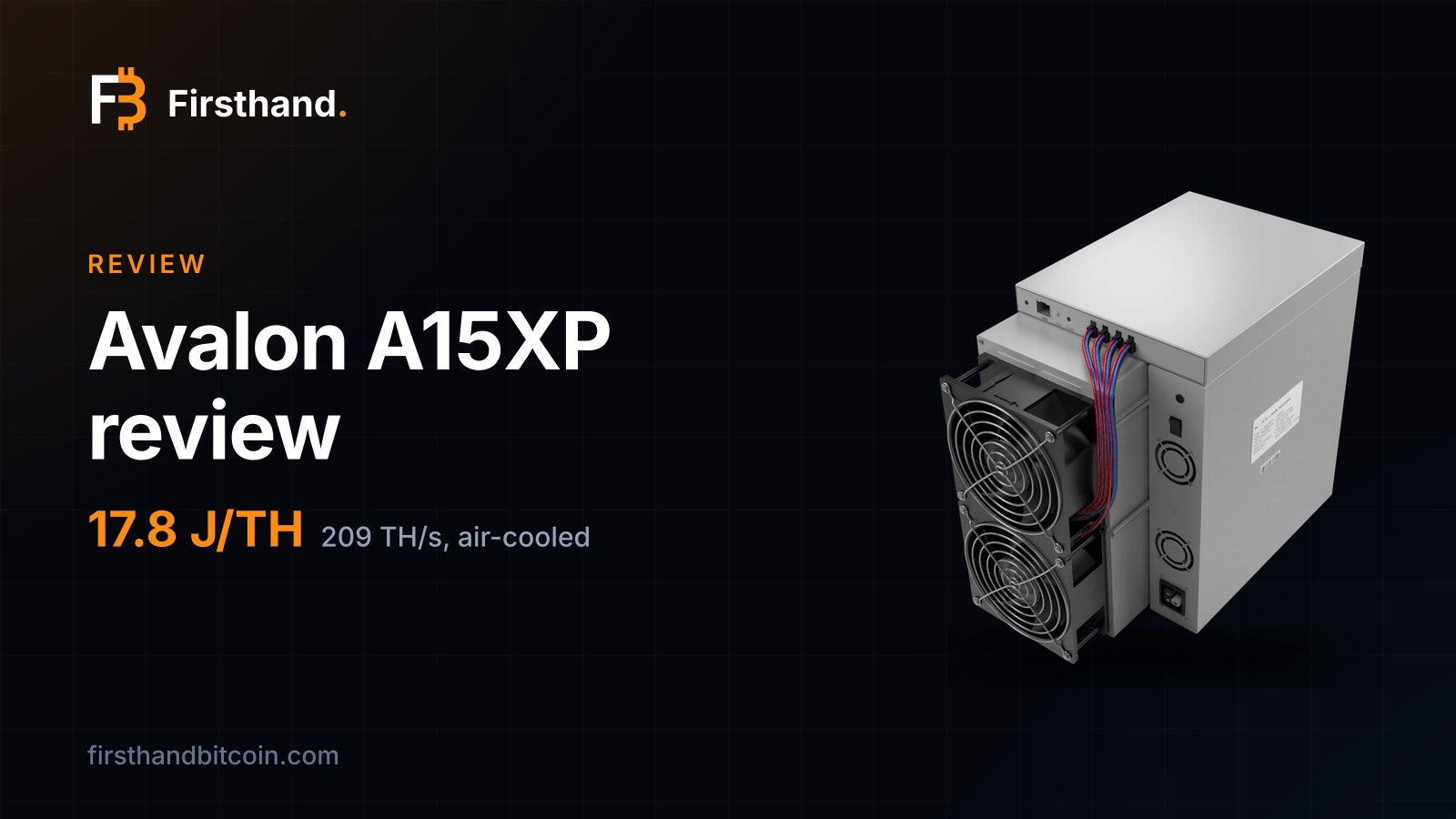
Canaan Avalon A15XP (209 TH/s)
The bottom line
The A15XP is Canaan's mid-range air-cooled Avalon from its A15 series: 209 TH/s from 3,720 W in the bin we list, 17.8 J/TH. At our Argentina site, at 6¢, it makes a bitcoin for about $56,500 of electricity and returns roughly 32% in its first year at today's price. At Nigeria's 3.9¢ the same coin costs about $36,700 and the first-year return is about 44%.
Bought once its price settled, in June 2026, it has mined and kept 0.0123 BTC for $672 of power: $349 of cashflow against a $2,269 landed cost, which is what the first months of a four-year machine look like. Between now and the 2028 halving it has another 0.054 BTC in it, worth about $6,761 with bitcoin back at its previous high: roughly 3.1× its hardware by the halving, with the machine still running afterwards.
What you are buying is a settled-price air-cooled unit at $5.88 a terahash. What you are not buying is a cheap coin: the S21 XP makes one in the same hall for about $42,900 against this machine's $56,500, and the A15 Pro+ beside it in Canaan's line makes one for about $49,200.
Scores
| Criterion | Score | Why |
|---|---|---|
| Cashflow | 5.5/10 | Makes a bitcoin for about $56,500 of electricity at 6¢ and returns roughly 32% in year one at today's price. It has covered 15% of its hardware so far and is on track for about 3.1× by the 2028 halving. |
| Longevity | 5/10 | At 17.8 J/TH its line is $25.63 a petahash a day at 6¢ and $16.66 at 3.9¢. Hashprice halved sits between the two, so after the halving it is a Nigeria machine, which is the move every machine makes once. |
| Efficiency | 4.5/10 | A mid-range figure for an air-cooled Avalon. The A15 Pro+ is 15.5 J/TH, the S21 XP and the M70S run 13.5 J/TH in air-cooled boxes. |
| Quality control | 5/10 | Scored as unknown rather than as good. We found no operator reports of the A15XP in the field that we could cite, and a repair shop's family guide is a troubleshooting reference, not a failure rate. |
| Serviceability | 6/10 | Canaan's Avalon boards have a third-party chip-level repair market, and hosted with us in Argentina a fault is a parts bill and a line item. We found no maker repair terms we could cite for this model. |
Weighted on what an owner gets back per dollar and how long the machine keeps clearing its power. It clears at 6¢ today and at 3.9¢ after the halving, but at 17.8 J/TH it makes a dearer coin than the 13.5 J/TH machines at every site.
Buy it if
- Your power is at or below 3.9¢, or you plan to cross to Nigeria once, where a coin costs about $36,700 and its line is $16.66 a petahash a day, under half of today's hashprice.
- You want an air-cooled unit that needs only a hall with cool intake air, at $1,229 for the 209 TH/s bin, with no loop and no coolant.
- You are adding hashrate in single units and would rather make the one move to Nigeria when the figures say so than pay up now for 13.5 J/TH.
- You are comparing it with the plain A15 at 18.8 J/TH and want the same case with 5% less power for each terahash.
Walk away if
- You plan to stay at 6¢ past the halving. Its line there is $25.63 a petahash a day and today's hashprice halved is about $19.78, so those years lean on bitcoin recovering.
- You want the cheapest coin. The S21 XP makes one in Argentina for about $42,900 and the M70S for about $42,900, against this machine's $56,500.
- Your power is above 6¢. At 8¢ its line is $34.18 a petahash a day, close to the $39.56 of 14 October and above the $27.74 low of 6 June; above 8¢, choose a more efficient machine.
- You want a public failure record. We found no operator reports of the A15XP that we could cite, so we score that as unknown.
What Canaan shipped
Canaan announced the upgraded A15 series on 7 November 2024: the A15 Pro at 215 TH/s or better and 16.8 J/TH, the A15XP at 200 to 212 TH/s and 17.8 J/TH, the A15 at 188 to 203 TH/s and 18.8 J/TH, and the A15SE at 170 to 185 TH/s and 19.9 J/TH. Canaan says the figures come from laboratory tests in a controlled environment and does not guarantee the same results in the field.
We could not open Canaan's own product page for the A15XP, so the specifications here are our store record: 209 TH/s from 3,720 W, 17.8 J/TH, air-cooled. A 206 TH/s bin exists at 3,667 W, and the figures in this review are the 209 TH/s bin. We leave out dimensions and weight because the store record does not hold them.
It sits in the middle of a line. The plain A15 runs 18.8 J/TH and the A15 Pro runs 16.8; the A15 Pro+ takes the same case to 15.5. The A15XP is the same idea with a little less power for each terahash than the A15, and a little more than the Pro.
An air-cooled box needs a hall built for air
Air cooling is the simple end of the spectrum: fans push hall air through the machine and out the back, and the building does the rest. There is no loop and no special rack, which is why a unit like this goes on an ordinary shelf. Our guide to air, hydro and immersion sets the three side by side.
The catch is the air itself. A machine drawing 3,720 W turns nearly all of it into heat, and the hall has to carry that away without the intake air warming. That is why air-cooled machines belong in a hall built for air and not in a shed, and it is the room we put them in. Our Argentina and Nigeria sites take air-cooled machines; an air-cooled machine starts in Argentina and makes one move, to Nigeria, when the cheaper rate starts paying better.
Fans and a shelf: no loop, no coolant. The cost is cool intake air.
A mid-priced unit for its efficiency
The first price we hold for the 209 TH/s unit, on 17 June 2026, was $5.78 a terahash. It is $1,229 today, $5.88 a terahash, for the same 209 TH/s at the same 17.8 J/TH. In between it has stayed between roughly $5.36 and $5.88 a terahash, which is what a settled price looks like.
Set against its neighbours, the plain A15 at 18.8 J/TH is $4.62 a terahash, so the A15XP costs more for each terahash in return for a lower power bill. The S21 XP, at 13.5 J/TH, is $11.55 and the M70S $12.60. The S21 Pro, at 15 J/TH, is $8.61, and the A15 Pro+ is $9.98. The guide to what a miner costs all-in shows what sits on top of the box.
What a coin costs it
At 6¢ in Argentina the A15XP makes a bitcoin for about $56,500 of electricity today, against a bitcoin price of $80,325. At Nigeria's 3.9¢ the same machine makes one for about $36,700. The S21 XP makes one in Argentina for about $42,900, the M70S for about $42,900, the S21 Pro for about $47,600 and the S21+ for about $52,400.
In its first year the A15XP returns about 32% in Argentina and 44% in Nigeria. The S21 XP returns 34% in Argentina and the S21 Pro 36%. A lower price per terahash buys more hashrate for the money, and in the first year that can outweigh a dearer coin; the A15XP sits behind the 13.5 J/TH machines on both measures, which is what 17.8 J/TH should do.
Over its run since June 2026, electricity has averaged about $54,700 a coin. That is a short lifetime average; the figure to plan on is today's.
Where the halving puts it
A machine's line is the hashprice at which it stops covering its own power. At 17.8 J/TH a petahash uses 427 kWh a day: $25.63 at 6¢, and $16.66 at Nigeria's 3.9¢. Network hashprice was $39.56 a petahash a day on 14 October on our hashprice chart, so the A15XP clears the 6¢ line today with room, and the 3.9¢ line with a lot of it.
The 2028 halving halves the coins a petahash earns. At today's price and difficulty that puts hashprice near $19.78, under the 6¢ line and above the Nigerian one by about $3. That is today's conditions held flat, not a forecast: it is why every projection we publish assumes the old high returns, and the forward figures here do the same.
A 13.5 J/TH machine has a line of $19.44 at 6¢, just under that halved level, which is the case for paying for the S21 XP or the M70S if you plan to stay in Argentina. The A15XP is a different bet: an Argentina machine now and a Nigeria machine after the halving, with the move made once. The guide to crossing once explains why, and the guide to efficiency and halvings shows where the line sits at every J/TH.
What a fault costs you here
We looked for operator threads and repair write-ups on the A15XP and found nothing specific to it that we could stand behind. What exists is a repair shop's family guide: D-Central's Avalon hashboard repair page lists the 15-series among the Avalon families it repairs at chip level, and describes the usual Avalon fault modes, weak or dead chips, string or regulator faults and power-supply and connector problems. We treat that as a troubleshooting reference and not as a failure rate, so the A15XP is scored as unknown on quality control.
What a fault costs is the part that matters. Hosted with us in Argentina, a repair is billed at the cost of the parts and nothing else, and it is a line item, not a catastrophe. We found no Canaan warranty terms for this model that we could cite, so we do not quote any.
We found no operator reports of the A15XP we could cite. We score that as unknown, not as good.
Our two cents
The A15XP is a sound machine at a settled price. It clears its power at 6¢ today with room, it needs only an air-cooled hall, and the one move it will make, to Nigeria, is where its figures improve most: a coin there costs about $36,700 to make.
If the aim is the cheapest coin, the S21 XP makes one for about $42,900 at the same site, and the S21 Pro returns about 36% in year one. The figure below ranks what beats this machine on cost per coin and then on first-year return, in stock today. A coin that costs less to make is a coin you keep more of.
- MicroBT Whatsminer M74S+ (332 TH/s) — 12 J/TH, In stock, $38,095 of electricity per bitcoin, 32% year one
- MicroBT Whatsminer M73S (560 TH/s) — 13 J/TH, In stock, $41,269 of electricity per bitcoin, 37% year one
- MicroBT Whatsminer M7DS (672 TH/s) — 13.5 J/TH, In stock, $42,857 of electricity per bitcoin, 39% year one
Sources and further reading
- Canaan Upgraded Avalon Miner A15 Series with Superior Performance — Canaan Inc. (PR Newswire), 7 Nov 2024
- Avalon hashboard repair — domain map and parts — D-Central, Aug 2026
Which machines this covers
Disclosure
Firsthand Bitcoin sells and hosts mining hardware, including this machine. No manufacturer, distributor or affiliate programme paid for or reviewed this page and we take no commission on the links above. Historical figures are computed from daily bitcoin price and network hashprice, each day valued at its own prices. Nothing here is investment advice.