Data insight · Oct 2, 2026 · 6 min read
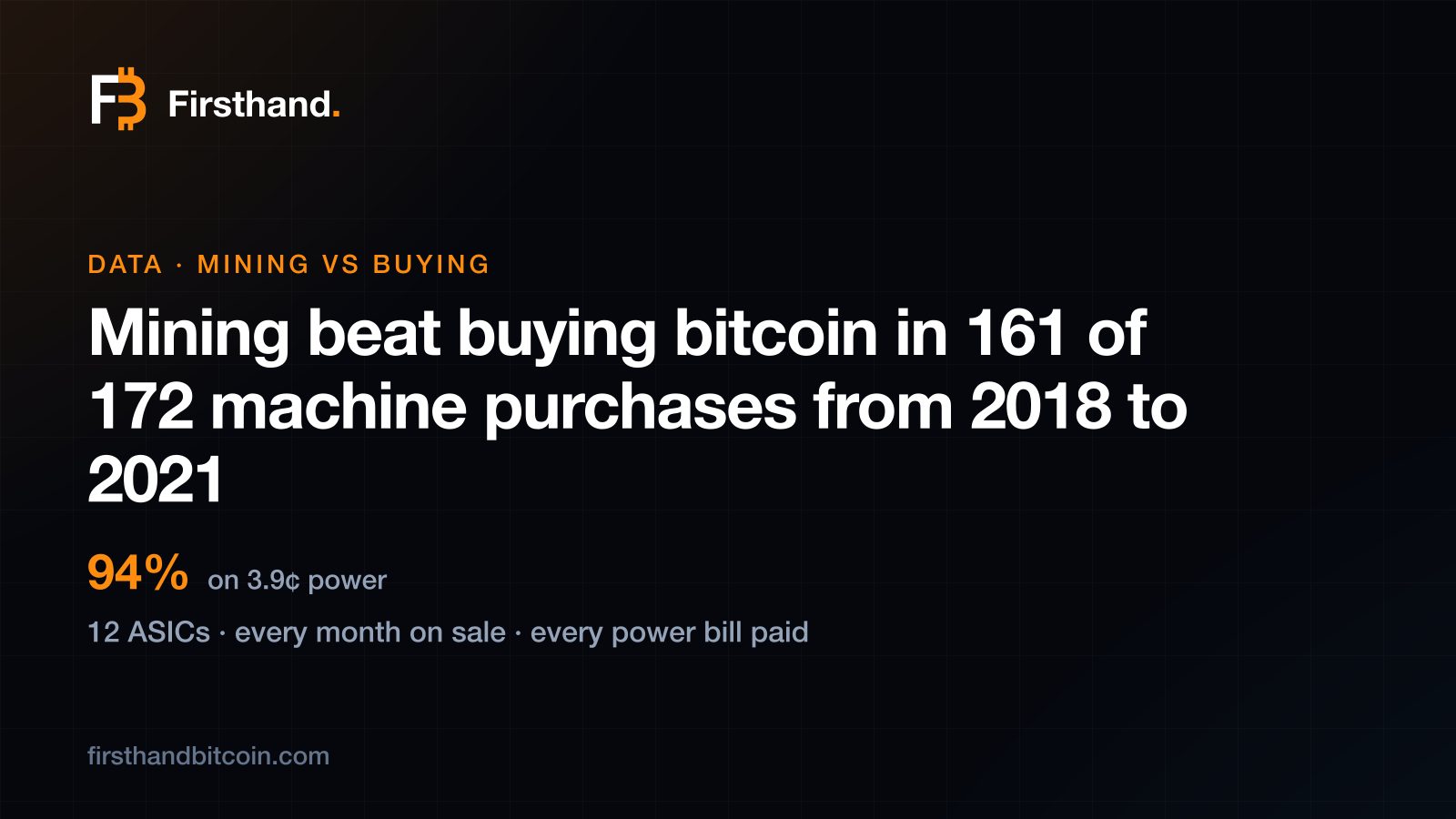
Mining beat buying bitcoin in 161 of 172 machine purchases from 2018 to 2021, on 3.9¢ power
We took twelve of the most-bought ASICs and every month each was on sale since 2018, paid every power bill, sold the machine today, and put the same dollars into bitcoin on the same days. On cheap power the machine ended with more bitcoin almost every time. Nothing bought in 2022 beat the coins.
TL;DR
- Power price decides it. On 3.9¢ power, 161 of 172 machines bought from 2018 to 2021 ended with more bitcoin than the same dollars put into bitcoin. At 6.5¢ it was about half; at 10¢, 8% of all 2018–2022 purchases.
- Know your break-even before you buy. The median purchase came out level with buying at 4.8¢ a kilowatt-hour. Above about 7.4¢, buying the coins usually won.
- When bitcoin itself is cheap, buy the coins. Nothing bought in 2022 beat buying at 6.5¢, and only 23 of 89 purchases did at 3.9¢.
- Overpaying at the top was survivable; timing still paid. An S19 bought at the 2021 top for $11,294 came out level at 6.5¢ and 19% ahead at 3.9¢. Bought two months later for $6,726, it was 29% ahead at 6.5¢.
- “It made money” is not the test. 95% of purchases made money at 6.5¢; only 35% beat simply holding the bitcoin. Check your own rate and the raw data.
The question every miner gets asked
Anyone who mines has heard it: why not just buy the bitcoin? A machine costs money up front, eats power every day, wears out and loses value. Bitcoin bought with the same money just sits there. The argument usually ends in anecdotes, because the numbers that would settle it are hard to put together. You need what each machine actually cost in the month it was bought, what it earned every day since, what the power cost, and what the machine is worth now.
We put those numbers together for twelve of the most-bought machines of the last eight years, from the Antminer S9 to the S21 XP, and for every month each one was on sale. Each purchase is settled in bitcoin on 2 October 2026, with bitcoin at $84,862. The whole study is an interactive page where you can set your own power price, and every result is in a CSV you can check line by line.
Two people, the same dollars, the same days
The rules are simple and the same for every purchase. The miner buys the machine on the first day of the month at that month’s market price, and starts mining the same day. Each day the machine earns that day’s hashprice for its hashrate, less 5% downtime and a 2% pool fee, and pays its rated power at a fixed price per kilowatt-hour. On any day it would lose money it is switched off.
The buyer spends exactly the same dollars on exactly the same days: the machine’s price on day one, then each day’s power bill, all turned into bitcoin at that day’s price. Today the miner sells the machine for what it would fetch; a model nobody sells any more counts as scrap, at zero. Whoever holds more bitcoin wins.
From 2023 the machine’s price is the median of its own market listings that month. Before that it is the market price per terahash of its efficiency class that month, times its hashrate. That is how an Antminer S19 comes out at $11,294 in March 2021, close to what people remember paying at the top. The miner price index and hashprice since 2013 are the inputs.
Same dollars, same days. Whoever holds more bitcoin at the end wins.
Power decides most of it
Across the 261 purchases made from 2018 to 2022, the machine ended with more bitcoin than buying 87% of the time at 3¢ a kilowatt-hour, 70% at 3.9¢, 57% at 4.5¢ and 48% at 5¢. At 6.5¢ it was 35%, at 8¢ 22%, and at 10¢ 8%.
Run the other way, the power price at which a purchase came out level had a median of 4.8¢. Half of all purchases broke even somewhere between 3.7¢ and 7.4¢. Below that band the machine usually stacked more coins than the cash; above it, buying usually did.
We chose 3.9¢ and 6.5¢ to show because they are the cheapest and the dearest rates we charge at our own sites today. Neither is special in the data. The study page recomputes everything at any rate from 2¢ to 15¢.
The year you bought mattered as much as the machine
Split by the year of purchase, the pattern is plain. At 3.9¢, machines bought in 2018 beat buying 9 times out of 12, in 2019 23 out of 26, in 2020 53 out of 55, and in 2021 76 out of 79. From 2018 to 2021 that is 161 purchases out of 172, or 94%. Even at 6.5¢, 44 of the 55 machines bought in 2020 came out ahead.
Then 2022. At 3.9¢, 23 of the 89 purchases made that year beat buying, and at 6.5¢ none did. Machines were still expensive in the first half of the year, and in the second half bitcoin itself was cheap: dollars spent on coins at $16,000 to $20,000 bought more bitcoin than any machine could mine.
That is the other half of the answer. Mining wins when hardware is cheap relative to what it earns, and loses when bitcoin is cheaper still.
In 2020 and 2021, a machine on cheap power beat the coins 129 times out of 134.
An S19 bought at the 2021 top still came out level
Take the purchase everyone regrets: an Antminer S19 at the top of the 2021 market. In March 2021 it cost $11,294. At 6.5¢ it paid $6,407 for power over 1,264 days of running, until 17 August 2025 when it stopped being worth switching on, and it mined 0.430 BTC. The same $17,701, spent on bitcoin on the same days, bought 0.440 BTC. After five and a half years, the overpriced machine finished 2% behind.
On 3.9¢ power the same machine never had to stop. It has run 1,891 days and mined 0.463 BTC against 0.388 BTC for the buyer, 19% ahead.
Buy the same S19 two months later, in May 2021, for $6,726, and at 6.5¢ it mined 0.398 BTC against 0.308 BTC bought: 29% more bitcoin. An Antminer S19 Pro bought in May 2020 for $2,741 mined 0.751 BTC against 0.636 BTC, 18% ahead, after paying $9,132 for power.
Where mining lost
The worst purchases in the study all share a date. An Antminer S19 XP bought in July 2022 for $7,993 has mined 0.303 BTC at 6.5¢ and would sell today for $740. The same dollars in bitcoin, bought that summer, came to 0.566 BTC, 45% more.
Old machines bought at a high price lost too. An Antminer S9 bought in January 2018 for $3,425 mined 0.406 BTC at 6.5¢ before it stopped paying for its power in May 2022; the buyer ended with 0.471 BTC.
Making money is a lower bar
Beating the coins is the hard test. The easy one is whether the machine paid back every dollar put into it: whether the bitcoin it mined, at today’s price, plus its resale, is worth more than the machine and all its power bills. At 6.5¢, 249 of the 261 purchases from 2018 to 2022 did, or 95%. At 10¢ it was 75%.
Both numbers are true at once. Almost every machine made money, because the bitcoin it mined went up. Whether it made more than simply owning the bitcoin depended on the price of power and the month it was bought.
What the study leaves out
It flatters mining in one way: every machine starts mining the day it is bought, with no shipping, customs or setup delay. It is hard on mining in another: a model nobody sells any more counts as scrap, and machines are run at their rated efficiency, with no firmware tuning. Repairs, failed hashboards and taxes are not counted. One machine at list price is assumed; a large buyer pays less.
Machines bought since 2023 are on the study page but not in these totals. Most of them are still running, so their result is not in yet.
What it means for a miner
On power around 4¢, a machine bought outside a bear-market low ended with more bitcoin than the cash would have bought 161 times out of 172. At 6.5¢ it was about half, and above 8¢ rarely, even though nearly every machine made money. The machine is a way to get bitcoin cheaper than the market sells it, and that only works when the power is cheap and the hardware was not bought at the top of a cycle.
Mining output depends on bitcoin’s price, difficulty and uptime, and isn’t guaranteed. These are past results, not a forecast.
Sources and further reading
- Mining vs buying bitcoin: the interactive study — Firsthand Bitcoin, 2 October 2026
- Every machine, every month, every power price (CSV) — Firsthand Bitcoin, 2 October 2026
- Miner prices per terahash by efficiency class, since 2018 — Firsthand Bitcoin, 2 October 2026
- Hashprice since 2013 — Firsthand Bitcoin, 2 October 2026
Disclosure
Firsthand Bitcoin sells and hosts mining hardware, including this machine. No manufacturer, distributor or affiliate programme paid for or reviewed this page and we take no commission on the links above. Historical figures are computed from daily bitcoin price and network hashprice, each day valued at its own prices. Nothing here is investment advice.