Home / Blog / Bitdeer SealMiner A4 Ultra Hyd
Outlook · Oct 2, 2026 · 5 min read
Bitdeer's A4 Ultra Hyd claims 9.45 J/TH at half an Antminer's price per terahash
Bitdeer's water-cooled flagship claims 886 TH/s at 9.45 J/TH, a quarter better than its own A3 Pro Hyd. On the numbers we hold it would return more in year one than any Antminer we have in stock. Here is what that rests on, and what would have to go wrong.
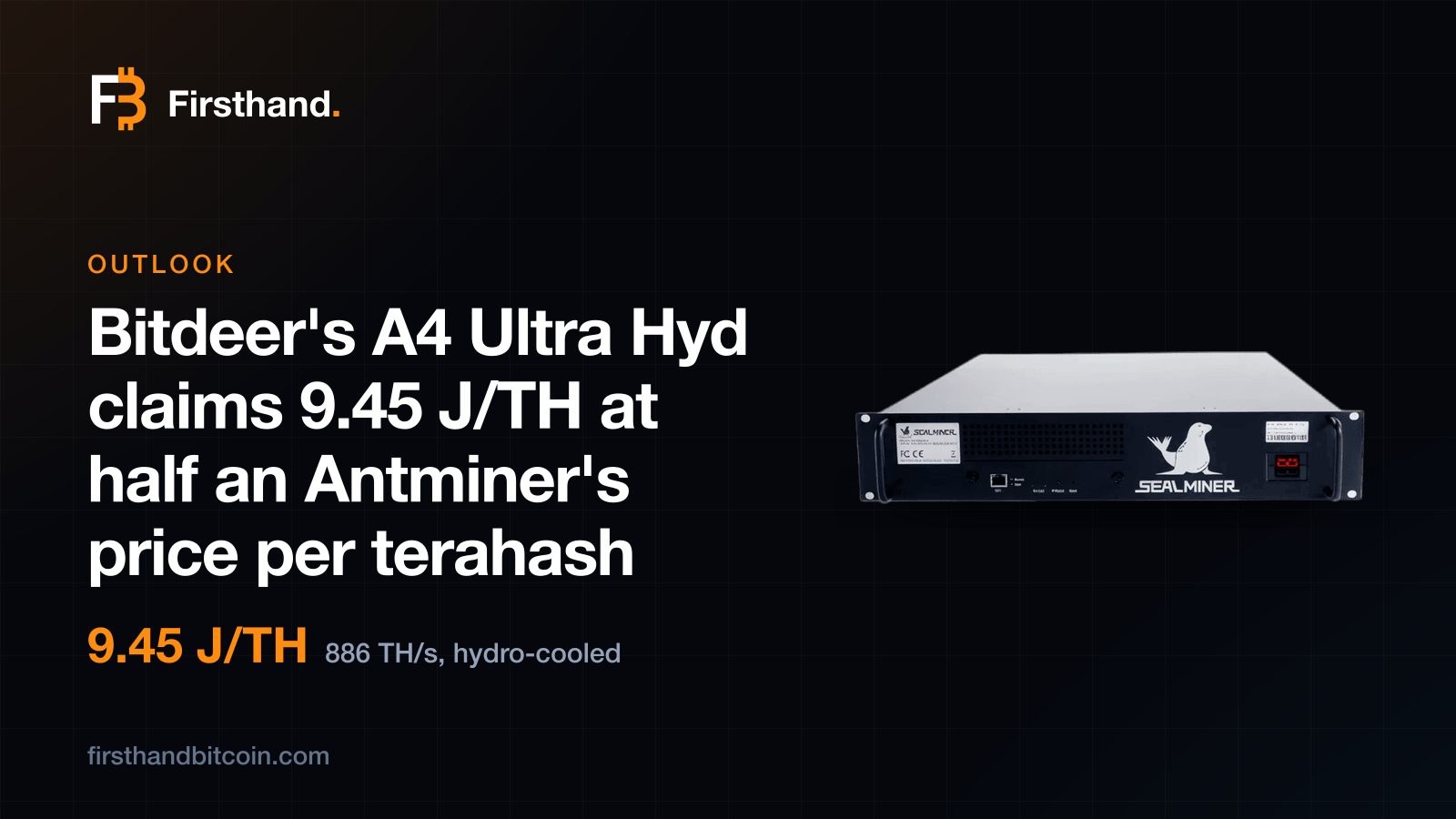
Bitdeer SealMiner A4 Ultra Hyd (886 TH/s)
886 TH/s at 9.45 J/TH, in a water loop
Bitdeer announced the SEALMINER A4 series on 7 April 2026. The top of it, the A4 Ultra Hydro, is rated at 886 TH/s and 9.45 J/TH from 8,372.7 W, water-cooled, built on Bitdeer's SEAL04 chip. Bitdeer states a tolerance of 5% on efficiency and 10% on hashrate and power, so the 9.45 is a typical figure, not a floor.
We hold no run record for it. What the numbers say, at 6¢ in the UAE where water-cooled machines start, is that it would make a bitcoin for about $30,600 of electricity and return roughly 64% in its first year at today's price. At Nigeria's 3.9¢ the cost per coin drops to about $19,900. The price behind that return is the reference price we show for it, and the machine is listed as sold out in our store today, so read the first-year figure as what the spec implies, not as an offer.
9.45 J/TH is a quarter less electricity per terahash than the A3 Pro Hyd it follows.
Three generations in about a year
The case for taking the number seriously is Bitdeer's own ladder. The air-cooled SealMiner A2 Pro was 14.9 J/TH. The A3 Pro Hyd, announced in September 2025, took the same company's silicon to 12.5 J/TH in a water loop. The A4 Ultra Hyd claims 9.45 seven months later: 24% less energy per terahash than the A3 Pro Hyd.
Each step is the kind of improvement a new chip gives, not a tuning gain, and it brings Bitdeer level with the Antminer ladder. The S23 Hyd is 9.5 J/TH and the S23 XP Hyd 8.9 J/TH, so the A4 Ultra Hyd claims a place between them and the A3 Pro Hyd it replaces.
What the lineage cannot tell us is whether this generation meets its rating. The A3 Pro Hyd review scored reliability as unknown because it was under a year old; the A4 is younger still, and Bitdeer has not disclosed the process node.
The price per terahash is the surprise
At the reference price, the A4 Ultra Hyd is $11.26 a terahash. The S23 Hyd is $23.52 for the same 9.5 J/TH class, and the S23 XP Hyd is $26.36 at 8.9. Next to them the A4 Ultra Hyd costs less than half per terahash for within 7% of the efficiency of the best of them.
That is why its first-year return is so far ahead. The S23 Hyd returns about 32% in year one and the S23 XP Hyd about 30%, against about 64% here. The coin costs about the same: $30,600 for the A4 Ultra Hyd, $31,200 for the S23 Hyd and $29,200 for the S23 XP Hyd.
A price that looks this much better than its neighbours is the part of the argument to hold loosely. It is a reference price on a machine that is sold out, and prices on a first-run machine move when stock arrives. The efficiency is the durable half of the case; the price is the half that has to be there when you buy.
It clears the halving with room
A machine's line is the hashprice at which it stops covering its own power. At 9.45 J/TH a petahash uses 227 kWh a day, which is $13.61 at 6¢ and $8.85 at 3.9¢.
Network hashprice was $39.95 per petahash per day on 1 October on our hashprice chart. The April 2028 halving cuts the coins a petahash earns in half at an unchanged price and difficulty, which would put it near $19.97. That is above this machine's line at both rates, by about a half at 6¢. By comparison a 16.8 J/TH machine's line at 6¢ is $24.19, above the halved figure.
This is today's conditions held flat, not a forecast. What it says is that at 9.45 J/TH the halving is a margin question, not a switch-off question, which is the point of the guide to efficiency and halvings.
At 9.45 J/TH the line is $13.61 at 6¢. Hashprice halved from its 1 October level is about $19.97.
What would have to go wrong
Three things. The first is the rating: with a 5% tolerance on efficiency a unit at 9.9 J/TH is still within spec, and its line at 6¢ would be $14.26, not $13.61. That would still clear the halved hashprice. The second is the record: there is no field data on SEAL04 boards, and a first-run machine is where early faults show up. We score that as unknown, not as good.
The third is the route a fault takes. Hosted in the UAE, the manufacturer warranty centre near the site is Bitmain's, and this is a Bitdeer machine, so repairs follow Bitdeer's route. We cover what that costs in the repairs guide; it is a line item, but one we cannot yet put a number on for this model.
What it means for a miner
If the rating holds, the A4 Ultra Hyd is a water-cooled machine that makes a coin for the electricity of an S23 Hyd at less than half its price per terahash, starts in the UAE and carries through the halving with margin. If it does not, the miss would have to be large to change that.
Our view stays the same as for any machine at the front of a generation: efficiency decides how many halvings it survives, and the A4 Ultra Hyd claims a great deal of it at a low price per terahash. Wait for it to be in stock, check the price then, and compare it with the S23 Hyd on the machine pages before you buy.
Sources and further reading
- Bitdeer launches SEALMINER A4 series, achieves a new efficiency benchmark of 9.45 J/TH — Bitdeer (press release via StockTitan), 7 Apr 2026
Which machines this covers
Disclosure
Firsthand Bitcoin sells and hosts mining hardware, including this machine. No manufacturer, distributor or affiliate programme paid for or reviewed this page and we take no commission on the links above. Historical figures are computed from daily bitcoin price and network hashprice, each day valued at its own prices. Nothing here is investment advice.