Data insight · Oct 10, 2026 · 6 min read
A year after the $19 billion crash, bitcoin futures carry half the leverage they did
On 10 October 2025 a tariff post set off the largest liquidation day crypto has recorded. Twelve months on, bitcoin futures open interest is down 47% from its peak while the price is down 34%, and a petahash earns 13% more coins a day than it did that morning.
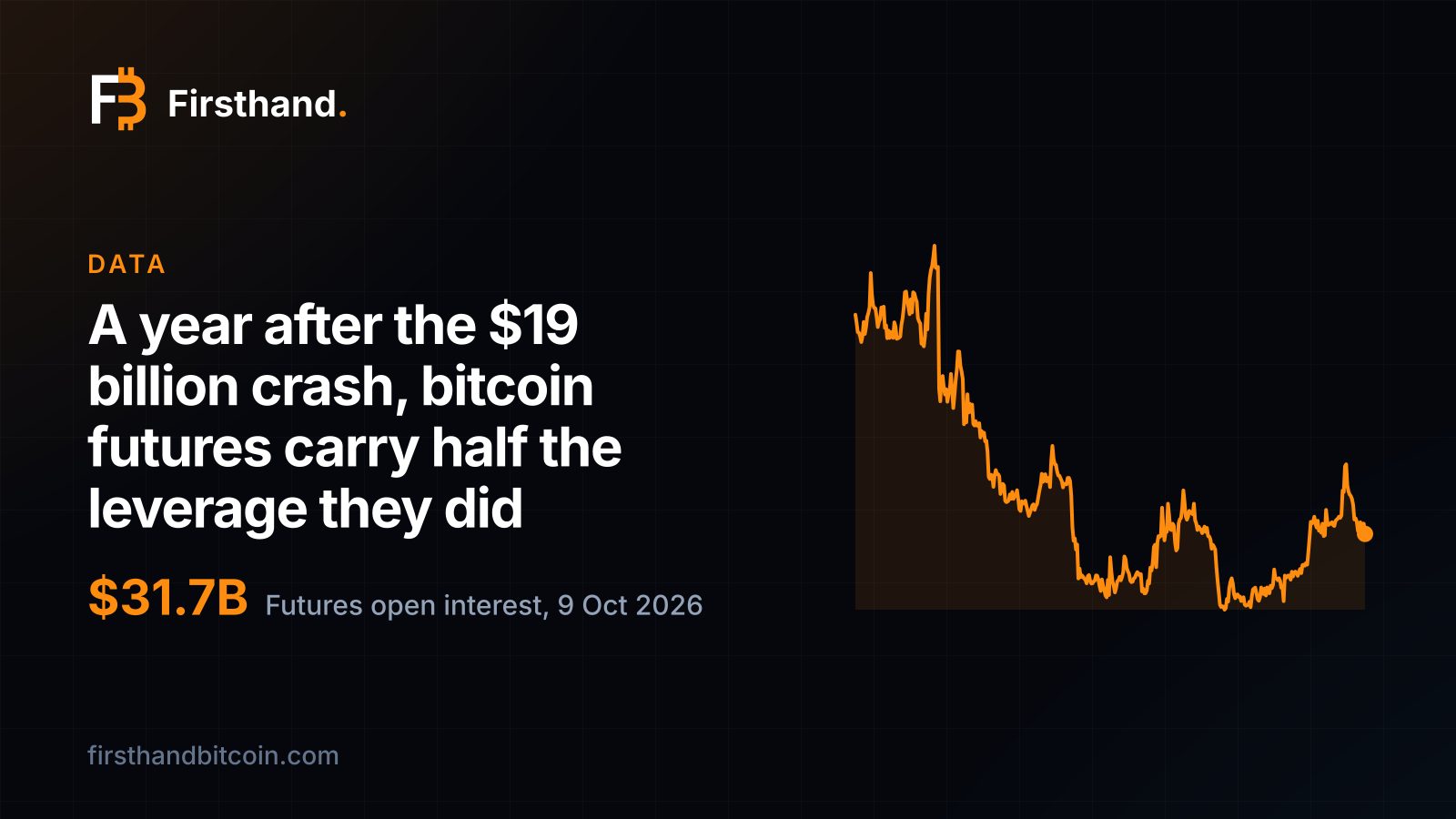
The crash took a fifth of futures open interest in a day
On Friday 10 October 2025 President Trump announced 100% tariffs on Chinese imports, and over the next day and a half more than $19 billion of leveraged crypto positions were force-closed across 1.6 million accounts, according to CoinGecko’s account of Coinglass data. About 70% of it went in 40 minutes that evening. Bitcoin fell from a Friday high of $122,574 to $104,782 by the next day.
Our daily series is gentler, because it samples once a day. It has bitcoin closing at $119,566 on 10 October and $111,871 on 11 October, down 6.4%. What it shows clearly is the leverage. Futures open interest, the dollar value of every open bitcoin futures contract on the major venues, went from $58.3 billion to $46.1 billion between those two readings: $12.2 billion, or 21%, gone in a day.
No other one-day fall in our open-interest series comes close. The next largest, on 31 December 2024, was $7.7 billion. (Two readings in September 2026 show a bigger dip, a third gone on 18 September and back by the 20th, which is a gap in the data, not a market event.)
$12.2 billion of open interest gone in a day, against $7.7 billion for the next largest fall.
A year on, open interest is about half its peak
Open interest peaked at $60.4 billion on 7 October 2025, three days before the crash and one day after bitcoin’s all-time high close of $124,493. On 9 October 2026 it read $31.7 billion, 47% below that peak. Bitcoin itself is 34% below its high, at $81,673.
That matters because a falling price alone shrinks open interest: the same number of contracts is worth fewer dollars. Counted in coins, open interest went from about 489,500 bitcoin to 387,700, a fall of 21%. The other 26 points of the dollar fall is price. And measured against what bitcoin is worth in total, open interest has gone from 2.5% of the market to 1.9%.
Where US institutions trade, the pullback is larger. Open interest on the CME was $18.4 billion on 7 October 2025 and $8.9 billion on 9 October 2026, down 52%.
Traders pay half as much to lean long
The funding rate on perpetual futures is what longs pay shorts, every eight hours, to keep their bets open. It rises when traders crowd one side. In the 30 days before the crash it averaged 9.4% a year on our funding chart. In the 30 days to 9 October 2026 it averaged 4.2%.
Leverage has not left; it has got cheaper to hold and smaller to hold. Funding is still positive, which means longs outnumber shorts. We covered the other side of that trade when funding turned negative after the September squeeze.
Every shock since has hit a smaller market
The test of a market with less leverage is whether the next shocks are smaller. Our liquidations chart counts bitcoin positions only and starts on 28 March 2026, so it cannot be set against Coinglass’s $19 billion for every coin. It can show the size of what has happened since. Its largest day for longs was 2 June, when $802 million of bitcoin longs were force-closed as the price slid from $72,280 to $66,335 in three days. Its largest of all was 19 August, when $1.36 billion of shorts were closed in the squeeze we covered in the squeeze and the flood.
The deepest point came on 30 June, when bitcoin closed at $59,014, 53% below its October high. Open interest that day was $24.6 billion, 59% below its peak, and funding was 2.5% a year. The market had run out of leverage before it ran out of falling price, which is the opposite order from the one that produced the October crash.
Since that low, open interest has recovered about $7 billion, with the price back above $80,000, and it is still 47% below where it began.
The people who own the coins mostly stayed
The US spot ETFs hold bitcoin outright, with no borrowing behind it. Their combined holdings peaked at 1,348,977 bitcoin on 13 October 2025, three days after the crash, and read 1,278,268 on 9 October 2026. That is 70,709 coins and 5.2% fewer. Over the same year open interest, in coins, fell 21%.
The funds’ low came on 8 July 2026, at 1,214,457. They have since taken back about 64,000 coins, even after this week’s outflows, which we covered in the worst ETF outflow since June.
Leverage fell four times as fast as the funds’ holdings.
What it means for a miner
A miner who keeps the coins, and pays the power bill out of pocket, is the opposite of a leveraged long. Nothing is borrowed against the price, so nothing can be force-closed when the price drops 6% in an evening. The coins mined on 10 October 2025 were still in the wallet on 11 October.
The machines have kept producing. Hashprice was 0.000421 bitcoin per petahash a day on 10 October 2025 and 0.000477 on 9 October 2026, 13% more coins for the same hashrate, because network difficulty is 12% lower than it was then. Bitcoin is down since the crash, and what a petahash mines is up.
On today’s hashprice the most efficient machine in stock on our cheapest power, the Bitmain Antminer S23 XP Hyd at 8.9 J/TH in Nigeria at 3.9¢ a kilowatt-hour, makes a coin for about $17,900 of electricity, against $82,562 to buy one. Output is never guaranteed, and the figure leaves out the machine.
Bitcoin is down since the crash. What a petahash mines is up 13%.
Sources and further reading
- October 10 Crypto Crash Explained — CoinGecko, updated 6 Feb 2026
- Live updates: XRP ETFs the only ones in green as BTC, ETH, ZEC funds post outflows — CoinDesk, 9 Oct 2026
Disclosure
Firsthand Bitcoin sells and hosts mining hardware, including this machine. No manufacturer, distributor or affiliate programme paid for or reviewed this page and we take no commission on the links above. Historical figures are computed from daily bitcoin price and network hashprice, each day valued at its own prices. Nothing here is investment advice.