Home / Blog / Bitmain Antminer S19j Pro+
Field report · Oct 10, 2026 · 5 min read
Not one day off in three years: the Antminer S19j Pro+ stayed just above the line
The S19j Pro+ ran through the 2024 halving and the hashprice trough that followed, then crossed to Nigeria once. It was never switched off: at 27.5 J/TH its power line stayed under every monthly average of hashprice, at both sites.
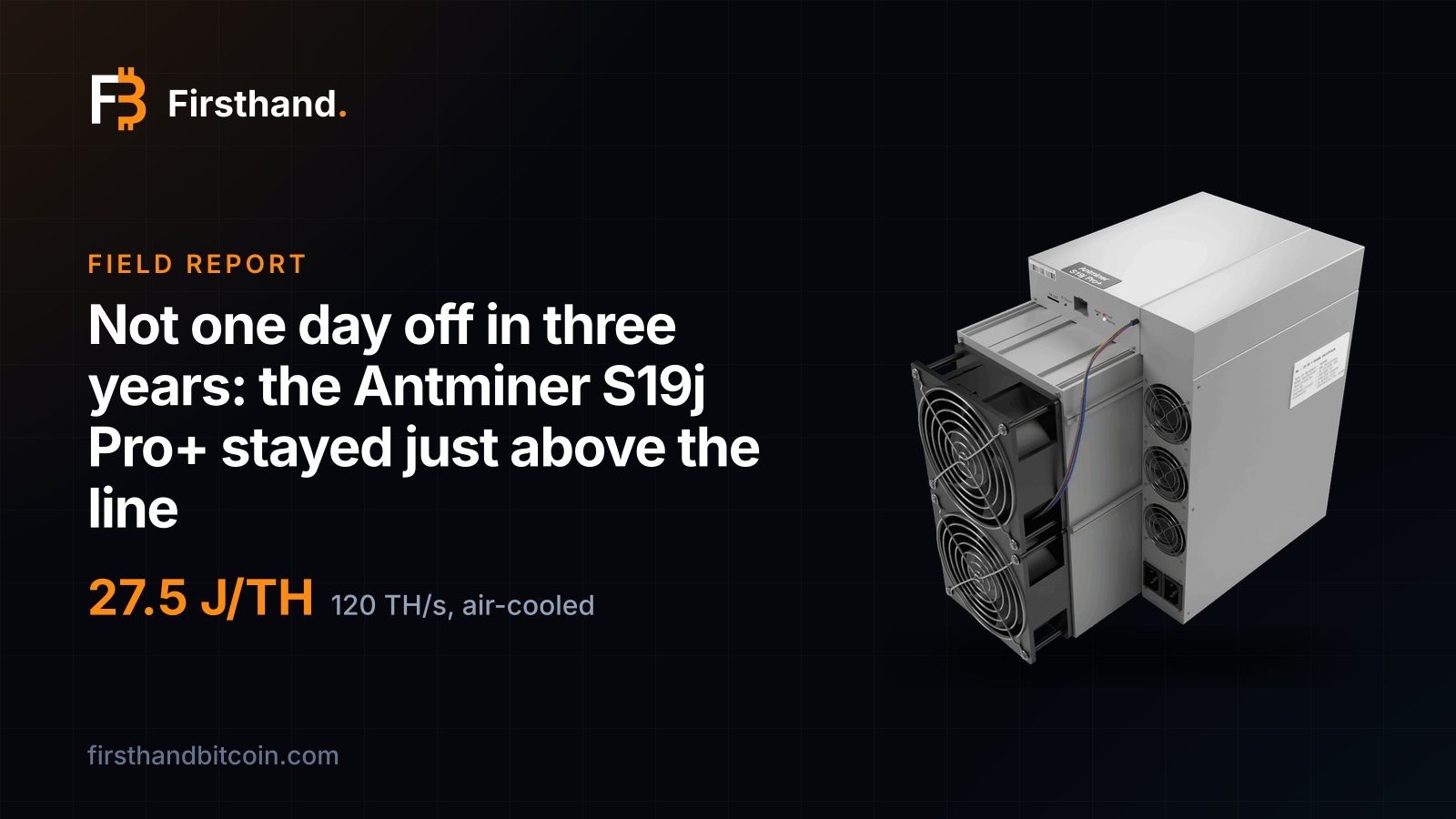
Bitmain Antminer S19j Pro+ (120 TH/s)
Three years in Argentina and then Nigeria, with no gap
The S19j Pro+ is a 120 TH/s air-cooled machine at 27.5 J/TH in our store record. Bought once its price settled, on 26 October 2023, it cost $1,310. Landed at our Argentina site, with freight, duty, setup and its place in a rack, the all-in cost was $2,403.
In 1,081 days since it has mined and kept 0.0921 BTC, worth about $7,518 today, for $3,839 of electricity. That is $3,679 of cashflow, or 1.5× its landed cost, and an average of about $41,700 of power per coin over the whole run. Not one coin was sold. The run has 0 days switched off in it.
August 2024: the month that switched off its neighbours
A machine’s line is the hashprice at which it stops covering its own power. At 27.5 J/TH a petahash uses 660 kWh a day. That is $39.60 at Argentina’s 6¢, and $25.74 at Nigeria’s 3.9¢.
Three and a half months after the halving, hashprice fell to $37.70 a petahash a day on 5 August 2024, on our hashprice chart, and averaged $41.71 over the 30 days to 25 September, its lowest 30-day average of the whole Argentina stretch. A machine switches off by house rule when its trailing month no longer pays at its site. For the S19j Pro+ that month never came: $41.71 is above $39.60.
A few J/TH changed that. The Antminer S19 Pro, at 29.55 J/TH, has a line of $42.55 at 6¢, above the same trough, and it was switched off through it. So was a 31 J/TH Whatsminer M30S++ run on the same rule, for 77 days from 15 August 2024. Same site, same hashprice, same rule. The difference was the 2 to 3.5 J/TH.
Its line was $39.60 a petahash a day at 6¢. The lowest 30-day average it met in Argentina was $41.71.
44% of its coins came before the halving
From the day we bought it to the April 2024 halving the machine ran 177 days and put 0.0404 BTC in the wallet, clearing about $6.02 a day after electricity. That is about $2,196 a year on a machine that cost $2,403.
On 20 April 2024 the block subsidy halved, and every machine on the network began producing half as many coins for the same electricity. The 904 days since have produced 0.0517 BTC at about $1.33 a day after power. Same machine, much smaller day. Hashprice was $73.37 on 26 October 2023, when we bought it, and $38.94 on 9 October 2026.
The coins did not stop. The first 16% of its life made almost half of everything it has mined, and the rest has been slower and steadier.
One move, to Nigeria, with the machine still running
On 5 March 2025 it made its one move, to Nigeria, where it has run 585 days at 3.9¢. It had spent 496 days in Argentina first, through the halving and the 2024 trough. A crossing is freight, customs and downtime at both ends, so a machine makes it once and does not shuttle, which is the rule in a machine crosses to cheap power once.
At Nigeria’s 3.9¢ the line fell to $25.74. Hashprice’s lowest day since the move was $27.74, on 6 June 2026, and its lowest 30-day average $30.09, to 3 July. Both are above the line. The machine has not been switched off at Nigeria either. A 31 J/TH M30S++ on the same rule was, for 5 days in March 2026 and 12 days from 29 June.
Where it stands now
Hashprice was $38.94 on 9 October. That is above the Nigerian line of $25.74 by about half, and just under the Argentine line of $39.60, which is why today’s cost per coin is $56,700 at 3.9¢ and $87,200 at 6¢, and why one bought at today’s price returns 16% in a year in Nigeria and less than its power costs in Argentina.
The April 2028 halving cuts the coins a petahash earns in half at an unchanged price and difficulty, which would put hashprice near $19.50, below the line at both rates. The forward figures to that date add 0.023 BTC, $2,925 with bitcoin back at $124,493, and then this is a machine for as long as hashprice stays above its line. That is today’s conditions held flat, not a forecast.
What it says about the next machine you buy
Nothing about this machine failed, and it never stopped. It mined every day it was on, it kept every coin, and it covered its landed cost 1.5×. What kept it on was a margin of a couple of J/TH over its neighbours in the worst months, and that margin is set at purchase. The guide to efficiency and halvings is the long version of this section.
The same logic runs forward. A machine at 15 J/TH has a line of $21.60 at 6¢, and one at 9 J/TH, $12.96, which is why the efficient end of the catalogue is the one still working after the next halving. The figure below ranks what we would put in its place today, on cost per coin and then year-one return.
- MicroBT Whatsminer M74S+ (332 TH/s) — 12 J/TH, In stock, $24,743 of electricity per bitcoin, 33% year one
- MicroBT Whatsminer M73S (560 TH/s) — 13 J/TH, In stock, $26,805 of electricity per bitcoin, 40% year one
- MicroBT Whatsminer M7DS (672 TH/s) — 13.5 J/TH, In stock, $27,836 of electricity per bitcoin, 43% year one
Which machines this covers
Disclosure
Firsthand Bitcoin sells and hosts mining hardware, including this machine. No manufacturer, distributor or affiliate programme paid for or reviewed this page and we take no commission on the links above. Historical figures are computed from daily bitcoin price and network hashprice, each day valued at its own prices. Nothing here is investment advice.