News · Oct 2, 2026 · 4 min read
Bitcoin today: SEC custody rules proposed, 10-year yield at a 24-year high
The SEC proposed a custody framework that would let advisers and funds hold bitcoin directly, not only through an ETF. The 10-year Treasury yield touched its highest since 2002. Bitcoin held about $83,600, and a petahash of mining still earned 0.00048 coins a day.
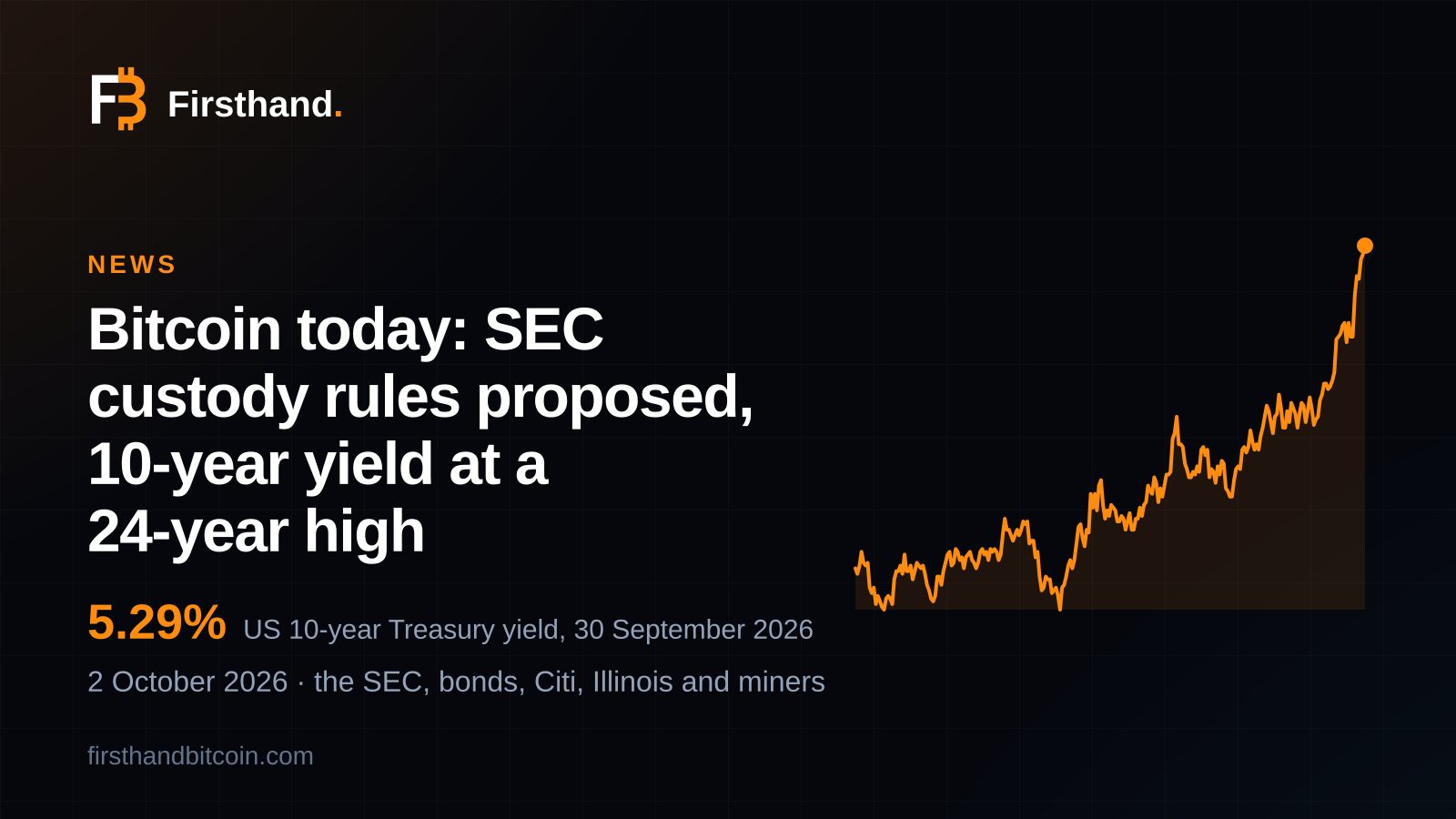
The SEC proposes a way for funds to hold bitcoin directly
The Securities and Exchange Commission proposed a custody framework on 1 October for investment advisers and regulated funds. It would allow crypto assets to be held in self-custody in certain circumstances and let state trust companies act as custodians. The comment period is 60 days from publication in the Federal Register.
SEC Chairman Paul Atkins said in the release that the crypto asset market "has grown from a niche curiosity into a multi-trillion-dollar asset class". The Block adds that advisers could act as custodians for client assets only when they find no permitted custodian is available, and quotes Commissioner Hester Peirce: "Regulators should zealously protect investors' right to self-custody and not attempt to force investors to custody their assets with someone else."
It is a proposal, not a rule. If it is adopted, it gives asset managers a way to hold bitcoin itself rather than only fund shares. The US spot ETFs held 1,281,355 bitcoin on 1 October on our ETF holdings chart, and took out $148.7 million on 30 September, their first net outflow since 16 September.
The 10-year yield touched its highest since 2002
The 10-year Treasury yield touched 5.34% on 1 October, its highest since 2002, after what Yahoo Finance described as the biggest quarterly rise in Treasury yields this century. The 30-year reached 5.61%. The article names elevated inflation from rising energy prices, money moving from bonds into AI infrastructure and higher rate forecasts as the causes.
Our own series closed the 10-year at 5.29% on 30 September, up from 4.96% on 22 September. Bitcoin closed at $83,571 on 1 October, about $800 under its close of $84,385 a week earlier, while the 10-year added 33 basis points.
Citi lifts its 12-month bitcoin target to $113,000
Citi raised its 12-month bitcoin target to $113,000 from $82,000, crypto.news reports, citing "stronger crypto activity, a more supportive macroeconomic backdrop and renewed demand through exchange traded funds". It expects $5 billion of crypto ETF inflows over the next year. Bitcoin was trading near $84,000 when the note came out.
A bank's target is one view, and we do not make price calls. What the note records is the direction of travel: Citi's old number was below where bitcoin already traded.
Illinois delays its 0.2% crypto tax to July 2027
Illinois and two industry groups, the Digital Chamber and the Illinois Blockchain Association, jointly asked a Sangamon County court on 1 October to pause the state's 0.2% digital asset transaction tax until 1 July 2027. It was due to start on 1 January 2027.
The groups argued that preparing for January would cost their members millions of dollars in compliance. The motion asks for a preliminary injunction, not a ruling on whether the tax is lawful.
Public miners shed 75 EH/s and wrote down $1.1 billion
Publicly listed miners lost about 75 exahash a second of realised hashrate in the first half of 2026, while their reported AI and high-performance computing revenue rose 52% on the quarter, according to Wolfie Zhao in TheEnergyMag on 1 October. Twelve companies took about $1.1 billion of impairments and held-for-sale markdowns, nearly 89% of it from IREN and Core Scientific.
The $1.5 billion price tag on the lost hashrate is the author's own calculation at $20 per terahash. Those machines are being redirected, not sold into the market for bitcoin, and it is one reason difficulty sits below its October peak.
What it means for miners
Network hashprice was 0.00047799 bitcoin per petahash per day on 1 October, or $39.95, on our hashprice chart. Difficulty has stood at 132.76 trillion since 19 September, 15% below its October 2025 record. The network's running estimate for the next adjustment, 142 blocks away on 2 October, is about +0.1%.
A rising bond yield does nothing to what a coin costs to make, which depends on a machine's efficiency and its power rate; what hashprice means for your machine shows the sum. The miner who keeps the coins is paid in the asset the SEC just proposed new ways to hold. Mining output is not guaranteed and depends on price, difficulty and uptime.
Difficulty has fallen 15% from its peak, and a petahash earns more coins than it did a year ago.
Sources and further reading
- SEC proposal would address how investment advisers and funds can custody crypto assets under the federal securities laws — US Securities and Exchange Commission, 1 Oct 2026
- SEC proposes framework allowing investment advisers, funds to self-custody crypto — The Block, 1 Oct 2026
- U.S. 10-year Treasury yield hits highest since 2002 — Yahoo Finance, 1 Oct 2026
- Bitcoin to $113,000? Citi raises forecast as ETF demand returns — crypto.news, 1 Oct 2026
- Illinois agrees to delay 0.2% crypto tax until July 2027 — crypto.news, 1 Oct 2026
- Bitcoin's great unplug: hardware left behind by AI — TheEnergyMag, 1 Oct 2026
Disclosure
Firsthand Bitcoin sells and hosts mining hardware, including this machine. No manufacturer, distributor or affiliate programme paid for or reviewed this page and we take no commission on the links above. Historical figures are computed from daily bitcoin price and network hashprice, each day valued at its own prices. Nothing here is investment advice.