Data insight · Nov 22, 2026 · 5 min read
Bitcoin's UTXO set is back to its February 2024 size, 25 million outputs below the peak
The number of unspent outputs on the bitcoin ledger fell to 164.1 million on 22 November, the fewest since February 2024 and 13% below its December 2024 high. The token boom that filled the set has drained out, and fees are low enough that tidying up costs almost nothing.
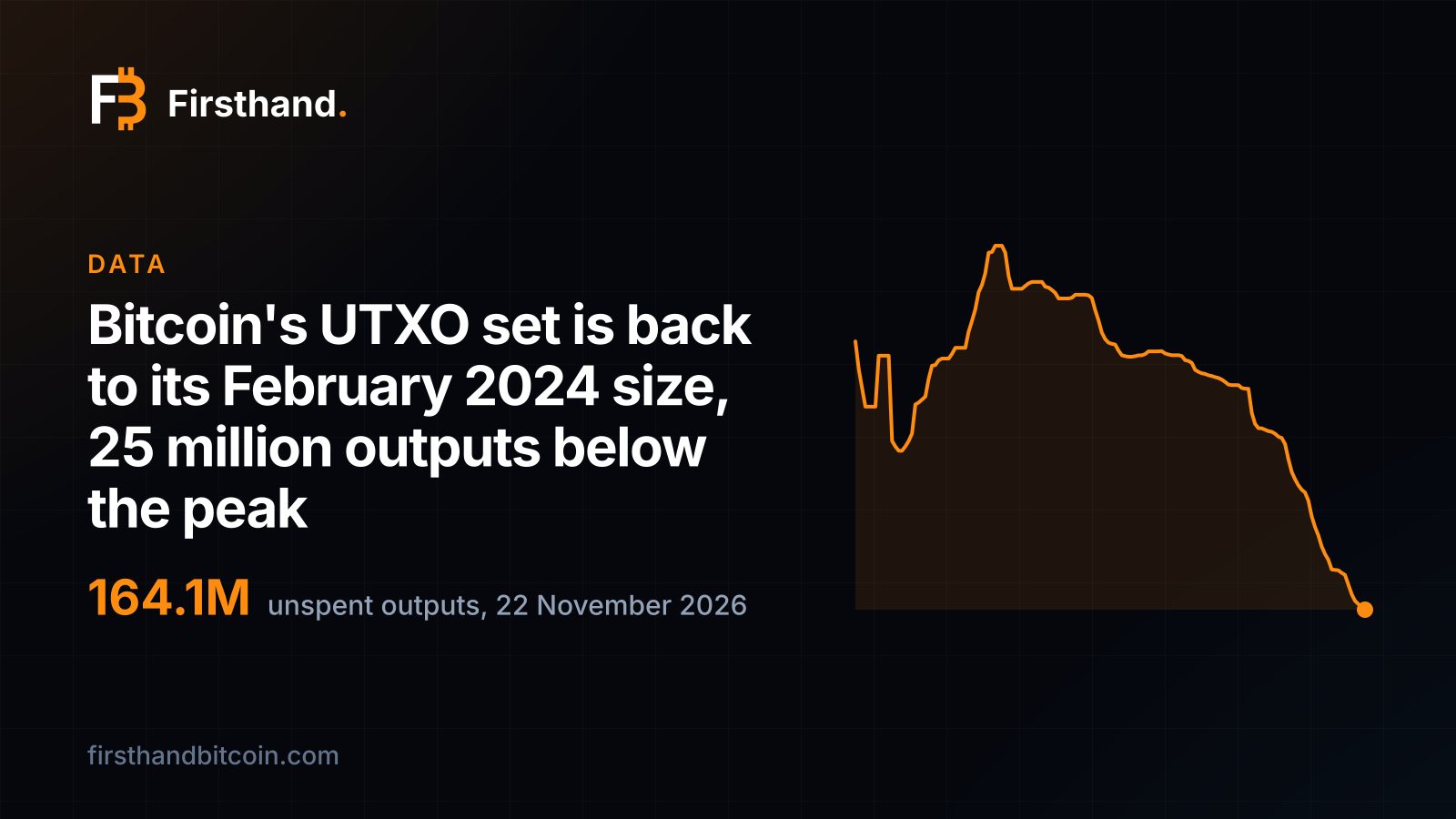
164.1 million outputs, the fewest since February 2024
Every bitcoin that has not been spent sits in an unspent transaction output, or UTXO: a chunk of BTC locked to an address, waiting to be used as the input of a future transaction. The UTXO set is the list of all of them, and every full node keeps it to check that new transactions spend something real. Blockchain.com counts it every day, leaving out the unspendable data outputs that carry no BTC.
On 22 November 2026 the count stood at 164,088,181 on our UTXO set chart. That is the lowest reading since 20 February 2024, when it was 163.5 million, and 25.2 million below the highest reading in our record: 189,282,514 on 22 December 2024. The set has shrunk by 13% in just under two years.
The fall has picked up this autumn. The count was 166.9 million on 1 September and 166.3 million on 1 October, so 2.2 million outputs have gone in the last 52 days. For most of 2026 before that it barely moved: 167.7 million on 5 January, 167.4 million on 6 July.
A token boom added 50 million outputs in a year
The set did not grow like that because more people were holding bitcoin. It grew because of inscriptions and the BRC-20 tokens built on them, which from early 2023 wrote data onto the chain and left tiny outputs behind. Glassnode counted an increase of 46.2 million outputs, or 33.8%, between February and late September 2023, the fastest weekly growth in the history of the set, in its September 2023 report. A single BRC-20 token was "responsible for at least 21M new UTXOs, around 45.5% of the increase", it wrote.
Our record shows the same climb from 139.3 million on 2 December 2023 to the peak a year later. The halving day of 20 April 2024 fell in the middle of it: the set held 178.3 million outputs that day, and fees paid to miners reached 1,257.7 BTC, as competing token transactions bid for space in the first blocks after the subsidy was cut.
One token alone left at least 21 million new outputs on the ledger.
Cheap fees made tidying up worth doing
An output leaves the set when it is spent. The cheapest way to remove many at once is a consolidation: one transaction that takes dozens or hundreds of small outputs as inputs and pays them into a single new one. The fee is charged by size, and every input adds size, so a consolidation is only cheap when the fee rate is low.
That is the market bitcoin has had since the token rush faded. Fees paid to miners averaged 41.5 BTC a day across 2024 and 2.85 BTC a day so far in 2026 on our fees chart. In February 2025, three months into the decline, CryptoSlate described fees near the network's minimum as "an ideal window for UTXO consolidation", with large holders and exchanges merging their outputs. The window has stayed open: over the 30 days to 21 November, fees averaged 2.84 BTC a day, and on 22 November the fee rate quoted for a place in the next block was just twice the lowest rate the network relays.
A consolidation moves bitcoin between addresses owned by the same holder. It shows up as fewer outputs, not as BTC changing hands, so a shrinking set says nothing on its own about selling.
The busiest network in years, with a shrinking set
A smaller set does not mean a quieter chain. The network confirmed a record 963,618 transactions on 15 November, as we set out in our piece on the record day, and 638,018 on 21 November. Many of those transactions spend more outputs than they create, which is how the count can fall on a busy day.
The two lines together describe a ledger being used for payments and housekeeping rather than for minting tokens. That matters to anyone who runs a node, because the set is what a node must hold in memory to check each block quickly, and it matters to miners through the fees, which is where the next section goes.
What it means for a miner
Fees made up 0.6% of everything miners were paid over the 30 days to 21 November, against 99.4% from the 3.125 BTC subsidy on every block. The token boom that swelled the set was also the last time fees were a real part of miner pay, and its unwinding is part of why they are not now. Until the next halving in 2028, what a machine earns is set by its share of the hashrate and the subsidy: a petahash earned 0.00047 BTC a day on 22 November on our hashprice in bitcoin chart.
For a miner who keeps the BTC, the set has a practical side. Every payout from a pool lands as its own output in the payout wallet, as our guide to how mining payouts reach a wallet address explains, so a year of daily payouts is hundreds of small outputs. Each one adds size, and so fee, to the transaction that eventually spends it. When fees sit near the minimum, as they have for most of 2026, bringing those outputs together costs the least it ever has.
On our best case, an Antminer S23 XP Hyd at 8.9 J/TH on Nigeria's 3.9 cents, electricity makes one BTC for about $17,700 at today's hashprice, against $59,068 to buy one on 22 November: 30% of the price. The cost-to-mine chart carries the line for every class of machine. These figures hold today's conditions flat, and output is not guaranteed.
Every pool payout is a new output. Fees this low are when a year of them costs least to bring together.
Sources and further reading
- Unspent Transaction Outputs — Blockchain.com, 22 Nov 2026
- Inscriptions, Mempools and Miners — Glassnode, 26 Sep 2023
- Why the drop in Bitcoin UTXOs, transactions, and fees is not bearish — CryptoSlate, 19 Feb 2025
- UTXO set — Firsthand Bitcoin data, 22 Nov 2026
- Fees paid to miners — Firsthand Bitcoin data, 22 Nov 2026
Disclosure
Firsthand Bitcoin sells and hosts mining hardware, including this machine. No manufacturer, distributor or affiliate programme paid for or reviewed this page and we take no commission on the links above. Historical figures are computed from daily bitcoin price and network hashprice, each day valued at its own prices. Nothing here is investment advice.