Home / Blog / MicroBT Whatsminer M32
Field report · Nov 23, 2026 · 4 min read
The Whatsminer M32 ran 713 days without a stop through 2021, then crossed to Nigeria once
A 54 J/TH machine bought two months after the 2020 halving. It ran every day of the 2021 bull run in Argentina, was switched off for the winter of 2022, crossed to Nigeria in February 2023 and was retired in September 2025. Almost every BTC it mined came before the 2024 halving, and all of them are still held.
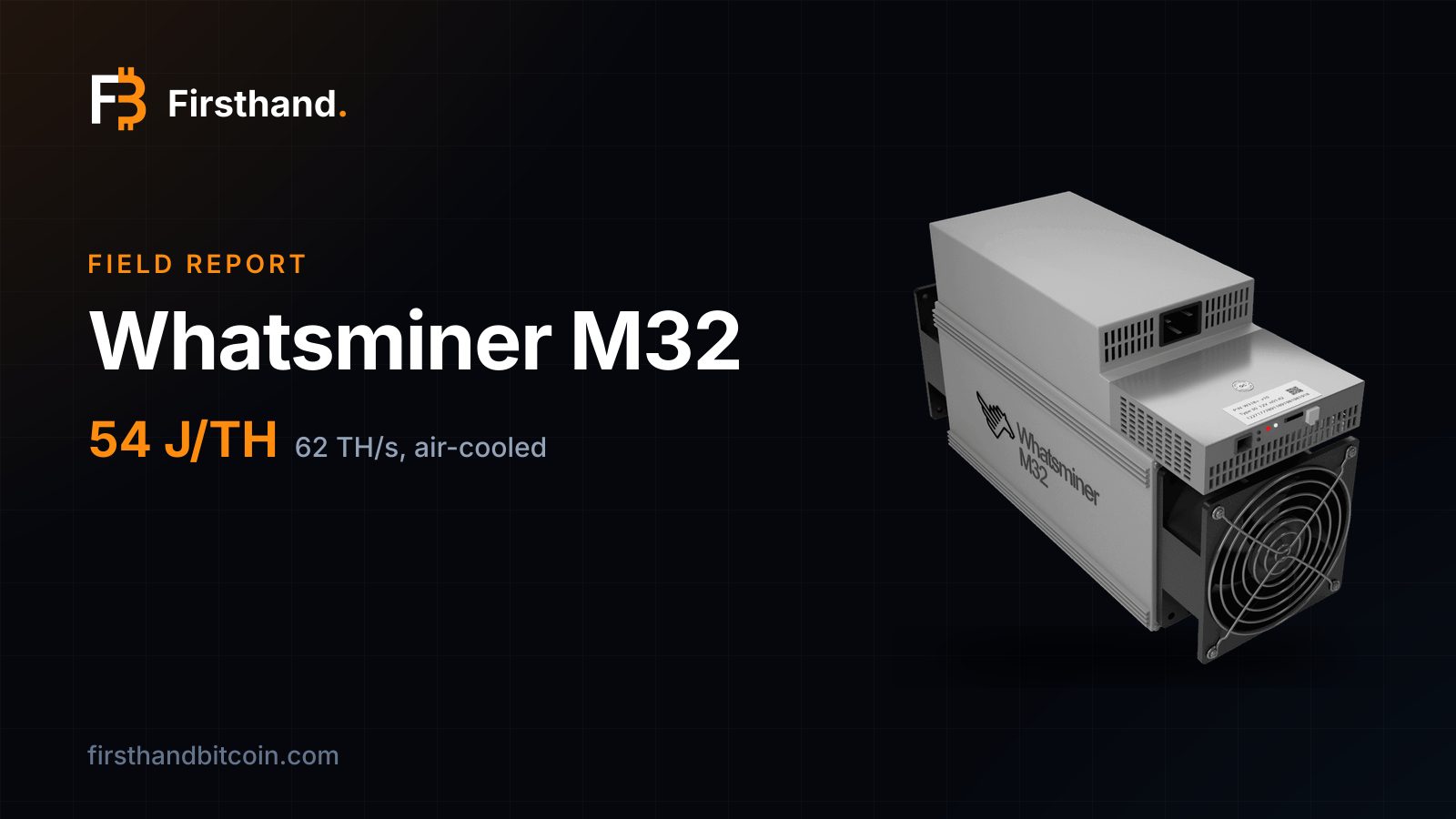
MicroBT Whatsminer M32 (62 TH/s)
Bought two months after the 2020 halving
The first price we hold for the Whatsminer M32 is from 10 July 2020: $1,228 for the 62 TH/s unit, $2,085 landed in Argentina with freight, duty and setup. Bitcoin had halved its block subsidy on 11 May 2020, eight weeks earlier, and was trading at $9,246 the day it was bought.
The M32 draws 3,348 W for 62 TH/s, which is 54 J/TH. A petahash of it uses 1,296 kWh a day: $74.52 at Argentina’s 5.75¢ and $50.54 at Nigeria’s 3.9¢. That is its line, the hashprice it needs to cover its own power, and the guide to efficiency and halvings shows why a line that high decides a machine’s life. On the day it was bought, network hashprice was $73.57 a petahash.
713 days without a stop
It ran 76 days, stopped on 23 September 2020 as hashprice came within a few dollars of its line, and was back on 29 October 2020. From then it did not stop for 713 days, to 11 October 2022: every day of the 2021 bull run, the China ban that summer and the first half of the 2022 fall.
Hashprice peaked at $412.85 on 20 October 2021, five and a half times what the machine’s power cost that day. Through the run in Argentina it mined most of everything it would ever mine.
The machine itself was worth more too. By March 2021 the same M32 sold for $5,979, 4.9× what we paid eight months earlier. Its owner could have mined for years and still had the option of selling the box near the top, or swapping it for the next generation, the move our guide on machines as the roof describes.
On 20 October 2021 a petahash earned $412.85 a day. The M32’s power cost $74.52.
One crossing, in February 2023
Hashprice fell under the Argentine line in October 2022 and the machine was switched off on 12 October, through the winter that followed the FTX collapse. Off costs nothing, and nothing it had mined was sold.
On 19 February 2023 it crossed to Nigeria, the one move a machine makes, when the cheaper power paid decisively better over a year of figures. The line fell from $74.52 to $50.54, hashprice was $80.45 that day, and it ran 459 days in Nigeria without a stop, straight through the April 2024 halving, to 22 May 2024. The guide to crossing explains why that move happens once.
On and off, then retired
After the halving a petahash earned half the BTC it had, and an M32 in Nigeria ran only when hashprice rose past $50.54. It did four times: 31 days in June and July 2024, 102 days from November 2024, 34 days in May and June 2025 and 87 days from 29 June 2025. Its last day was 23 September 2025, with hashprice at $50.03, and it was retired on 24 September 2025.
In all it has run 1,502 days and been off for 826. A machine is retired when it is off today, and its BTC never are. At today’s price one BTC from an M32 in Nigeria would cost about $113,100 in electricity, against $61,406 to buy one.
What it banked
Over its 1,502 running days the M32 mined and kept 0.3435 BTC for $5,505 of electricity, about $16,000 a BTC averaged over its life. At today’s price that is $20,638, and $15,133 of cashflow after every dollar of power: 7.3× the $2,085 it cost to land.
98% of that BTC came before the April 2024 halving. Nobody sold any of it to pay the power bill, which is why a machine that has been off for over a year still has its whole record in the wallet.
Off costs nothing. Every BTC it mined while it was on is still held.
What we would tell ourselves
Buy the machine whose line sits far below hashprice, because that gap is what carries it through the troughs and the halvings. The M32’s line was a fifth of the 2021 peak and right at the market from 2022 on.
Today’s air-cooled machines sit a long way lower. The Whatsminer M74S+ at 12 J/TH makes a BTC for about $37,100 in Argentina, and on hydro the Antminer S23 XP Hyd at 8.9 J/TH makes one for about $19,300 in Nigeria. The M32 did its work with a line four and a half times higher, and the lesson it leaves is to start where it never could: far under the market.
- MicroBT Whatsminer M74S+ (332 TH/s) — 12 J/TH, In stock, $25,131 of electricity per bitcoin, 21% year one
- MicroBT Whatsminer M73S (560 TH/s) — 13 J/TH, In stock, $27,225 of electricity per bitcoin, 25% year one
- Bitmain Antminer S21 XP (270 TH/s) — 13.5 J/TH, In stock, $28,272 of electricity per bitcoin, 24% year one
Which machines this covers
Disclosure
Firsthand Bitcoin sells and hosts mining hardware, including this machine. No manufacturer, distributor or affiliate programme paid for or reviewed this page and we take no commission on the links above. Historical figures are computed from daily bitcoin price and network hashprice, each day valued at its own prices. Nothing here is investment advice.