Guide · Nov 23, 2026 · 5 min read
Do you need to run a bitcoin node to mine? No, and here is who runs it for your machine
A mining machine never talks to a bitcoin node. It talks to a pool, and the pool runs the node. Here is what a node does, what one would take to run at home, when running your own is worth it, and what to check instead before your first machine starts.
The short answer: your machine never talks to a node
You do not need to run a bitcoin node to mine. Almost nobody who owns a mining machine does, and the machine has no way to use one even if you did.
A mining machine does one job. It is handed a small block of data, about 80 bytes, and tries billions of variations of it every second, looking for one that meets the network’s target. It does not store the history of bitcoin, check anyone’s transactions or choose which payments go into a block. Those are a node’s jobs.
What your machine needs is three settings: the address of a mining pool, a worker name and a password. Our guide to what a mining pool is explains why every machine mines in one. The pool does everything a node does on the machine’s behalf.
On most machines those settings sit on one page of the machine’s own web dashboard, with room for up to three pools: a main one and two backups the machine switches to if the first stops answering. That page is the whole of a mining machine’s connection to bitcoin. There is no field for a node, because there is nothing a node could give the machine that the pool does not already send.
What a node actually does
A node is a program that keeps a full copy of bitcoin’s history and checks every new payment and every new block against the rules. In the words of bitcoin.org, “A full node is a program that fully validates transactions and blocks.”
When someone sends bitcoin, the payment travels from node to node across the internet. Each node checks it: is the signature right, does the sender actually hold that bitcoin, has it already been spent? A payment that fails is dropped. One that passes waits in the node’s queue, the mempool, until a miner puts it in a block.
When a new block arrives, every node checks it the same way before adding it to its copy of the record. That is what makes bitcoin hard to cheat: a block that breaks the rules is rejected by thousands of independent computers, however much hashing went into it. Our guide to what a bitcoin block is covers what goes inside one.
A node earns nothing for this work. Nobody pays it, and running one adds no bitcoin to anyone’s wallet. People run nodes because they want to check bitcoin’s rules for themselves rather than trust someone else’s copy.
A node is bitcoin’s record keeper and referee. A miner is the worker that seals each new page.
The pool runs the node and hands your machine the work
A mining pool runs its own nodes. The Bitcoin Developer Guide puts it plainly: “The mining pool gets new transactions from the network using bitcoind,” bitcoind being the standard node software.
From those transactions the pool builds the next block it would like to find, then sends each machine connected to it just the part it needs to hash. Most pools do this with a protocol called Stratum. The same guide describes it as giving miners “the minimal information they need to construct block headers on their own”.
Your machine hashes that work and sends back its best attempts, called shares, which is how the pool measures what each machine contributed. When any machine in the pool finds a valid block, the pool’s node announces it to the network and the reward is paid to the pool, which then pays you by the rules explained in our guide to how pools pay.
The trade-off is that a machine on Stratum cannot see or choose the payments inside the block it is working on. The developer guide says so: “miners using Stratum cannot inspect or add transactions to the block they’re currently mining.” For someone mining to hold bitcoin, that changes nothing about what the machine earns.
What running your own node would take
A node is not demanding by mining standards. It runs on an ordinary computer with a large drive. Bitcoin.org lists 2 gigabytes of memory as the minimum, warns that a node commonly uploads 200 gigabytes a month or more on a fast connection, and gives a one-time initial download of about 740 gigabytes.
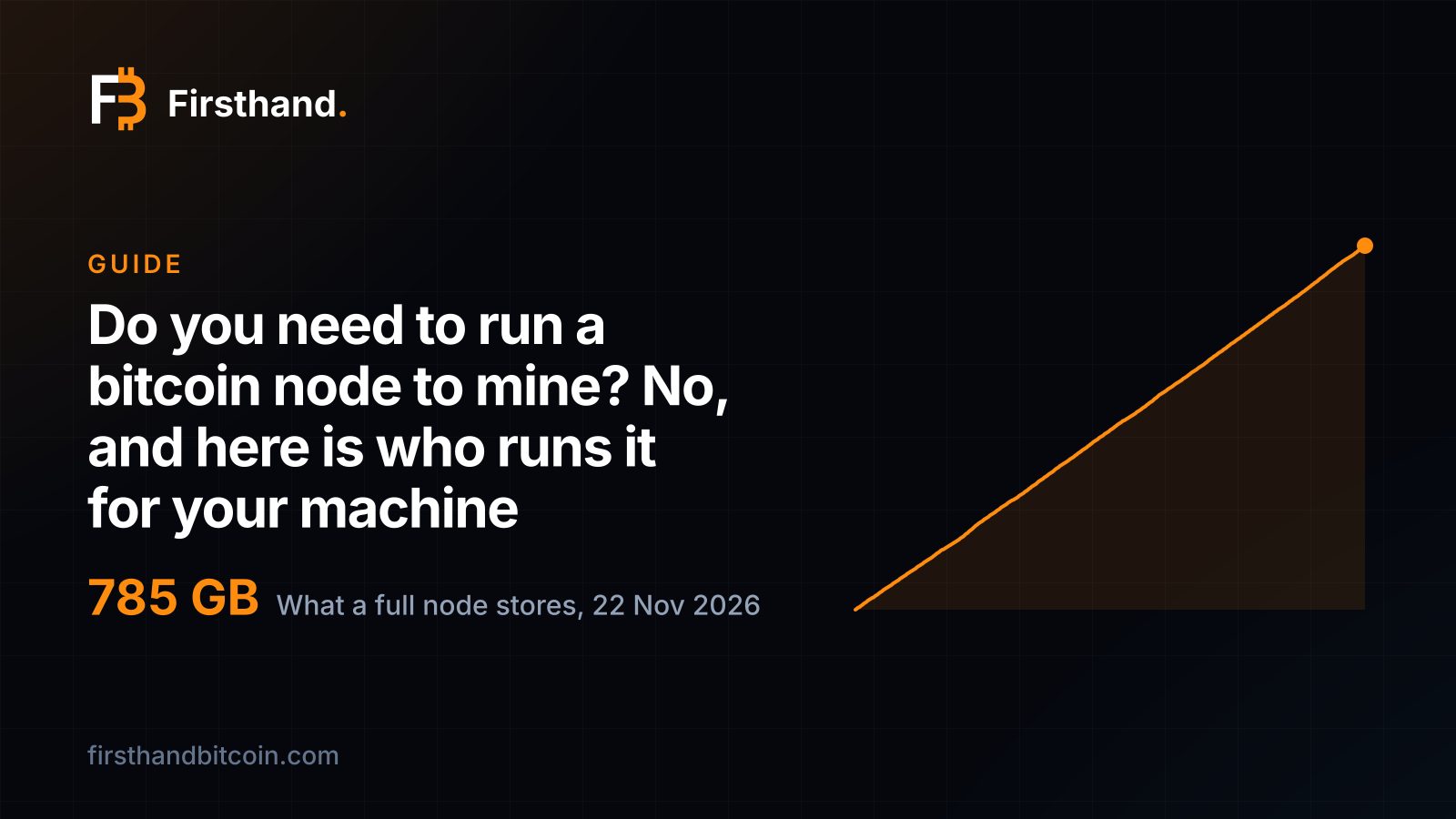
That download is the whole history of bitcoin, and it keeps growing. Our blockchain size chart put it at 785 gigabytes on 22 November 2026, up from 701 gigabytes a year earlier. A 1 or 2 terabyte drive gives room for several more years.
A node can also run pruned, keeping only recent blocks and checking everything as it goes. Bitcoin.org says pruned mode brings storage down to around 7 gigabytes. It still verifies every rule; it just does not keep the old pages. For someone who wants a node only to check their own wallet, a pruned node on a spare laptop is enough.
None of this has anything to do with your machine’s earnings. A node does not add hashrate, does not raise your share of the pool’s rewards and does not lower your power bill.
When running a node is worth it anyway
There are good reasons to run one, and none of them is mining income. The first is checking your own payouts and balance without asking anyone else’s server. A wallet connected to your own node looks up your addresses privately and verifies the payments itself. If you would rather use a public site, our guide to checking a payout on a block explorer shows how.
The second is solo mining, where a machine tries to find a whole block alone instead of sharing a pool’s reward. A solo miner needs a node to build its own blocks. For a single machine the odds are long, as our guide to solo mining works through, which is why almost every machine mines in a pool.
The third is simply taking part. Every node is one more independent check on bitcoin’s rules. Many long-term holders run one for that reason alone, on a small computer in a corner of the house, completely separate from any mining machine.
What to check instead before your machine starts
The settings that decide where your bitcoin goes are the pool account and the payout address, not a node. Make sure the pool account is in your name, each machine has its own worker name, and the payout goes to a wallet address you control, with its seed phrase written down and stored safely.
At a hosting site, the site keeps the machine connected and running, and the pool handles the node work. Your part is the account and the wallet. If either ever needs to change, our guide to changing a machine’s pool or wallet explains what happens to bitcoin already earned.
What a machine earns is decided by its hashrate, the hours it runs and the price of the power it uses. A node changes none of those. Choose an efficient machine, put it on cheap power, point it at a pool and a wallet you control, and keep the bitcoin it mines.
The three settings that matter are the pool, the worker name and the wallet the pool pays.
Disclosure
Firsthand Bitcoin sells and hosts mining hardware, including this machine. No manufacturer, distributor or affiliate programme paid for or reviewed this page and we take no commission on the links above. Historical figures are computed from daily bitcoin price and network hashprice, each day valued at its own prices. Nothing here is investment advice.