Home / Blog / MicroBT Whatsminer M20S
Field report · Nov 22, 2026 · 5 min read
The Whatsminer M20S mined all of 2021 in Argentina. Its thirstier sibling could not
Bought three months before the 2020 halving, the 49 J/TH M20S kept clearing Argentina’s power for almost five months after it, came back within three weeks of its first pause, and mined the entire 2021 boom there. It crossed to Nigeria once, in March 2023, and kept every bitcoin it made until it was retired in October 2025.
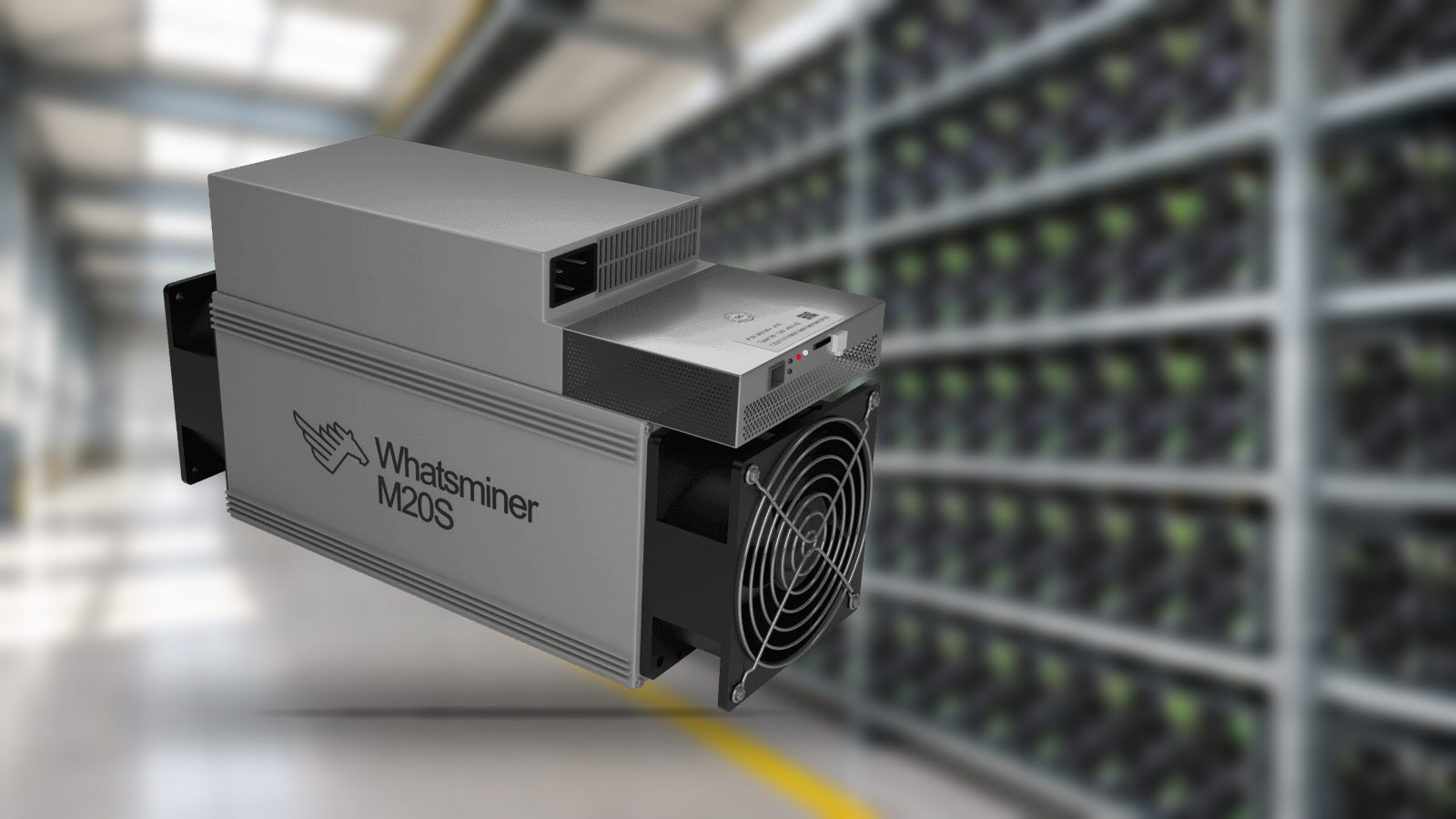
MicroBT Whatsminer M20s (68 TH/s)
Ten fewer watts a terahash than the M21S
MicroBT’s M20 range was the machine of 2019, and it came in two bins that looked alike and ran very differently. Our store record gives the M20S 68 TH/s at 49.4 J/TH, air-cooled. The Whatsminer M21S beside it made 56 TH/s at 60 J/TH: about ten more watts for every terahash.
An owner who reviewed an M20S on Bitcointalk in June 2019 measured 69.6 TH/s from 3,370 W at the wall, a little above the label, and reported no heat trouble in that setup. That gap of ten watts a terahash is the whole story of the two machines.
Ours was priced at $1,214 on 4 February 2020 and landed at our Argentina site for $2,068, with freight, duty and setup included.
Three months of 12.5 BTC blocks
It started hashing while every block still paid 12.5 bitcoin. Hashprice was $157.36 per petahash per day on the day it was bought, and it stayed well above $100 until the halving.
Those three months produced 0.1112 BTC, 20% of everything the machine would mine in its life, worth $6,685 at today’s price. Nobody sold them to pay the power, so today’s price is the one that counts.
The halving cut its margin, not its run
Block 630,000 was mined on 11 May 2020 and cut the subsidy from 12.5 to 6.25 BTC. Hashprice went from $169.75 per petahash per day on 10 May to $86.91 on 12 May.
That left the M21S with nothing over its power, and it went dark five weeks later. The M20S kept running. A petahash of it draws about 49 kW against the M21S’s 60, so at 5.8¢ it was still clearing its line through the middle of 2020.
It held on until 2 October 2020, when hashprice had slid to $67.14 and its trailing month no longer covered the electricity. It was off for 22 days. On 24 October 2020 hashprice was back at $81.03 and the machine was back on, in Argentina. Efficiency decides how much of a halving a machine can absorb, and this was the difference made visible.
Same range, same halving, same site. Ten watts a terahash decided which machine stayed.
Argentina, for the whole bull run
From 24 October 2020 it ran 740 days without a stop, all of them in Argentina. That stretch held the entire 2021 boom, with hashprice peaking at $412.85 per petahash per day on 20 October 2021, about six times what a petahash of M20S cost to power at 5.8¢.
While a terahash earns that well, high uptime beats cheap power outright, and a machine that can clear the expensive site has no reason to leave it. The M21S had crossed to Nigeria in October 2020 because it had to. The M20S never had to, and mined its best years where the most hours were.
The machine was worth 5.4× its price
The 2021 market lifted the price of machines along with bitcoin. By March 2021 an M20S was changing hands at $6,557, 5.4× the $1,214 this one cost.
A seller at that point would have had 0.2529 BTC of mining, worth $15,197 today, plus $6,557 for the machine: $21,754, or 10.5× its landed cost, thirteen months after buying it. That is the replace-the-roof move. This run kept the machine and kept mining.
One crossing, in March 2023
The 2022 low did what the 2020 halving could not. On 2 November 2022 the machine stopped in Argentina, and three weeks later, on 21 November, hashprice touched $55.86. It came back on 1 February 2023 for six weeks.
On 21 March 2023 it crossed to Nigeria: the one crossing a machine makes, made once its own trailing year said 3.9¢ was decisively the better home. At that rate a petahash of M20S costs about $46 a day to power instead of about $68.
Build quality was never the issue. A long-time operator in the same thread judged the M20 and M21 family more robust than the competing generation from the reviews he had seen. Hosted with us, a fault on a machine like this is a parts bill: repairs in Argentina are billed at the cost of the parts and nothing else.
The 2024 halving finished what 2020 started
Nigeria ran it without a stop from March 2023 until 8 August 2024, when hashprice, cut again by the April 2024 halving, had fallen to $41.19, under its line even at 3.9¢. It came back twice when the trailing month paid again: from 14 November 2024 to 27 March 2025, and from 12 May to 30 October 2025.
Its last day of mining was 30 October 2025, and it has been retired since 31 October 2025. Hashprice has not been above $45 since; it stood at $28.55 on 20 November 2026. A machine is retired when it is off today. Its bitcoin never is.
The tally: 0.5448 BTC for $6,921 of electricity
Over 1,842 running days the M20S mined and kept 0.5448 BTC for $6,921 of electricity: $12,704 one BTC, averaged over its life. At today’s price those BTC are worth $32,735.
That is $25,814 of cashflow against a $2,068 landed cost: 12.5× its box, from the BTC alone. 98% of them came before the 2024 halving.
The lifetime average describes a machine that met most of its blocks at 12.5 and 6.25 BTC. At today’s difficulty one BTC from an M20S in Nigeria would take about $103,500 of electricity, against a bitcoin at $61,406, which is why it stays off.
Bought for $1,214, it kept 0.5448 BTC. That is the whole case for efficiency at the right entry price.
What the M20S says about buying now
Two machines from one range met the same halving at the same site. The one with ten fewer watts a terahash stayed where the hours were, mined the bull run there, and crossed to cheap power only when the next downturn made the case. The other spent the boom on cheaper power because it had no choice.
That gap still decides outcomes. Bitmain’s air-cooled Antminer S21 XP needs 13.5 J/TH, under a third of the M20S’s power for every terahash, and makes one BTC in Argentina for about $41,700 of electricity today.
The April 2028 halving is the next test. Buy for the halving in front of you: a machine that can lose half its subsidy and still clear its site has the M20S’s run ahead of it, with cheap power held in reserve.
- MicroBT Whatsminer M74S+ (332 TH/s) — 12 J/TH, In stock, $25,131 of electricity per bitcoin, 21% year one
- MicroBT Whatsminer M73S (560 TH/s) — 13 J/TH, In stock, $27,225 of electricity per bitcoin, 25% year one
- Bitmain Antminer S21 XP (270 TH/s) — 13.5 J/TH, In stock, $28,272 of electricity per bitcoin, 24% year one
What people are saying online
A stable result for the power consumption at wall was 3370 W, and the average hash rate for the mining was 69.6 Th/s.
A reviewer who tested an M20S measured it slightly above its 68 TH/s label at the wall.
judging by large sample reviews it's pretty obvious the M21s and the M20 is a lot more robust than all the 17 series of bitmain including the Pro version
A long-time operator rated MicroBT’s 2019 range as one of the sturdier generations of its time.
Sources and further reading
- Bitcoin records its third-ever block reward halving — The Block, 11 May 2020
- (Review/Guide) WhatsMiner M20S 68.0 Th/s ASIC miner — Bitcointalk, Jun 2019 – Jul 2021
Which machines this covers
Disclosure
Firsthand Bitcoin sells and hosts mining hardware, including this machine. No manufacturer, distributor or affiliate programme paid for or reviewed this page and we take no commission on the links above. Historical figures are computed from daily bitcoin price and network hashprice, each day valued at its own prices. Nothing here is investment advice.