Home / Blog / Bitmain Antminer S17 Pro
Field report · Nov 10, 2026 · 5 min read
Bought in October 2019, the Antminer S17 Pro mined 97% of its coins before the 2024 halving
The S17 Pro was bought when a petahash earned nearly three times its Argentine power bill. It crossed to Nigeria once, ran through the 2024 halving, stopped and started again through 2026, and was retired in October with every coin it mined still kept.
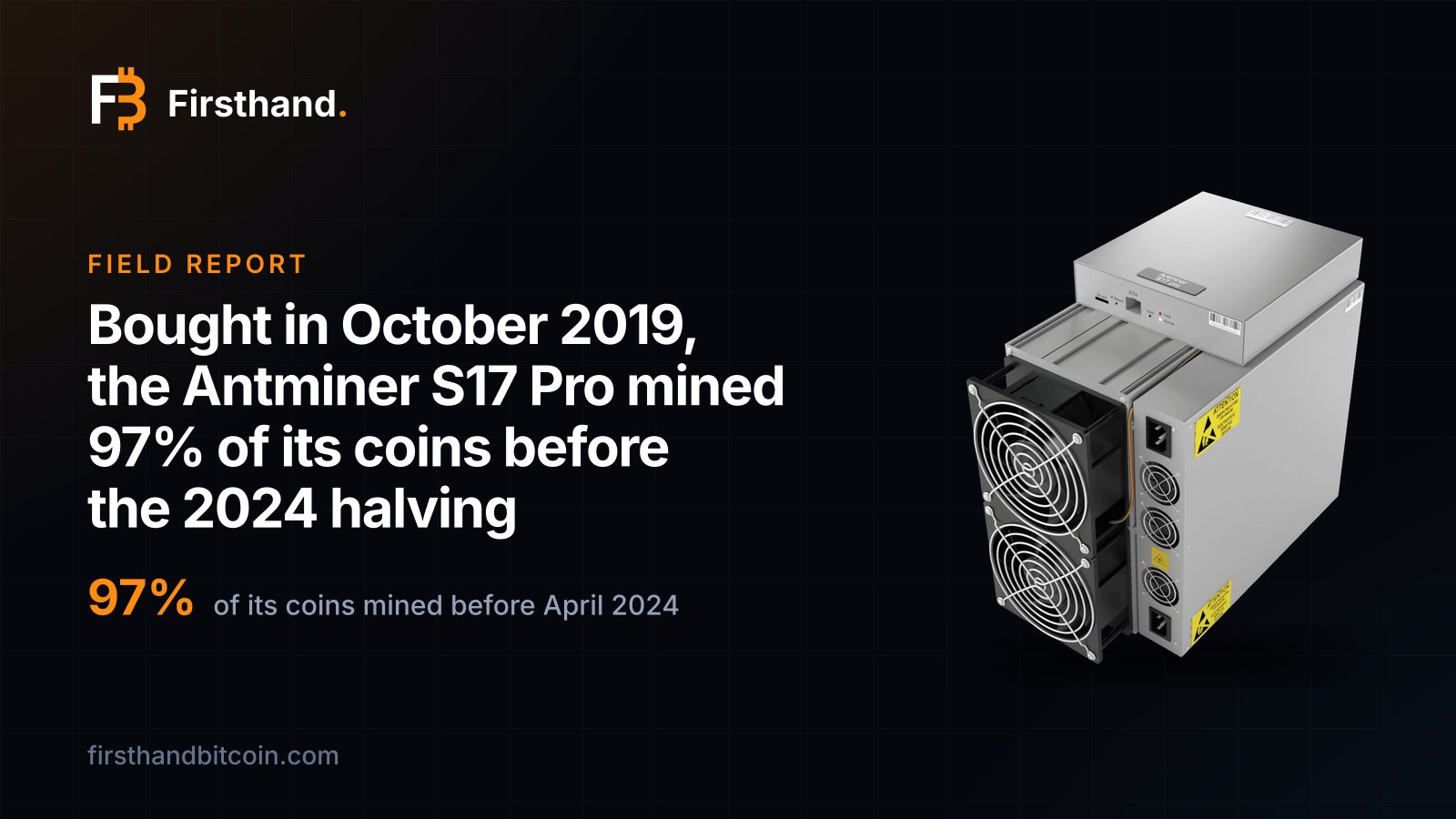
Bitmain Antminer S17 Pro (53 TH/s)
Bought when a petahash earned almost three times its power bill
Bitmain announced the S17 Pro in March 2019, in a post its Twitter account made that Bitcointalk members quoted: "We're excited to announce the soon to come Antminer S17 Pro, Antminer S17, and the Antminer T17." The unit in our store is the 53 TH/s version at 2,094 W, which is 39.51 J/TH, and every figure in this report is for that unit.
The first price we hold for it, on 16 October 2019, was $1,181, or $2,026 landed in Argentina with freight, duty and setup. Hashprice, what one petahash earns in a day, was $160.46 that day. The same petahash cost $56.89 a day in power at Argentina's 6¢. The machine was bought with its power bill covered nearly three times over.
A 39.5 J/TH machine has a high line, and the bull run cleared it by a wide margin
A machine's line is the hashprice at which it stops covering its own power. At 39.51 J/TH a petahash uses 948 kWh a day: $56.89 at 6¢ and $36.98 at Nigeria's 3.9¢. The guide to efficiency and halvings shows where every J/TH puts the line.
Argentina's line was cleared on all but three of the first 1,147 days. Hashprice peaked at $412.85 on 20 October 2021, more than seven times the line. By the May 2020 halving the machine had mined 0.1972 BTC, 35% of what it has kept in total, and by the 2024 halving 0.5490 BTC, 97%.
Before the May 2020 halving the S17 Pro had already mined 35% of everything it would ever keep.
The 2022 low stopped it for eight days, and in April 2023 it crossed once
The first test of Argentina's line came in the bear market of 2022. Hashprice touched $55.86 on 21 November, $1.03 under the line, and on 5 December 2022 the S17 Pro was switched off. It ran again from 13 December, when hashprice was $65.10, and spent 133 more days at Argentina's rate.
On 25 April 2023 it crossed to Nigeria, the one move a machine makes. Hashprice was $73.16 that day, twice the new $36.98 line. The guide to crossing explains why the move happens once and why it comes before the old site turns negative.
957 days in Nigeria, across the halving
The machine ran 957 days there to 6 December 2025, and hashprice was above the Nigerian line on 950 of them. The April 2024 halving fell inside that stretch. Hashprice was $103.64 the day before it, nearly three times the line.
Before the halving the S17 Pro mined 0.5490 BTC over 1,641 days, 97% of everything it kept and about $4.91 a day after power. In the 664 days since it has mined 0.0154 BTC, at about $0.44 a day. A 39.5 J/TH machine earns its money while hashprice is high, and this one was bought at the start of a long stretch of it.
At Nigeria's rate the line fell by a third, and hashprice cleared it on 950 of 957 days.
It stopped, ran twice more, and was retired on 26 October
Hashprice was $37.97 on 6 December 2025 and the S17 Pro stopped. It ran again from 19 January 2026, when hashprice was $40.04, for 30 days. Its last day was 17 February, when hashprice was $34.10. It stayed off for about seven months, until 18 September, when hashprice was $39.20, and ran 38 more days.
On 26 October hashprice was $35.93, under the $36.98 line. It was $31.93 on 9 November. The machine was retired: a machine is retired when it is off today, and its coins never are. In all it has run 2,305 days and been off for 279.
What it banked
Over the days it ran, the S17 Pro mined and kept 0.5644 BTC for $5,553 of electricity. At today's price the coins are worth $42,451, so the machine has covered its $2,026 landed cost 18.2× over: $36,898 of cashflow after every power bill. Electricity averaged about $9,800 a coin across the run. That is a lifetime average over 2,305 running days, and it sits far under the $74,198 a coin sells for today.
The entry mattered as well. Our market index put an S17 Pro at $5,111 in March 2021, 4.3× what we hold as its first price, the one moment a miner's box is worth a multiple of what it cost. An owner who sold then would have held 0.3146 BTC plus the box: $28,774 in all, 14.2× the landed cost. The coins were never sold to find out.
The S17 range had a reputation for sensor trouble. In a Bitcointalk thread from April 2020 mikeywith wrote that a temperature-sensor error "Indicates a problem with the sensor, in some cases, the following methods will help fix it," and the fixes listed were a reboot, a firmware reflash and cleaning the power supply. In Argentina we repair on site and bill parts only, which is what the guide to failed hashboards means by a line item.
Nothing it mined was sold. A machine that is off spends nothing.
What we would tell ourselves
Efficiency sets how many cycles a machine can sit through. At today's conditions a coin from an S17 Pro in Nigeria costs about $91,000 in electricity, against $74,198 a coin sells for. The line is $36.98 at 3.9¢ and hashprice was $31.93 on 9 November. The S23 XP Hyd at 8.9 J/TH has a line of $8.33 and makes a coin in Nigeria for about $21,300.
The lesson is where the line sits. The S17 Pro was bought to harvest a high hashprice and did: 97% of its coins came before 2024, and the ones it cost to make were cheap. A machine whose line is a quarter of hashprice runs through every trough; one whose line is hashprice's own level waits for the next peak. The roof guide says what the earnings are for: the next machine.
Sources and further reading
- Bitmain introduces the Antminer S17 Pro, Antminer S17 and Antminer T17 — Bitcointalk, March 2019
- Antminer T17/S17 Temp Sensor problem discussion — Bitcointalk, April 2020
Which machines this covers
Disclosure
Firsthand Bitcoin sells and hosts mining hardware, including this machine. No manufacturer, distributor or affiliate programme paid for or reviewed this page and we take no commission on the links above. Historical figures are computed from daily bitcoin price and network hashprice, each day valued at its own prices. Nothing here is investment advice.