Data insight · Oct 22, 2026 · 6 min read
Hashprice has never fallen under the power cost of a 19 J/TH machine since the 2024 halving
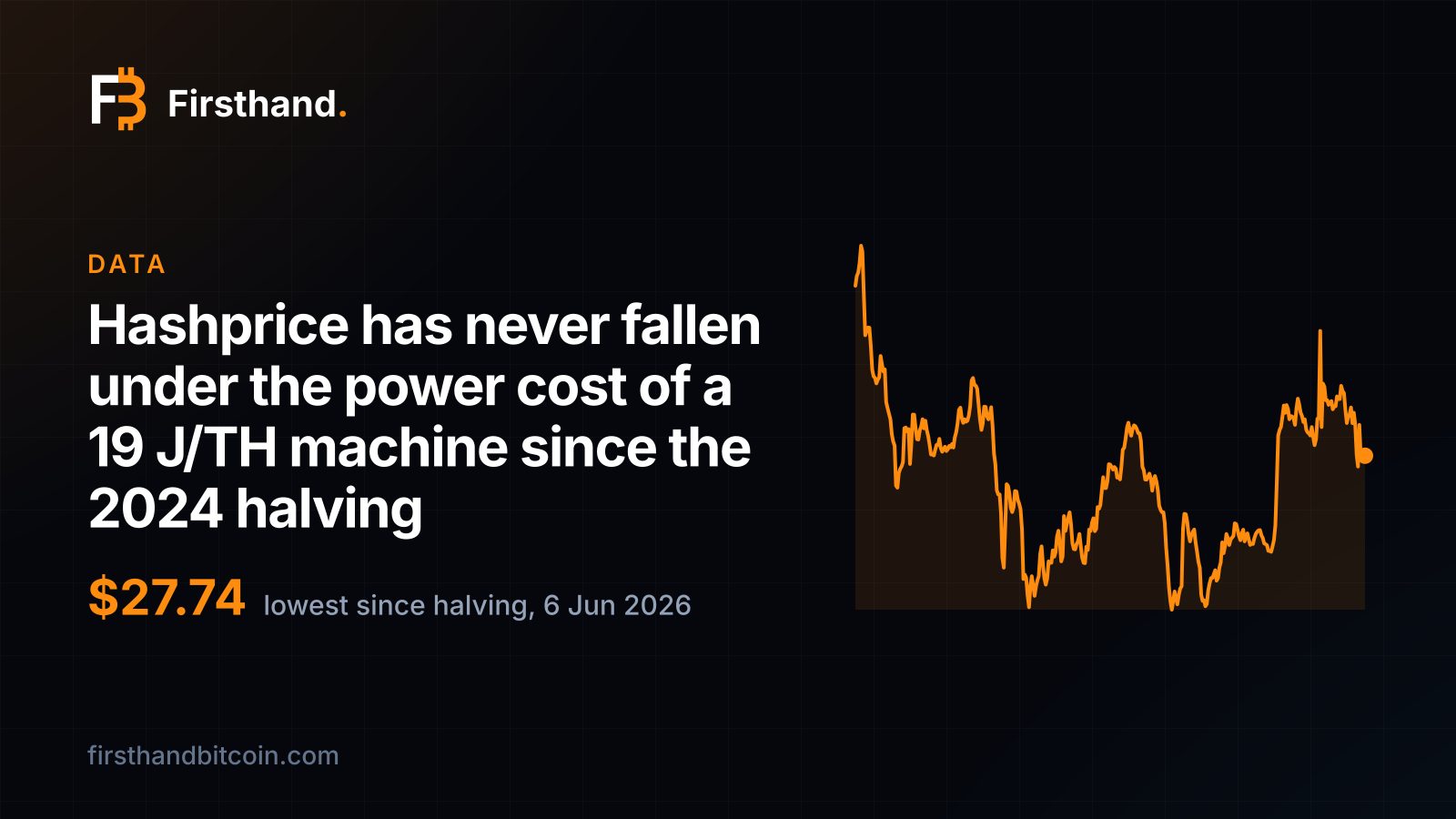
In the 914 days from the April 2024 halving to 21 October 2026, a petahash never earned less than $27.74 a day. That is above the power bill of every machine at 19 J/TH or better, at 6¢, on every one of those days. Older machines are a different story, and 2026 is when it started.
A machine's power bill is a line, and hashprice is the thing that crosses it
Hashprice is what one petahash of mining power earns in a day, in dollars. It is the revenue side of every machine's day, and it moves with the price of bitcoin, with difficulty and with fees. The guide to hashprice shows how to turn it into a figure for your own machine.
The cost side is simpler. A machine's efficiency, in joules per terahash, fixes how much electricity a petahash uses in a day: 1,000 terahash times its J/TH times 24 hours. At 17 J/TH that is 408 kWh, which costs $24.48 at 6¢ and $15.91 at Nigeria's 3.9¢. Call that figure the machine's line. When hashprice is above it, a day of running covers its own electricity. When hashprice is below it, the day costs more than it earns.
This piece counts how often that has happened. The count runs from 21 April 2024, the first day after the halving, to 21 October 2026: 914 days of our hashprice series, at the price of bitcoin on each day.
The efficient machines never saw their line
The lowest hashprice in the 914 days was $27.74, on 6 June 2026. Divide it by the 1.44 kWh a day that each J/TH costs at 6¢ and the answer is 19.3 J/TH: a machine at 19 J/TH or better has a power line at or under $27.36, and hashprice was above that on every day since the halving.
The efficient end of the store is nowhere near it. The S21 XP at 13.5 J/TH has a line of $19.44 at 6¢. The Whatsminer M63S+ at 17 J/TH has $24.48. The S23 XP Hyd, at 8.9 J/TH, has $12.82. None of them has had a day under its line since the halving, at either 6¢ or Nigeria's 3.9¢.
That matters because it is the opposite of how the last two years are usually remembered. The price of bitcoin fell, difficulty rose and hashprice fell from $123.75 to $27.74 at its lowest, and a machine at 19 J/TH or better still covered its power on every one of those days.
| Machine efficiency | Line at 6¢ | Days under it | Of those, in 2026 | Line at 3.9¢ | Days under it |
|---|---|---|---|---|---|
| 8.9 J/TH | $12.82 | 0 | 0 | $8.33 | 0 |
| 13.5 J/TH | $19.44 | 0 | 0 | $12.64 | 0 |
| 17 J/TH | $24.48 | 0 | 0 | $15.91 | 0 |
| 19.9 J/TH | $28.66 | 14 | 14 | $18.63 | 0 |
| 21.5 J/TH | $30.96 | 55 | 55 | $20.12 | 0 |
| 26 J/TH | $37.44 | 211 | 195 | $24.34 | 0 |
| 34 J/TH | $48.96 | 551 | 294 | $31.82 | 84 |
The older machines met their line in 2026
The line moves with efficiency, and a few J/TH matter. A machine at 19.9 J/TH, like the Whatsminer M60, has a line of $28.66 at 6¢, only 92 cents above the lowest reading. Hashprice sat under it on 14 days, between 23 February and 1 July 2026, and on no day before that.
At 21.5 J/TH, the efficiency of the Antminer S19j XP, the line is $30.96 and hashprice was under it on 55 days, again all in 2026, from 5 February to 11 July. At 26 J/TH the line is $37.44 and the count reaches 211 days, 16 of them in late 2025 and the rest in 2026. On 21 October, at $37.29, hashprice was still 15 cents under that line.
The picture for older machines at 6¢ is worse. At 34 J/TH, the efficiency of the Whatsminer M30S+ that our field report follows, the line is $48.96 and hashprice was under it on 551 of the 914 days, including every one of the 294 days of 2026. At Nigeria's 3.9¢ the same machine's line is $31.82, and hashprice was under that on 84 days, all of them in 2026.
Of the 914 days since the halving, 84 sat under the Nigerian line of a 34 J/TH machine. Every one of them fell in 2026.
Today's reading is above every line that matters to a machine bought now
Hashprice was $37.29 on 21 October, according to our series. That is above the line of every machine at 21.5 J/TH or better at 6¢, and above Nigeria's line for any machine up to about 39 J/TH. It is below the $37.44 of a 26 J/TH machine at 6¢, and below the $48.96 of a 34 J/TH one.
The median reading since the halving is $46.34, and the first day after it, 21 April 2024, was $123.75, the highest in the 914 days. The year 2025 never went below $35.06, on 22 November. The low of 2026 came in June.
These lines are electricity only, at full uptime. They leave out the pool's fee and the hours a machine is off, and hashprice is a network-wide average rather than what any single machine collects, so a real machine sits a little further from its line than the table shows. The direction is the same.
What it means for a miner
Efficiency is what kept a machine's days positive through the weakest stretch since the halving. The best machines we stock make a coin for about $18,000 of electricity at Nigeria's 3.9¢, against a bitcoin price of about $82,000 on 22 October. That is electricity only, at today's hashprice, and leaves out the machine and the pool's fee.
A machine's line is a number you can look up before you buy: its J/TH times 24, times your power rate per kWh, in dollars per petahash. Compare it with the hashprice chart rather than with the price of bitcoin, and the guide to efficiency and halvings shows what the line does to a machine's life.
The 2028 halving halves hashprice again at today's price and difficulty, to near $18.64, which is under the line of everything above about 13 J/TH at 6¢. Every figure here is a snapshot to 21 October 2026, and a machine's output is not guaranteed: hashprice moves with the price of bitcoin and with difficulty.
Sources and further reading
- Hashprice, daily, 13 years of bitcoin data — Firsthand data, 21 Oct 2026
Disclosure
Firsthand Bitcoin sells and hosts mining hardware, including this machine. No manufacturer, distributor or affiliate programme paid for or reviewed this page and we take no commission on the links above. Historical figures are computed from daily bitcoin price and network hashprice, each day valued at its own prices. Nothing here is investment advice.