Home / Blog / MicroBT Whatsminer M30S+
Field report · Oct 22, 2026 · 5 min read
The Whatsminer M30S+ paid for its box, then spent 2026 switching on and off at Nigeria's line
MicroBT's 34 J/TH M30S+ was bought in October 2023, six months before the halving, and has more than paid for its box. This year hashprice sank under even Nigeria's line on 84 days, and the machine switched itself off twice for about two months at a time.
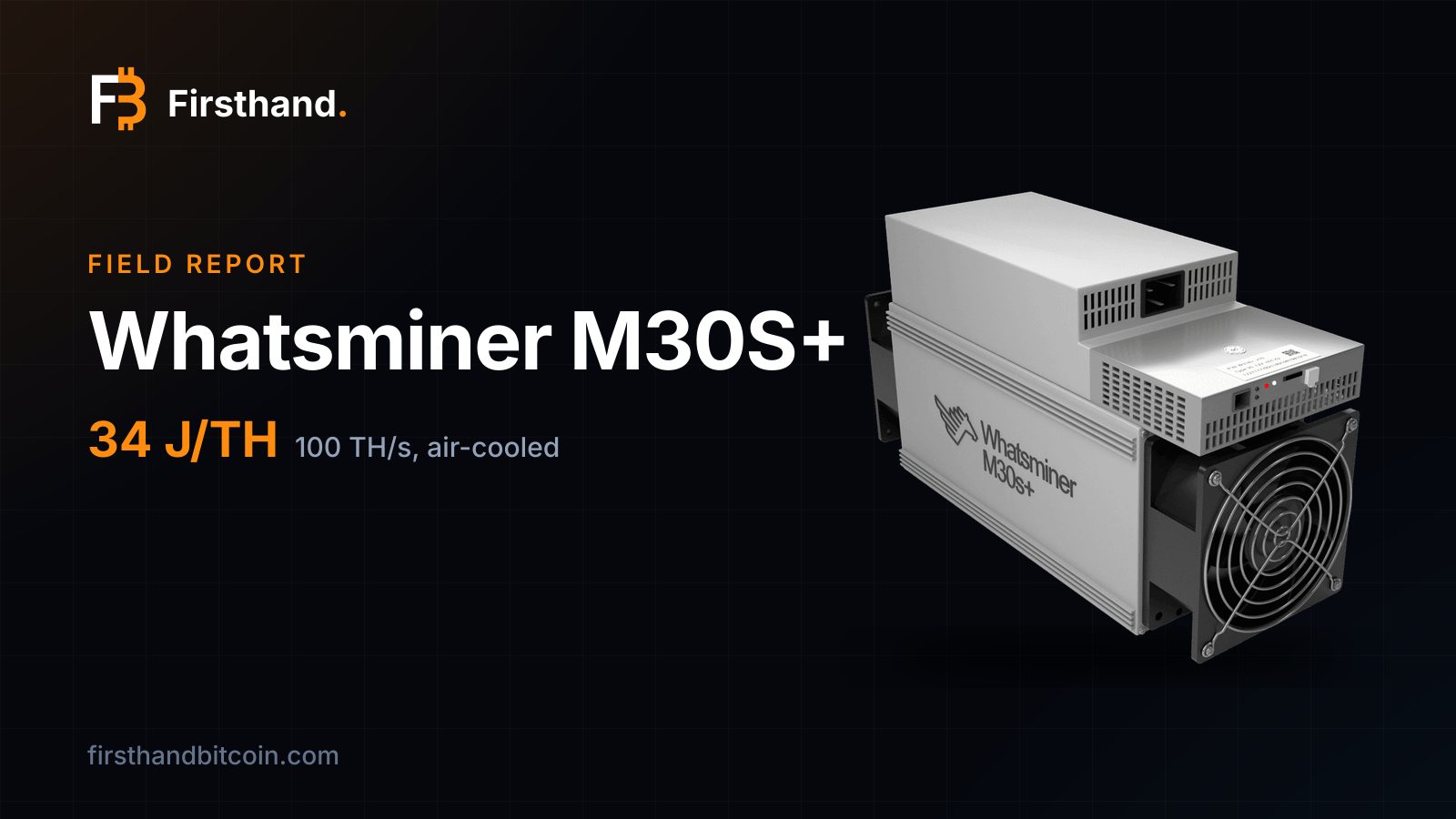
MicroBT Whatsminer M30s+ (100 TH/s)
A box bought for $788 has kept 0.0661 bitcoin
The Whatsminer M30S+ is a MicroBT air-cooled machine at 34 J/TH. Our store lists it at 100 TH/s from 3,400 W, and the model is no longer in the store. We could not open MicroBT's own product page for it, so those figures are our store record and nothing more is claimed about the chassis.
Bought once its price settled, on 11 October 2023, it cost $788. Landed at our Argentina site, the all-in cost was $1,535. In 874 days since it has mined and kept 0.0661 BTC, worth about $5,485 today, for $2,845 of electricity. That is $2,640 of cashflow, or 172% of its landed cost, with every coin kept: it has paid for its box 1.7× over.
Most of its coins came before the halving
The M30S+ was bought six months before the April 2024 halving. In the 192 days before it, it kept 0.0369 BTC, 56% of everything it has mined, in 22% of its life so far, and those coins are worth about $3,058 today. A petahash earned $60.32 a day on the day we bought it and $123.75 on 21 April 2024, the day after the halving, on our hashprice chart.
After the halving it kept 0.0293 BTC in 682 days. Its cash margin after electricity, at the prices of each day, was about $3.81 a day before it and about $0.98 a day after. A machine bought ahead of a halving is paid for in advance by the months before it, and this one was.
At 34 J/TH the line is $48.96 in Argentina and $31.82 in Nigeria
A machine's line is the hashprice at which it stops covering its own power. At 34 J/TH a petahash uses 816 kWh a day: $48.96 at Argentina's 6¢, and $31.82 at Nigeria's 3.9¢. The guide to what ends a machine's working life explains why that line, and not the age of the box, decides how long a machine runs.
The M30S+ spent its first months in Argentina. On 7 July 2024 hashprice was $46.60, under the Argentine line, and the machine stood switched off until it crossed to Nigeria on 9 October 2024, a day on which hashprice was $44.11. That is the rule in a machine crosses to cheap power once: one move, to cheaper power, and never back.
It has run 608 days in Nigeria since. Since the halving, hashprice has been under Argentina's $48.96 line on 552 of 915 days, so at 6¢ it would have been losing money on more than half of them. Under Nigeria's $31.82 line it has been on 84 days, and every one of them fell in 2026.
2026 is when it ran out of room
For its first 505 days in Nigeria the machine never stopped. Then hashprice slid. It spent February and March of 2026 under the line on 33 days, and the machine switched off on 25 February, when hashprice was $29.16. It came back on 27 April at $36.20, ran 45 days, and switched off again on 10 June, four days after hashprice reached its lowest reading of the past year, $27.74 on 6 June 2026.
The lowest 30-day average since the halving was $30.09, to 3 July, 5% under the line. The machine restarted on 26 August at $39.55 and has run 58 days since. Between the two pauses it stood off for 61 and 77 days, 138 in all, and over its whole life it has stood switched off for 234 days.
Hashprice was $37.29 a petahash a day on 21 October, 17% above Nigeria's line and 24% under Argentina's. At 6¢ this machine would not be running today, and at 3.9¢ it earns, but with a margin that a 15% fall in hashprice removes.
The M30S+ cleared its box several times over, and the only site it can still run at is the one with the cheapest power.
What is left, and what the halving does to it
Today a coin costs it about $74,300 of electricity at Nigeria's 3.9¢, against a bitcoin price of $81,427. At 6¢ the same coin would cost about $114,400, more than a coin is worth. A new owner would see 4% in a first year in Nigeria.
The April 2028 halving halves the coins a petahash earns. At today's price and difficulty that puts hashprice near $18.64, well under even the Nigerian line of $31.82. At $124,493, the assumption behind every forward projection, a halved hashprice would be about $27.98, still 12% under the line. The forward figures to the halving add 0.018 BTC, worth about $2,249 at that price, and stop there because that date is known.
A machine that no site can pay for is switched off rather than mined at a loss, and it keeps every coin it has made.
What it says about the next machine you buy
Machines are the roof, not the building, as the roof guide puts it: the test is whether a machine earned enough to buy its replacement. The M30S+ has banked $2,640 after electricity against a $1,535 landed cost, so it has.
We found no operator survey of this machine to cite, so reliability is unknown rather than good. What exists is a repair shop's guide: D-Central describes a voltage-domain failure on one board as "dropping a contiguous block of 7-15 BM128x ASIC chips off the chain", with the rest of the miner still hashing. That is a troubleshooting reference and not a failure rate.
The arithmetic for its replacement is plain. A machine at 13.5 J/TH has a line of $19.44 at 6¢, within a dollar of a halved hashprice at 6¢, where the M30S+ is $13 under its line even at Nigeria's 3.9¢. The figure below ranks what we would put in its place today, on cost per coin and then year-one return.
- MicroBT Whatsminer M74S+ (332 TH/s) — 12 J/TH, In stock, $26,235 of electricity per bitcoin, 31% year one
- MicroBT Whatsminer M73S (560 TH/s) — 13 J/TH, In stock, $28,422 of electricity per bitcoin, 38% year one
- MicroBT Whatsminer M70S (256 TH/s) — 13.5 J/TH, In stock, $29,515 of electricity per bitcoin, 33% year one
Sources and further reading
- WhatsMiner M30S+ voltage domain fail — D-Central, 2026
Which machines this covers
Disclosure
Firsthand Bitcoin sells and hosts mining hardware, including this machine. No manufacturer, distributor or affiliate programme paid for or reviewed this page and we take no commission on the links above. Historical figures are computed from daily bitcoin price and network hashprice, each day valued at its own prices. Nothing here is investment advice.