Home / Blog / Guide for first-time buyers
Guide · Oct 22, 2026 · 6 min read
How mining pools pay you: FPPS, PPLNS, fees and payout minimums
Every pool counts your machine's work, but they pay for it in different ways, and the fee and the payout minimum change what reaches your wallet. Here is what FPPS and PPLNS mean, what a 2% and a 4% fee cost a real machine, and the three lines to read before you point one at a pool.
Every pool counts shares, then decides how to pay for them
A machine in a pool does not find blocks on its own. It sends the pool small proofs of work called shares, and the pool counts them. If you have not met the idea yet, what a mining pool is, and why your machine mines in one covers it from the start.
The count is the easy part. The question this guide answers is the next one: once the pool knows how many shares you sent, how does it turn them into bitcoin in your wallet? There are two broad answers. Some pools pay for your work whether or not the pool finds a block. Others pay out of the blocks the pool actually wins, so what you get depends on how lucky the pool has been.
The name of the scheme is on the pool's rewards page, usually next to the fee. Three of them cover almost everything a first-time owner will meet: PPS, FPPS and PPLNS.
FPPS pays for every share, whether or not the pool finds a block
FPPS stands for full pay per share. Luxor's documentation describes it as a model in which miners are paid for each valid share whether or not the pool finds a block, and says that "pools using FPPS take on the variance risk": the pool carries the luck, and you get a steady daily payment.
The rate comes from a formula, not from a block. Luxor's page starts from the block subsidy, "currently 3.125 BTC", adds the transaction fees averaged over the last 144 blocks with the highest and lowest 5% thrown out, and divides the total by network difficulty to get what a unit of hashrate earns. Braiins' rewards page describes the same two parts, a coinbase reward cut and a transaction fees cut, and says "every unit of work (share) delivered to the pool is guaranteed a mining reward".
This is why FPPS income tracks the hashprice you see on the hashprice chart so closely. Your machine earns its share of the subsidy and of an average of recent fees, every day, in line with the difficulty. The guide to hashprice shows how to turn that number into a figure for your own machine.
PPS and PPLNS are the older ways, and the difference is who carries the luck
The Bitcoin wiki's comparison of pools defines PPS as "Each submitted share is worth certain amount of BTC", and notes that it is "risky for pool operators, hence the fee is highest". FPPS is "similar to PPS" but also divides some of the transaction fees. PPLNS, pay per last N shares, "instead looks at the last N shares, regardless of round boundaries".
Put simply, PPS and FPPS pay a fixed amount for work, and the pool takes the swings. PPLNS pays from what the pool wins, and you take them. When Braiins announced in November 2023 that it was switching from its scoring system to FPPS, it described the old system as "like a rollercoaster - thrilling but unpredictable", and FPPS as bringing "more stability and predictability".
F2Pool's front page, read on 22 October 2026, lists two payout methods for bitcoin: FPPS at a 4.0% fee and PPLNS at 2.0%. That is the trade the wiki describes: the scheme in which the pool carries the risk is the one with the higher fee.
The fee is a percentage of every payout, for as long as the machine runs
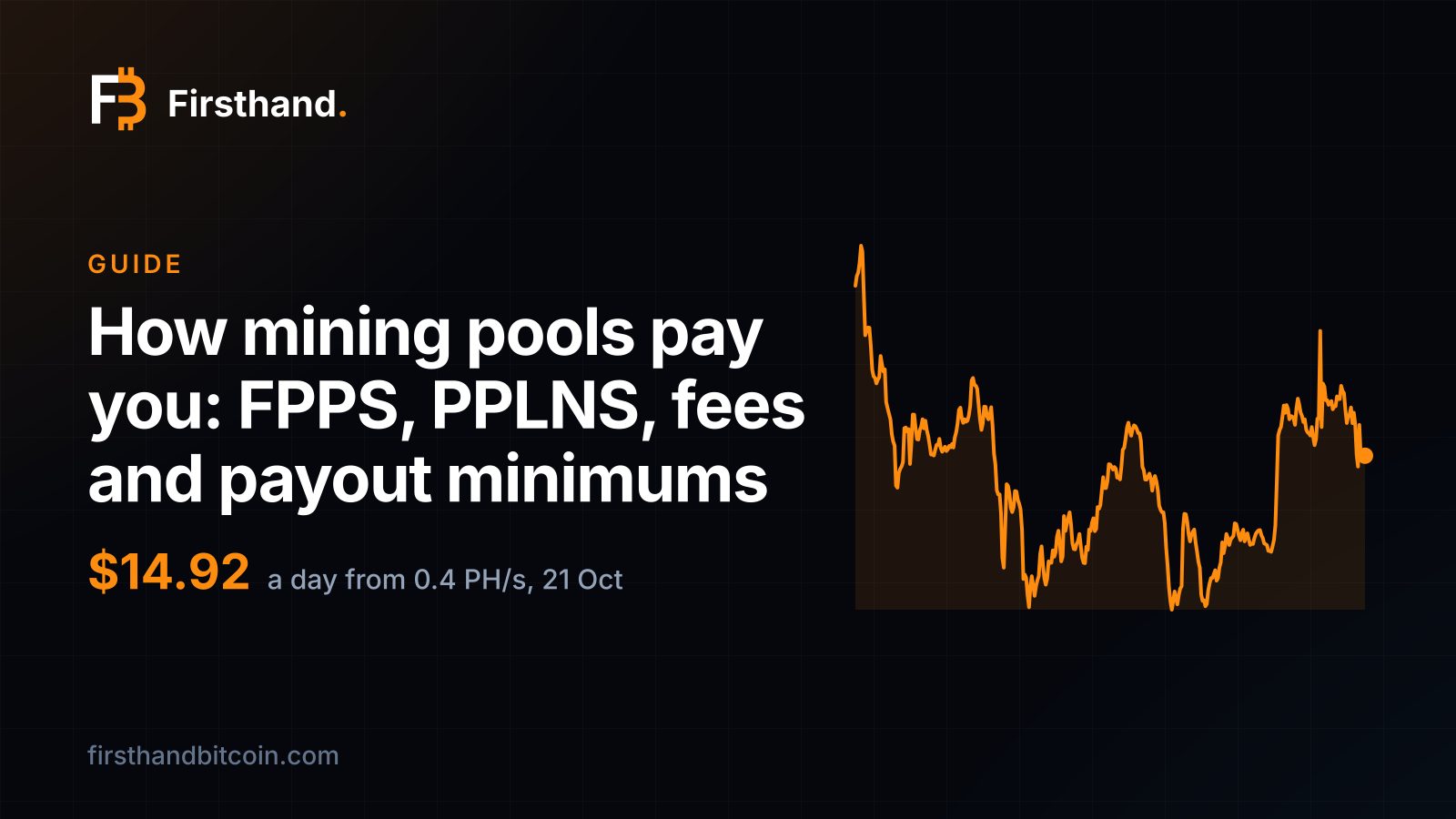
A fee of 2.5% sounds like nothing. It is taken from every day's earnings for the whole life of the machine, so it is a running cost, and it is worth seeing in dollars. Take a machine of 400 TH/s, which is 0.4 petahash. On 21 October hashprice was 0.000450 bitcoin per petahash per day, which at that day's close of $82,943 is $37.29. That machine earns about 0.000180 bitcoin, or $14.92, a day before the pool's fee and before electricity.
Over 30 days that is about 0.005395 bitcoin, or $447. The table shows what three fee levels take out of it. The gap between the cheapest and the dearest is about $9 a month on this machine, and it grows with every machine you add, so it belongs next to the electricity rate when you compare costs.
Luxor's documentation says its fee works as a discount: it buys hashrate at a discount to the spot FPPS rate, and that discount is the pool fee. Braiins' rewards page lists a 2.5% pool fee. Fees move, so read the pool's page on the day you sign up rather than trusting any article, including this one.
| Pool fee | Taken each day | Taken over 30 days | Left of 30 days' earnings |
|---|---|---|---|
| 2.0% | $0.30 | $8.95 | 0.005287 BTC |
| 2.5% | $0.37 | $11.19 | 0.005260 BTC |
| 4.0% | $0.60 | $17.90 | 0.005179 BTC |
Payout minimums and fees decide how soon the coins arrive
A pool pays you when your balance passes a minimum, and some charge a fee for the transfer. Braiins' rewards page says payouts are created daily at 09:00 UTC, with a minimum of 0.0002 bitcoin on-chain, free from 0.005 bitcoin, and a fee of 0.0001 bitcoin on smaller on-chain payouts. Luxor's page lists a minimum of 0.001 bitcoin and a flat withdrawal fee of 0.000075 bitcoin, with daily, weekly or monthly payouts. F2Pool's page, read on 22 October, lists a minimum bitcoin payout of 0.005.
Set those against what the 400 TH/s machine earns, about 0.000175 bitcoin a day after a 2.5% fee. It passes 0.001 bitcoin in about six days and 0.005 in about 29. On a pool with a 0.005 minimum, the first payment arrives after the first month, which is normal and not a fault: check the balance on the pool's dashboard and the first payout after that.
A flat withdrawal fee matters more for a small machine that waits for a small payout than for a large one. If a pool lets you choose weekly or monthly payouts, one larger transfer a month pays the flat fee once, instead of each time the balance clears the minimum.
Three lines to read before you point a machine at a pool
The scheme, the fee and the payout rules are three lines on the pool's rewards page, and they are all the comparison a first-time owner needs.
First, the scheme. FPPS gives you a steady daily amount in line with the hashprice. PPLNS can be lumpier but charges less. Second, the fee, in dollars for your machine, not as a percentage. Third, the minimum and the withdrawal fee, against what your machine earns in a day, so you know when the first payment will land.
A pool does not change what a machine earns. It changes how the earnings arrive, and what is taken on the way.
What it means for a miner
The pool is a small cost with a big effect on how steady your income feels. The three numbers that decide whether a machine pays are still its efficiency, the electricity rate and the hashprice, as the guides to electricity and profit and why nobody sells the coins to pay the power bill show. The pool's fee comes out of the same earnings, and it is the one cost on the list you can compare in five minutes.
Pick a scheme you are comfortable with, read the fee in dollars, and give the pool an address you control, so the coins you keep are paid straight to your own wallet. Output is not guaranteed: hashprice moves with the price of bitcoin and with difficulty, and every figure here is a snapshot of 21 October.
Sources and further reading
- Revenue & Payments — Luxor documentation, 22 Oct 2026
- Rewards and payouts — Braiins Academy, 22 Oct 2026
- Goodbye luck, hello consistency: big news from Braiins Pool — Braiins, 29 Nov 2023
- Comparison of mining pools — Bitcoin Wiki, 27 Aug 2026
- F2Pool — F2Pool, 22 Oct 2026
Disclosure
Firsthand Bitcoin sells and hosts mining hardware, including this machine. No manufacturer, distributor or affiliate programme paid for or reviewed this page and we take no commission on the links above. Historical figures are computed from daily bitcoin price and network hashprice, each day valued at its own prices. Nothing here is investment advice.