Home / Blog / How to think about mining
Guide · Nov 8, 2026 · 6 min read
Is it too late to start bitcoin mining? The three numbers that decide it now
On the best machine at the cheapest site, a bitcoin costs about a quarter of its price to make, so a beginner can still start. A petahash does earn fewer coins than in 2021, but three other numbers matter more, and you can check each one yourself.
Too late for 2021's coin counts, not for cheap coins
It is too late to earn what a machine earned in 2021. It is not too late to mine bitcoin cheaply, because the thing that decides whether mining works is not how many coins a machine finds. It is what each coin costs you to find.
That cost depends on three numbers you can check before you buy anything: how efficient the machine is, what you pay for electricity, and what you do with the coins afterwards. The rest of this guide takes them in order, with today's figures. Nothing here is a promise about what a machine will earn. It is a way to see the answer for yourself.
A petahash earns 93% fewer coins than in 2021
Mining power is counted in hashes per second, and a petahash is a thousand terahashes, which is the unit on a machine's spec sheet. If you want the basics first, our guide to what the TH/s on a spec sheet counts takes five minutes. What matters here is how much bitcoin one petahash earns in a day, which we call hashprice, and it fell every year to 2025.
In the 30 days to 7 November 2021, a petahash earned an average of 0.00627 bitcoin a day. In the 30 days to 7 November 2026 it earned 0.00045. That is about 93% fewer coins. The same comparison for 2022 gives 0.00355, for 2023 0.00214, for 2024 0.00070 and for 2025 0.00042, so it has been roughly level for the last year. You can see the whole line on our hashprice in bitcoin chart.
In dollars the fall is smaller, because the bitcoin price rose over the same five years from an average of about $60,600 to about $80,500. A petahash earned about $380 a day in 2021 and about $36 a day now, a fall of around 90%.
A petahash earned 0.00627 bitcoin a day in November 2021. It earns 0.00045 now.
The same prize is now shared about seven times more ways
Every ten minutes or so the network pays out a fixed prize, the block reward, to whichever miner finds the next block. Since the April 2024 halving that reward is 3.125 bitcoin per block, which comes to about 450 new coins a day. On top of that come fees from the people sending bitcoin: about 2.7 bitcoin on 7 November.
That daily amount does not grow when more machines arrive. It is split between all of them in proportion to their share of the total hashing power. In the 30 days to 7 November 2021 the network averaged 153 exahashes a second. In the same window this year it averaged 1,037, about 6.8 times more. A year ago it was 1,103, so it has not grown since.
More machines sharing the same prize is the whole reason a petahash earns fewer coins. It is also why "too late" is the wrong frame: the sharing has been going on since the first block, and what has always counted is how little electricity a machine needs for its share.
Number one: efficiency has improved 3.3 times
Efficiency is how much electricity a machine needs for each unit of hashing it does, written as joules per terahash, or J/TH. A lower number is better. If it is new to you, what is a good J/TH explains how to read it.
The most efficient machine launched in 2021 in our store records was the Antminer S19j Pro at 29.5 J/TH. The most efficient one in stock today is the Antminer S23 XP Hyd at 8.9 J/TH: 3.3 times less electricity for the same hashing. That change is the other half of the story. The network got about seven times bigger, and the machines doing the work got about three times thriftier.
Efficiency also decides how long a machine stays worth switching on as the prize keeps being shared. Our guide on efficiency and the halvings is the longer version.
The best machine on sale today is 3.3 times more efficient than the best of 2021.
Number two: the power price sets the daily bill
Efficiency turns into a daily power bill once you attach a price per kilowatt-hour. One petahash of machines running flat out at 29.5 J/TH draws 29.5 kilowatts, which is 708 kilowatt-hours a day. At 8.9 J/TH the same petahash draws 8.9 kilowatts, or 214 kilowatt-hours a day.
Our lowest hosting rates are 3.9¢ at our Nigeria site and 6¢ at the sites in the UAE and Argentina. On 7 November a petahash earned $32.35 a day before the pool's fee. Set that against the power bill:
| Machine | J/TH | kWh per PH per day | Power at 3.9¢ | Power at 6¢ |
|---|---|---|---|---|
| Antminer S19j Pro (June 2021) | 29.5 | 708 | $27.61 | $42.48 |
| Antminer S19 XP Hyd (March 2022) | 20.8 | 499 | $19.47 | $29.95 |
| Antminer S21 XP Hyd (October 2024) | 12 | 288 | $11.23 | $17.28 |
| Antminer S23 XP Hyd (in stock now) | 8.9 | 214 | $8.33 | $12.82 |
Old machines need cheap power; the best one clears either rate
The 2021 machine costs $27.61 a day to run at 3.9¢ against $32.35 earned, which still leaves something, and $42.48 at 6¢, which is more than it earns. That is why older machines end up on the cheapest power, or are switched off. The 2022 machine clears both rates. The 2024 machine and the 2026 machine clear them by a wide margin: the S23 XP Hyd spends $8.33 a day at 3.9¢ and $12.82 at 6¢ for the same $32.35.
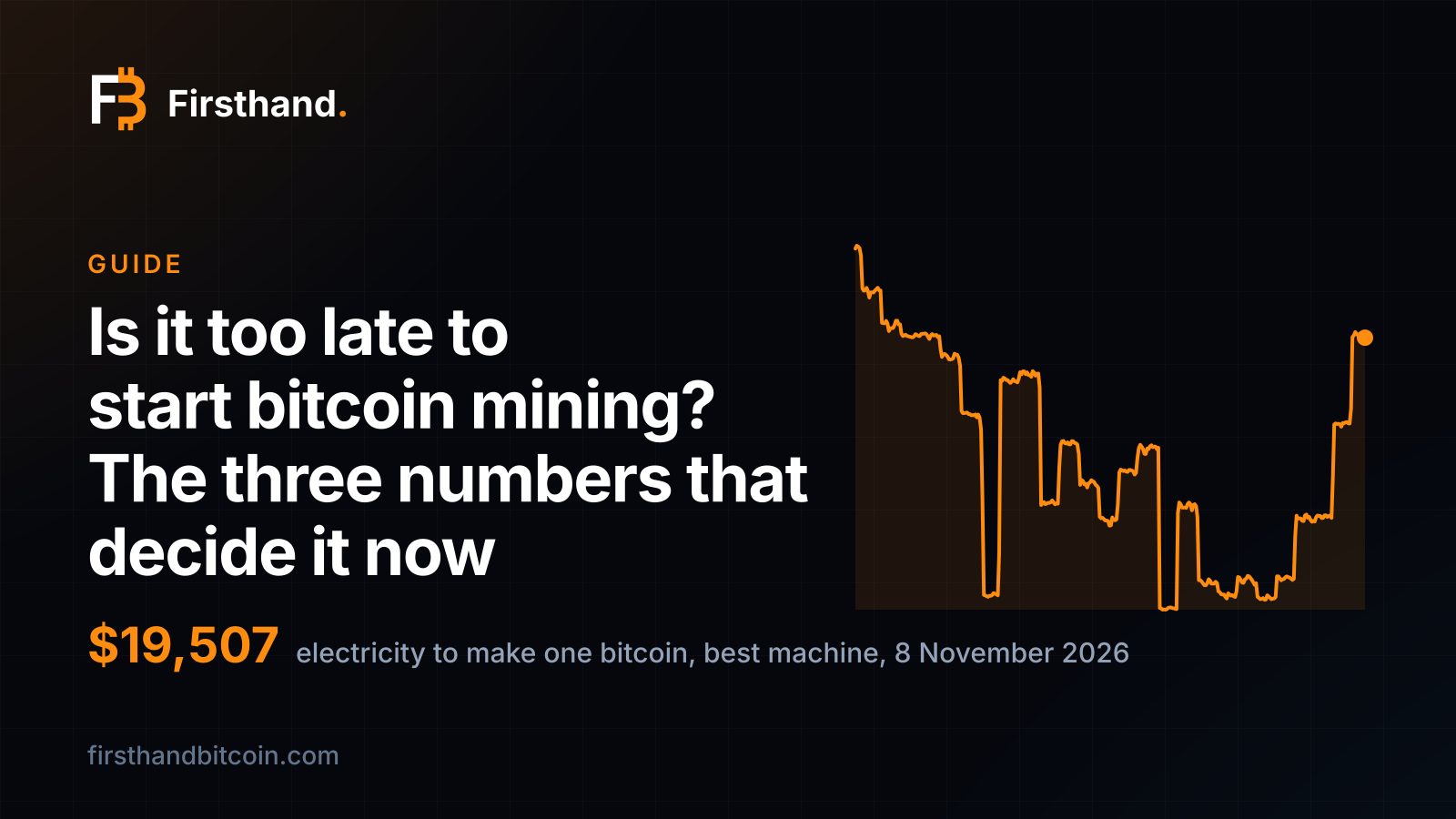
Turn $8.33 a day into a price per coin. At 0.000427 bitcoin a petahash, that is about $19,500 of electricity per bitcoin. Another way to say it: with the best machine at our cheapest site, making a coin costs about a quarter of what buying one does. On 8 November that was $19,507 to make and $75,871 to buy. Those numbers leave out the machine and the pool's fee, and they move with the market.
That gap is why a beginner can still start. The question is not how many coins a machine finds, it is whether finding a coin costs less than the coin is worth. You can ask that of any machine with the table above. The longer version of how the power price decides profit is in how much electricity a miner uses.
Number three: keep the coins you mine
The third number is not on any spec sheet. It is whether you plan to keep the coins you mine. A miner who sells every coin to pay the power bill is exposed to the price on every one of those days. A miner who keeps the coins pays the power bill another way and collects the stack.
Keeping the coins is how the cost per coin turns into a result. If a coin cost you $19,500 in electricity and you keep it, what it is worth is the price on the day you choose to sell, or never. Our guide on why nobody sells the coins to pay the power bill sets out how that plays out.
No bitcoin price is guaranteed and no machine's output is either. What you control is the cost of making a coin and whether you keep it.
What to do next
If you are weighing a first machine, check the three numbers in this order. Find the machine's J/TH on its page. Choose a site and read its rate. Multiply as the table did and see what a petahash costs a day. If the answer sits well below $32.35 at today's hashprice, the machine is worth a closer look.
Then decide whether you will hold what it mines. That decision changes which machine suits you more than any spec. Our pre-buy checklist covers the rest, and the S23 XP Hyd page shows the machine used in the best-case figures above.
So, is it too late? The answer in numbers is that a petahash earns a tenth of what it did in dollars, and that a coin can be made for about a quarter of its price. Efficiency and a cheap power rate decide the rest.
Disclosure
Firsthand Bitcoin sells and hosts mining hardware, including this machine. No manufacturer, distributor or affiliate programme paid for or reviewed this page and we take no commission on the links above. Historical figures are computed from daily bitcoin price and network hashprice, each day valued at its own prices. Nothing here is investment advice.