Data insight · Nov 7, 2026 · 5 min read
Sentiment fell 20 points twice in a week, a first since 2021; a petahash earned the same coins
The Fear & Greed Index dropped 21 points on 30 October and 22 on 6 November, the first pair of falls that size within eight days since November 2021. Over the same nine days a petahash earned between 42,566 and 42,749 satoshis a day. Sentiment moved the price; it did not move the coins.
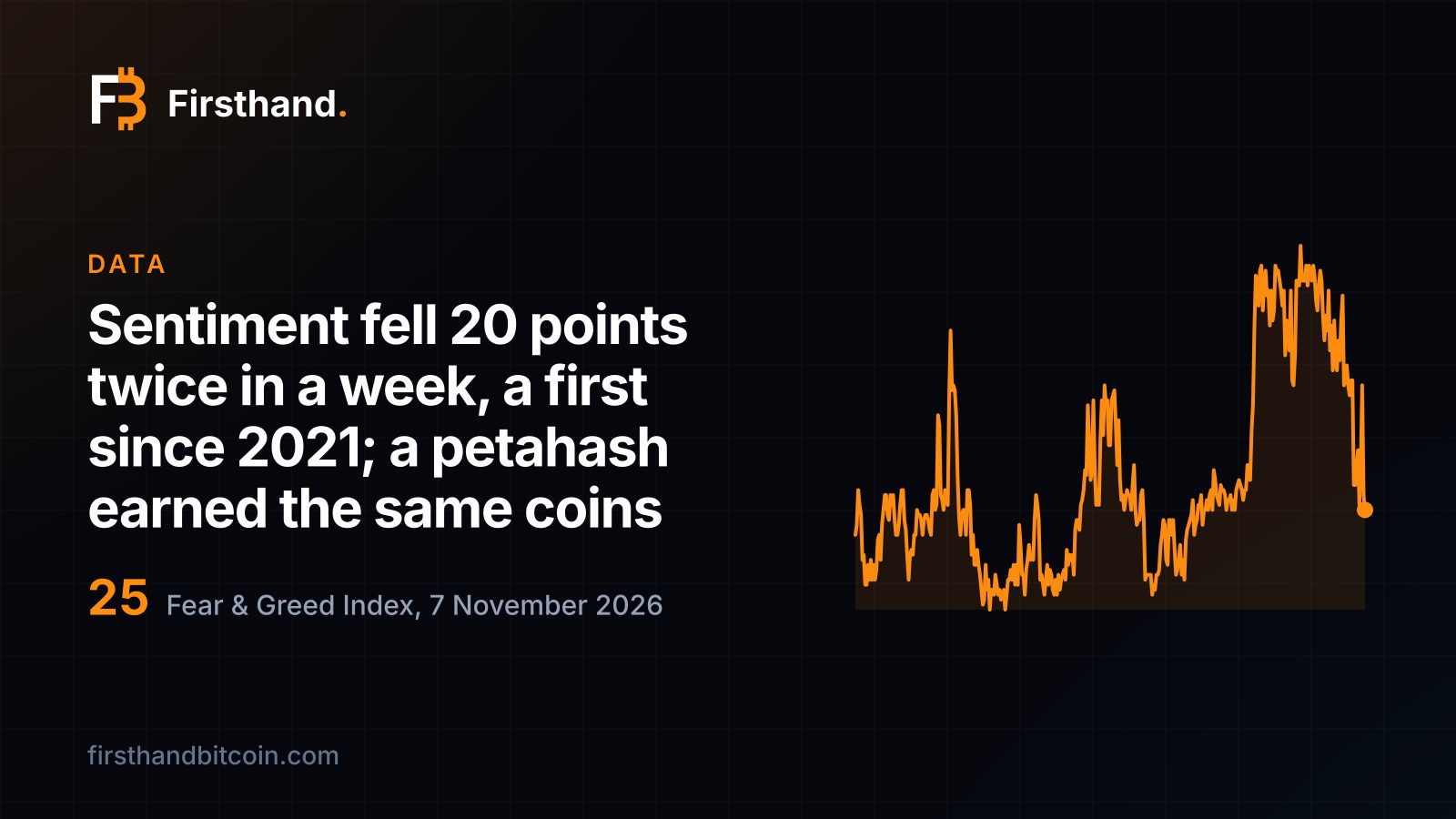
The index fell 21 points on 30 October and 22 on 6 November
The Fear & Greed Index scores bitcoin sentiment from 0 to 100, one reading a day. On 29 October it read 51. The next day it read 30, a fall of 21 points, with bitcoin closing at $77,802 against $81,275 the day before, 4.3% lower.
It then climbed back. The readings from 30 October to 7 November were 30, 30, 34, 37, 26, 34, 50, 28 and 25. On 5 November it reached 50 as bitcoin closed at $80,431, up 4.0% on the day. On 6 November bitcoin closed at $75,989, 5.5% lower, and the index fell 22 points to 28. By 7 November it read 25, labelled Extreme Fear, with bitcoin at $76,003.
Two falls of more than 20 points, seven days apart, with a full recovery to neutral in between. The price range across all nine days was $75,989 to $80,431, a spread of 5.8%.
Twenty-point falls are rare, and two within eight days has not happened since 2021
We hold the index from 1 February 2018. In the 3,195 days since with a reading on the day before, it has fallen by 20 points or more in a single day 36 times, roughly one day in ninety. Most came in 2019, with 13, and 2021, with nine. There have been eight since the start of 2022.
Two such falls within eight days of each other are rarer still. Before this week it last happened on 19 and 27 November 2021. In the nearly five years between, no fall came within eight days of another: the closest pair, 11 October and 4 November 2025, were 24 days apart.
The table lists every fall of that size since mid-2024, with what bitcoin and a petahash's daily earnings did on the same day.
Thirty-six falls of 20 points in 3,195 days. Two of them came in the last seven.
| Day | Index | Bitcoin that day | Coins per petahash that day |
|---|---|---|---|
| 3 August 2024 | 57 to 37 | −3.9% | +0.1% |
| 25 February 2025 | 49 to 25 | −6.1% | −0.7% |
| 11 October 2025 | 64 to 27 | −6.4% | +0.2% |
| 4 November 2025 | 42 to 21 | −3.6% | +0.2% |
| 30 October 2026 | 51 to 30 | −4.3% | −4.1% |
| 6 November 2026 | 50 to 28 | −5.5% | +0.3% |
Both falls came on days bitcoin dropped 4% to 6%
The index is built mostly from price behaviour. Its own methodology page lists volatility and market momentum with volume at 25% each, with social media, dominance and search trends making up the rest. A single sharp down day moves the first two at once, which is why a 4% to 6% fall in the price can take 20 points off the score.
Every fall in the table has a bitcoin drop of between 3.6% and 6.4% behind it. The index is a read on how the price moved, quickly summarised. It does not measure anything about the network, the miners or the coins being produced.
A petahash earned the same coins through all of it
On our hashprice in bitcoin chart, a petahash per second earned 44,533 satoshis on 29 October and 42,690 on 30 October. That 4.1% step is the one entry in the table's right-hand column that is not close to zero. It is the 5.5% difficulty rise that landed on 29 October, which we covered in the two 5% rises in 13 days.
After that step, nothing. From 30 October to 7 November a petahash earned between 42,566 and 42,749 satoshis a day, a spread of 0.4%, across a sentiment range of 25 to 50 and a price range of 5.8%. On 6 November, the day the index fell 22 points, it earned 42,749, up 0.3% on the day before.
Coins per petahash are set by the network: the block subsidy, the fees in each block and how much hashing competes for them. A sentiment reading enters none of those. The dollar value of the coins moved with the price. The coins did not.
Extreme Fear is the usual state of the last year
The index has read Extreme Fear on 182 of the last 365 days, about half. A reading of 25 is therefore less a rare event than a familiar one, and over the same year the machines mined every day regardless of it.
What a reading of 25 does change is the dollar price of a coin. On 7 November bitcoin cost about $19,500 in electricity to make on the most efficient machine we stock, the Antminer S23 XP Hyd, at Nigeria's 3.9¢ rate, against a market price of about $76,000. That is 26% of the price, and it is electricity only, at today's hashprice, excluding the machine and the pool fee. We have written about how that figure has moved in a bitcoin costs about a quarter of its price to make.
The hashprice chart in dollars shows the same thing from the revenue side: it moves with the price day by day, while the coins behind it are fixed until the next retarget.
What it means for a miner
For someone who mines to hold bitcoin, the sentiment score and the coin count are two different instruments. The score is a summary of the last few days' price action and the coin count is set by the network. In the nine days from 30 October to 7 November a petahash earned the same 42.6 to 42.7 thousand satoshis a day while the score ran from 25 to 50.
A machine that keeps running on cheap power adds to its owner's stack on every one of those days, whatever the index says. The coins already mined are the ones the price is measured against, and the lower the price at which a coin is produced relative to its market price, the more an owner who keeps them holds. Nobody sells the coins to pay the power bill sets out how that works.
Output is not guaranteed: the coins per petahash will step again at the next difficulty retarget, as it did on 29 October. The index will not be the reason.
Fear moves the price of a coin. It does not change how many coins a petahash makes.
Sources and further reading
- Crypto Fear & Greed Index: methodology and latest reading — Alternative.me, 7 Nov 2026
Disclosure
Firsthand Bitcoin sells and hosts mining hardware, including this machine. No manufacturer, distributor or affiliate programme paid for or reviewed this page and we take no commission on the links above. Historical figures are computed from daily bitcoin price and network hashprice, each day valued at its own prices. Nothing here is investment advice.