Guide · Oct 14, 2026 · 6 min read
What to check before you buy your first bitcoin miner: six questions, in order
Before you pay for a miner, six questions decide whether it makes sense: what your power costs, what the whole box costs, where it will live, how many halvings it survives, what a fault costs, and where the coins go. Each one has a number, and this guide shows you how to find it.
TL;DR
- Start with the power price. A machine's line is its J/TH times 24 times your rate per kWh. If hashprice is above the line it earns; if not, it does not.
- Price the whole box. Freight, duty, customs and setup sit on top of the sticker, and they are paid per box.
- Decide where it lives first. A miner needs a high-power supply and a way to move out its heat. That is a site, not a spare room.
- Check the halving, the repair terms and the wallet. Four years of working life, a fault is a line item, and the coins go to an address you control.
Start with the number that decides everything: your power price
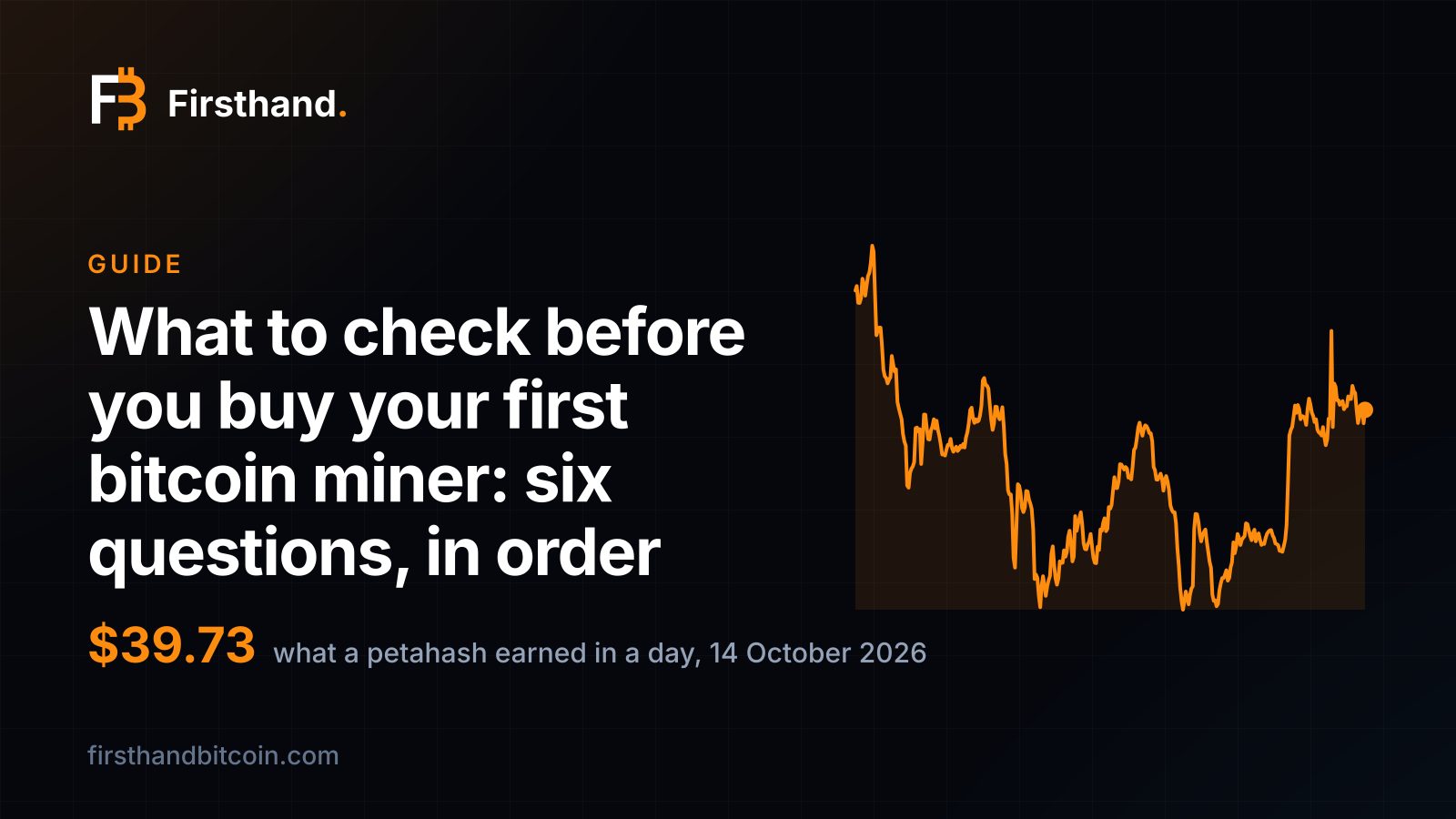
A miner turns electricity into guesses, and the guesses earn bitcoin. Whether that is worth doing depends on one comparison: what a day of its guessing earns against what a day of its electricity costs. The industry measures the first as hashprice, what one petahash earns in a day, which was $39.73 on 14 October on our hashprice chart.
The second is easy to work out from the spec sheet. A machine's efficiency in joules per terahash, multiplied by 24, is the kilowatt-hours it uses per petahash per day. Multiply that by your price per kilowatt-hour and you have its line: the hashprice at which it stops covering its own power. A 13.5 J/TH machine uses 324 kWh per petahash per day, so its line is $19.44 at 6¢. Hashprice is above that today, by about double.
The table shows the line for five efficiencies at three power prices. A line above today's hashprice is a machine that loses money at that price. Our guide to how much electricity a miner uses goes through the sum with a worked machine.
A machine's line is its J/TH times 24 times your rate. Hashprice has to be above it.
| Efficiency | Line at 3.9¢ | Line at 6¢ | Line at 10¢ |
|---|---|---|---|
| 8.9 J/TH | $8.33 | $12.82 | $21.36 |
| 13.5 J/TH | $12.64 | $19.44 | $32.40 |
| 15 J/TH | $14.04 | $21.60 | $36.00 |
| 16.5 J/TH | $15.44 | $23.76 | $39.60 |
| 28 J/TH | $26.21 | $40.32 | $67.20 |
Then price the whole box, not the sticker
A machine's price is only part of what it costs to get one running. Freight, import duty, customs and setup are added, and they are charged per box. The Antminer S21+ we follow was bought for $3,208 in April 2025 and cost $4,870 landed at our Argentina site: 52% more than the sticker.
That is why the number to compare between machines is the landed cost per terahash, not the price. Our guide to what a miner costs all-in shows what sits on top of the box, and the guide to how long a miner takes to pay for itself takes the landed figure through a four-step sum.
On 14 October our price per terahash was $6.72 for the Antminer S21+, $7.67 for the S21 Pro and $11.55 for the S21 XP, at 16.5, 15 and 13.5 J/TH. The cheapest terahash is the least efficient of the three. The extra $4.83 a terahash for the S21 XP buys 3 J/TH, which is 72 kWh per petahash per day, or $4.32 a day at 6¢. Which is better depends on how long you hold it and what your power costs. A low price for an old machine is not a bargain by itself. The second question is always the line: a box that costs half as much and has a line above hashprice never earns.
Decide where it will live before you pay
A bitcoin miner is not a computer you put on a desk. A single air-cooled machine draws 3 to 4 kilowatts all day, which is more than a large space heater, makes a noise rated near 75 decibels, and needs a 220 to 277 volt supply. Water-cooled machines need a coolant loop and three-phase power on top. Our guide to air, hydro and immersion cooling explains the three ways to move the heat out.
This is why most people who buy a machine host it. A host runs it in a building built for the load, with the power and cooling, and pays out the coins to your own wallet. Our guide to how hosting works takes it from checkout to first payout, and the one on uptime shows what a day offline costs.
Where it lives also sets the power price, and so the line from the first question. Our sites range from 3.9¢ to 6¢. A machine you cannot place at a price below its line is the wrong machine.
Check how many halvings it will survive
Every four years the reward per block halves, and so does what a petahash earns in coins. The next halving is in April 2028. At today's price and difficulty it would put hashprice near $19.87, which is the number to hold your line against. Our guide to the halving explains the mechanism.
Against that figure, the table above sorts machines. A 13.5 J/TH machine at 6¢ has a line of $19.44, just under it. A 16.5 J/TH machine at 6¢ has $23.76, over it, and needs Nigeria's 3.9¢ to carry on. A 28 J/TH machine needs more than that: its line at 3.9¢ is $26.21. This is why the guide to efficiency and halvings says efficiency decides how many halvings a machine survives.
A machine that stops clearing at one site is not finished. It can move once, to cheaper power, which is the rule in a machine crosses to cheap power once. Our field report on the Whatsminer M50 shows a 28 J/TH machine doing exactly that.
Ask what a fault costs, not whether one will happen
Every machine develops faults. A hashboard is the part that does the guessing, and when one fails a typical three-board machine loses a third of its output until it is repaired. What matters is what a repair costs you and how long it takes.
Check the maker's warranty on the product page and read what it covers. Then find out who repairs the machine where it will live. With a host, the answer should be written down: with us, repairs in Argentina are billed at the cost of the parts, and the UAE has a manufacturer warranty centre close by. Our guide to a failed hashboard shows why a fault is a line item across a fleet and a crisis in a garage.
If you cannot find any record of how a model fails in the field, take that as unknown, not as good. We score it that way in every review.
Know where the coins go
A machine on its own would win a block about once in many lifetimes, so it joins a pool, which shares each win out in proportion to the work contributed. The pool pays to a bitcoin address you give it. That address should belong to you, in a wallet you control, before the machine is switched on. Our guide to what a mining pool is explains the first half, and the one on wallet addresses and payouts the second.
Pools are replaceable. Binance, for one, said on 13 October that it will close its pool on 10 November, and every machine pointed at it has to be moved. Moving is a change of address and worker name; the machine, the wallet and the coins are unchanged.
What it means before you buy
Six questions, one number for each: the line against your power price, the landed cost, a site, the halving, the repair terms and an address. A machine that answers all six is one you can buy without needing the price of bitcoin to cooperate.
The reason to be this careful is what a coin can cost to make. For the most efficient machine we stock, the Bitmain Antminer S23 XP Hyd at 8.9 J/TH, on our cheapest power in Nigeria at 3.9¢, that is about $18,000 of electricity per bitcoin, against a market price near $83,000. That is a best case, not an average, and it leaves out the machine's price. Output is not guaranteed, and a machine's coins are kept by its owner.
Disclosure
Firsthand Bitcoin sells and hosts mining hardware, including this machine. No manufacturer, distributor or affiliate programme paid for or reviewed this page and we take no commission on the links above. Historical figures are computed from daily bitcoin price and network hashprice, each day valued at its own prices. Nothing here is investment advice.